
Summary
DOWNLOAD PDFDigital labour platforms are an increasingly important way of organising work across the European Union (EU), connecting consumers and businesses with people who provide services ranging from delivery and transport to software development and professional advice. The Platform Work Directive must be transposed by member states no later than 2 December 2026. Its implementation will determine whether people performing platform work can rely on effective protection and whether platforms face rules that are clear enough to support investment, compliance and cross-border activity.
The Directive addresses three practical issues. First, it requires EU countries to determine employment status according to how work is organised in practice, rather than the contractual label used. Second, it establishes safeguards for the use of personal data and automated systems, including transparency, human oversight and review of important decisions. Third, it requires platforms to provide public authorities and representatives of people performing platform work with specified information.
This study examines draft transposition measures in Austria, Czechia, Estonia, the Netherlands and Sweden. It assesses whether the national rules are clear, workable and proportionate for people performing platform work, platforms, intermediaries and public authorities. No draft provides a complete model. Taken together, however, they show that effective transposition depends less on adding new obligations than on translating the Directive’s requirements into clear procedures, proportionate reporting duties and identifiable responsibilities.
The study makes five recommendations:
- Make employment-status rules clear and enforceable. Member states should identify the main facts that may indicate that a platform directs and controls work, while assessing the relationship as a whole rather than applying a mechanical checklist. The law should also explain how the platform, intermediary and person performing platform work may submit evidence, and in which proceedings the presumption applies. This can help correct misclassification while protecting people who work independently in practice.
- Allocate responsibility clearly where intermediaries are involved. The entity that controls a relevant function should bear the related obligation. Targeted joint and several liability (a legal term that means that the individual can seek the full remedy from either the platform or the intermediary) should provide a safeguard where divided responsibilities would otherwise leave an individual without an effective remedy.
- Transpose the EU safeguards on data and automated systems closely. The Directive provides detailed rules on data use, transparency, human oversight, review and correction. Close transposition can protect people performing platform work while allowing platforms to use common procedures across member states. Unnecessary national differences can increase compliance costs and create barriers to cross-border digital services.
- Use one clear electronic route for reporting platform work. Member states should connect the initial declaration of platform work with continuing information duties through one identifiable electronic process. The law should identify who must report, what must be submitted, which authority receives it and when information already supplied can be reused.
- Keep reporting proportionate. Member states should use the Directive’s flexibility to allow annual updates for qualifying small and medium-sized enterprises (SMEs) where more frequent reporting is not necessary for effective supervision. Detailed information on activity duration, working time and income should normally be available on request rather than included in every routine update.
The country comparisons in this report show how different national choices can support, or undermine, these objectives. The detailed analysis and country annexes identify the legal provisions behind each recommendation.
1. Overview of the EU Platform Work Directive
1.1 A Common Framework for Platform Work
Directive (EU) 2024/2831[1] on improving working conditions in platform work (the Platform Work Directive, or PWD) is the first EU instrument designed specifically to improve the working conditions of people performing platform work. The Directive was adopted on 23 October 2024, entered into force on 1 December 2024, and must be transposed by 2 December 2026. The national choices made during transposition will shape the legal certainty, compliance costs and enforcement conditions of this market for years to come.
The Directive pursues two main objectives. First, it aimed to improve working conditions and access to labour and social protection for people performing platform work. Second, it sought to provide the legal certainty and level playing field needed for the development of digital labour platforms in the EU. The Directive should therefore be understood as seeking both effective protection and a regulatory framework that allows the digital labour market to develop without unnecessary fragmentation or administrative burden.
In addition, the Directive covers a varied market: from food delivery and ride-hailing to software development, design and consultancy. The Commission’s 2021 impact assessment estimated that 28 million people performed platform work in the EU and projected that number would reach 43 million by 2025.[2] Platform operators also vary greatly in size and resources. They range from large, multi-country platforms to small local platforms matching customers with home-care workers, cleaners or tradespeople. Accounting for this heterogeneity, Recital 70 underlines the need for member states to avoid unnecessary administrative, financial and legal constraints, with particular attention to small and medium-sized enterprises (SMEs).
1.2 Three Policy Areas of Regulation
The Directive groups its rules into three policy areas (see Table 1). First, employment status requires member states to assess whether a person is an employee or genuinely self-employed according to how the work is performed in practice, supported by a rebuttable presumption where the facts indicate direction and control by the platform. Second, personal data and automated systems set safeguards on the use of data and automated decision-making, including transparency, human oversight and a right to challenge certain decisions. Third, transparency and information sharing requires platforms to declare platform work to the relevant authorities and provide specified information on their workforce, contractual arrangements and operations.
A central feature of the Directive is the rebuttable presumption of employment. First, the person relying on the presumption must establish facts giving reason to assume that the platform directs and controls the work. Once that threshold is met, the relationship is presumed to be one of employment rather than self-employment. The presumption does not determine status automatically. The platform, intermediary or person performing platform work may submit evidence, based on how the relationship operates in practice, to show that the relationship is not one of employment.
Table 1: What the Directive requires and why national choices matter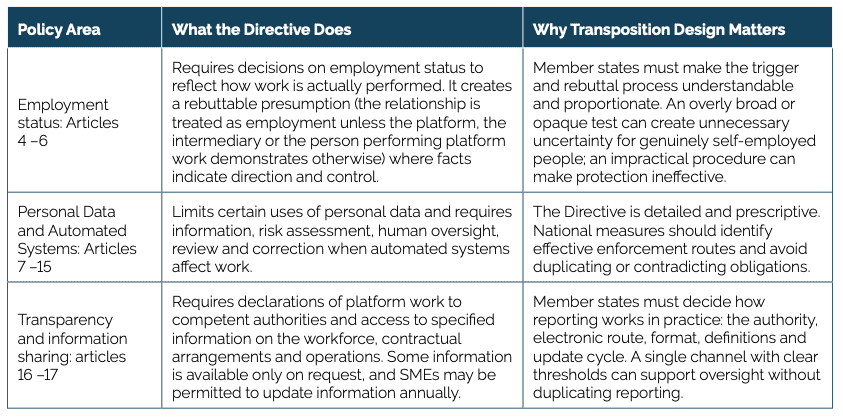 Source: Directive (EU) 2024/2831, Articles 4–17.
1.3 Structure of This Study
This study provides a comparative assessment of draft transposition measures in Austria, Czechia, Estonia, the Netherlands and Sweden. These countries were selected because their legislative preparations were among the most advanced at the time of assessment. The study examines how their proposed rules give effect to the Directive and identifies practical lessons for other member states. Chapter 2 explains the assessment method and the criteria used to compare national drafts and Chapter 3 presents the comparative findings and recommendations for transposition. The country annexes set out the detailed national analysis and legal references.
[1] Directive (EU) 2024/2831 of the European Parliament and of the Council of 23 October 2024 on improving working conditions in platform work. (2024). Official Journal of the European Union, L 2024/2831. https://eur-lex.europa.eu/eli/dir/2024/2831/oj
[2] European Commission. (2021). Impact assessment report accompanying the proposal for a Directive on improving working conditions in platform work (SWD(2021) 396 final).
2. Assessment Framework
Using draft texts available in July 2026, this study compares proposed measures to transpose the PWD in Austria, Czechia, Estonia, the Netherlands and Sweden which, at the time of the assessment, were the most advanced EU countries in the transposition process. It assesses proposed legal frameworks, not final legislation or national enforcement practice. The five countries are compared across the three policy areas set out in Chapter 1: employment status; personal data and automated systems; and transparency and information sharing. The purpose of this study is to identify choices that other member states can adopt, avoid or refine during their respective transposition of the Directive.
Each measure is assessed against two complementary questions. Clarity and practical application means that the relevant actors (e.g., a platform, a person performing platform work, a workers’ representative or a public authority) can identify what the rule requires, who is responsible and how the procedure operates. Proportionality and administrative burden asks whether the rule meets the policy objective without avoidable cost, duplicate obligations, delay or legal uncertainty.
Table 2: Assessment framework for national transposition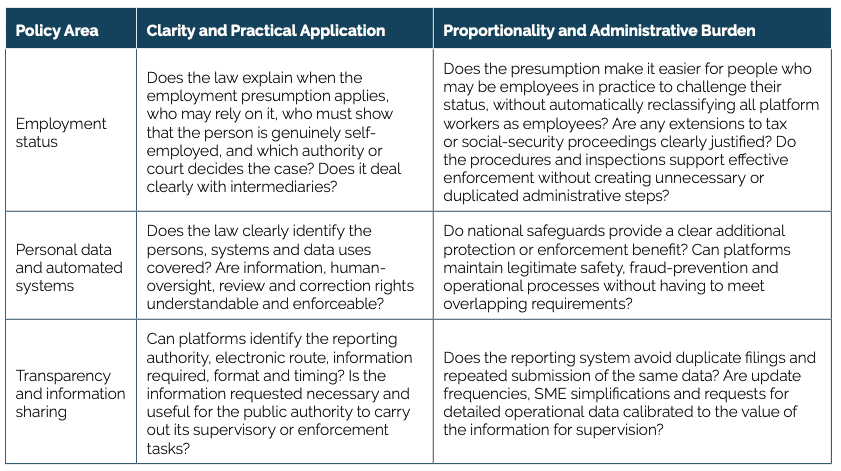 Source: ECIPE.
3. Findings and Recommendations for Transposing the Platform Work Directive
None of the five drafts assessed as part of this study provides a single complete model for transposition. Instead, they show a recurring choice between measures that make rights clear and enforceable, and measures that risk creating legal uncertainty and disproportionate compliance costs.
The following analysis is organised around the Directive’s three policy areas: employment status; personal data and automated systems; and transparency and information sharing. It sets out five recommendations for member states: one on employment status, one on the allocation of responsibility where intermediaries are involved, one on personal data and automated systems, and two on reporting and information requirements.
Each policy area is addressed in three parts. The analysis first explains why the issue matters for member states. It then compares how Austria, Czechia, Estonia, the Netherlands and Sweden have approached it, identifying useful features and remaining points of uncertainty. Finally, it sets out the relevant policy recommendation and explains what it would achieve in practice. As mentioned previously, the country annexes provide the detailed legal evidence that supports the comparative analysis and the policy recommendations derived from it.
3.1 Determination of Employment Status
3.1.1 Why Employment Status Matters
The national drafts take different approaches to the employment presumption. A workable transposition law should set out a clear sequence leading from the facts of the working relationship to a final decision on employment status. First, it should explain which facts may indicate that a platform directs and controls the work, and when those facts are sufficient to trigger the presumption. The assessment should consider the overall working relationship. It should not treat the presence of a limited number of indicators as automatically decisive.
Second, the law should explain how the presumption may be rebutted. Where facts indicate direction and control, the relationship is presumed to be one of employment. This does not automatically determine employment status. The platform, intermediary and person performing platform work should each have a realistic opportunity to submit evidence on how the work is carried out in practice, including evidence that the relationship is not one of employment.
Third, the law should make clear how the presumption operates in practice. It should identify the courts, public authorities or labour inspectors that can apply it, the proceedings in which it applies, and the consequences of a final employment-status decision. This matters because a finding that a person is an employee may affect not only employment rights but also related obligations, such as social-security contributions or tax treatment.
This is one of the most important parts of transposition. It gives people who are employees in practice a practical route to challenge a contractual label that treats them as self-employed. Equally, self-employed people need a clear and realistic way to demonstrate their independence. Moreover, people performing platform work, platforms and intermediaries need to understand the test before entering into or designing contractual relationships, or facing an inspection or status determination. If the law is unclear, similar working relationships may receive different classifications, creating uncertainty for people performing platform work, digital platforms, businesses and authorities.
3.1.2 Country Comparison
- Sweden provides a useful statutory basis for applying the employment presumption. It requires the person performing platform work first to show facts that give reason to assume that the platform directs and controls the work; the platform or intermediary must then show that the overall relationship is not one of employment.
- Austria also gives priority to the facts of the relationship and identifies the entity responsible for employer obligations where an intermediary is involved.
- Czechia links the employment presumption to its established Labour Code concept of dependent work, connecting the new rules to an existing national test.
- Estonia applies the existing management-and-control test in its Employment Contracts Act rather than introducing a separate test for platform work. The draft law clarifies that assessments should consider the degree of management and control exercised through automated monitoring and decision-making systems. This approach may avoid a parallel system of status assessment. However, the draft does not specify how the test should be applied to trigger the presumption in individual cases, what evidence is needed to rebut the presumption, in which proceedings the presumption may be invoked or what effect it has in tax or social-security matters.
- The Netherlands leaves important points unresolved. Its key indicators of direction and supervision will be set later in an Order in Council (secondary legislation adopted by the government under powers set out in the primary law), and the primary legislation does not yet explain what evidence can rebut the presumption. This makes it harder for people performing platform work, platforms and authorities to predict how the rule will apply before the later rules are adopted.
3.1.3 Recommendation 1: Make Employment-Status Rules Clear and Enforceable
Member states should set out the main elements of the employment-status assessment in the transposition law itself. The law should identify the facts that can trigger the employment presumption, while requiring the overall working relationship to be assessed rather than treating a limited number of indicators as automatically decisive.
It should also explain how the presumption may be rebutted. The platform, intermediary and person performing platform work should each have a reasonable opportunity to submit relevant evidence before a final decision is made, including evidence that the person operates on an independent basis. Finally, the law should identify the authority, court or labour inspector able to apply the presumption, the proceedings in which it applies, and the entity responsible for employer obligations where an intermediary is involved.
This would allow people who are employees in practice to challenge an inaccurate contractual label, while giving self-employed people and platforms a clear and realistic basis to demonstrate genuine independence. It would also help authorities apply employment-status decisions consistently where they affect related obligations, such as social-security contributions or tax treatment.
Table 3: Recommendation 1: Make employment-status rules clear and enforceable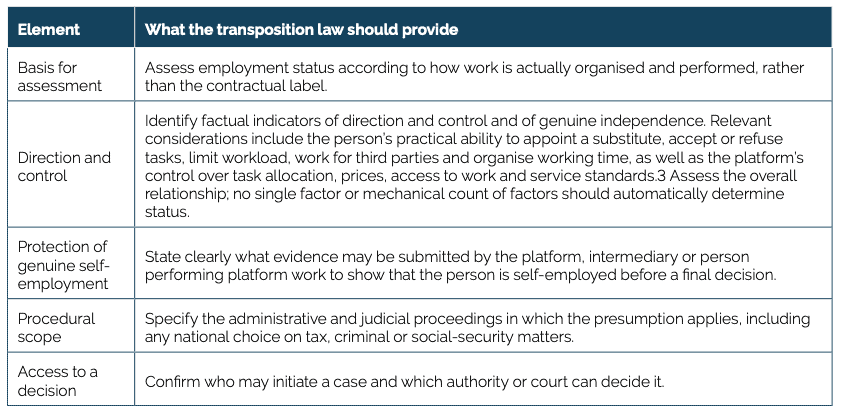 Source: ECIPE.
3.2 The Responsibilities of Intermediaries
3.2.1 Why Responsibility Must Be Clear
The three policy areas (i.e., employment status; personal data and automated systems; and transparency and information sharing) set out the main substantive requirements of the PWD. However, the Directive also raises a separate practical issue: how its protections apply where platform work is organised through an intermediary. The following section considers how member states can allocate responsibilities clearly between platforms and intermediaries.
Where an intermediary is involved, it can be harder for people performing platform work to identify the organisation responsible for their rights. A person may have a contract with an intermediary, while the platform controls important aspects of the work through its systems. National law should therefore allocate responsibility according to the function that each organisation performs or controls. The aim is to ensure effective protection without treating the platform as responsible for every obligation connected with an intermediary.
This distinction matters in practice. A platform may design and operate the system that allocates tasks, sets access conditions or suspends accounts, while an intermediary may be responsible for the employment contract, payroll and social-security contributions. The platform should normally remain responsible for obligations linked to the automated systems it controls, while the intermediary should remain responsible for its employment and contractual obligations. If the platform and intermediary can each point to the other, the individual may be left without a clear route to obtain redress. Conversely, requiring both entities to meet every obligation, regardless of their role, can duplicate costs and reporting without improving protection.
Targeted joint and several liability can provide a backstop where this division of responsibilities would leave an individual without an effective remedy. This does not transfer all of an intermediary’s obligations to the platform. It should apply only to clearly identified obligations for which divided responsibility would otherwise prevent the individual from obtaining redress. For those obligations, it allows the individual to seek the full remedy from either the platform or the intermediary, rather than first having to establish which organisation is responsible. The two organisations may allocate costs and responsibilities between themselves through private arrangements, but those arrangements should not reduce the rights or remedies available to the person performing the work.
3.2.2 Country Comparison
- Sweden provides the clearest functional model in the measures assessed. Employment status is assessed primarily against the contractual entity, while the platform remains responsible for the automated systems it controls. Targeted joint and several liability acts as a backstop where this division would otherwise leave a gap in protection.
- Austria identifies the entity responsible for employer obligations in intermediary arrangements, although the scope of some joint claims is less clear.
- Czechia and Estonia provide less clarity on how responsibilities are allocated across intermediary arrangements and how those rules interact with employment-status determination.
- The Netherlands extends the employment presumption to intermediary arrangements but leaves key operational details for later rules.
3.2.3 Recommendation 2: Allocate Responsibility According to the Function Each Entity Controls
Member states should ensure that people performing platform work through an intermediary receive the same level of protection as those who contract directly with a platform. Once an employment relationship has been established, the law should identify the entity responsible for employer obligations. Responsibility for an automated system should remain with the organisation that designs, operates or controls that system, while intermediaries should remain responsible for their own employment and contractual decisions. Member states should provide for targeted joint and several liability for clearly identified obligations where divided responsibility would otherwise leave an individual without an effective remedy.
Table 4: Recommendation 2: Allocate responsibility according to the function each entity controls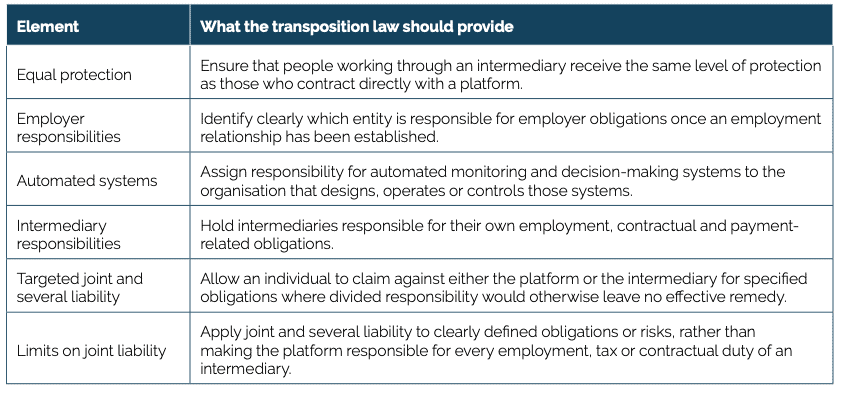 Source: ECIPE.
3.3 Personal Data and Automated Systems
3.3.1 Why EU Safeguards and Consistent Transposition Matter
The Directive sets detailed EU safeguards on the use of personal data and automated systems by digital labour platforms. Several of the core safeguards in Articles 7–11 (e.g., limits on the processing of personal data, information on automated systems, human oversight and the review of important decisions) protect people performing platform work, including those who have not been classified as employees. These safeguards are not conditional on the employment-status presumption, although some Chapter III provisions apply specifically to platform workers or their representatives. National law should make clear which people, automated systems and decisions are covered.
These safeguards restrict specified forms of personal-data processing and require platforms to provide information about automated monitoring and decision-making systems. They also require human oversight of those systems and a human decision where a platform restricts, suspends or terminates a person’s account or contractual relationship, or takes another decision with a comparable detrimental effect. People performing platform work must be able to obtain an explanation, request a review and have an unlawful decision corrected or, where correction is no longer possible, receive compensation.
These systems can influence recruitment, access to tasks, earnings, working time and decisions to restrict, suspend or terminate an account – the digital profile through which a person accesses work on the platform. For digital labour platforms, they are also part of daily operations: platforms use them to match supply and demand, organise work, allocate tasks and manage access to their services.
Faithful transposition of these rules should be the default approach. It protects people performing platform work against harmful or mistaken automated decisions, while allowing platforms to use common procedures across EU markets. This matters for the Single Market. If member states adopt materially different rules (e.g., on the systems and decisions covered, the information platforms must provide, the deadlines for review, or when human involvement is required), platforms operating across borders may need to redesign software, internal processes and staff training for each national market. These fragmentation costs reduce the benefits of operating across borders and may deter smaller platforms from expanding into additional member states, because the fixed costs of maintaining separate compliance systems are harder to absorb when a business carries out less work across borders.
3.3.2 Country Comparison
- Sweden provides the closest example of faithful transposition. Its proposal retains the Directive’s broad coverage of people performing platform work, including people who have not been classified as employees. It also retains the requirement for a human to take important automated decisions and the process for reviewing those decisions.
- Austria provides a clear sequence for explanation, review, correction and compensation. However, its proposed three-year data-retention requirement means that platforms must continue to store data securely and delete it when the retention period ends.
- Czechia also broadly follows the Directive and sets out a clear process for challenging automated decisions, including access to a qualified person, review and a reasoned response.
- Estonia provides for human involvement, explanation, review and correction, but calculates the deadline for correcting an unlawful decision from the point at which the infringement is detected. This may make it less clear how quickly a person can expect a decision to be corrected.
- The Netherlands leaves the scope of the automated-systems rules unclear. It refers to systems that have “significant consequences” for people performing platform work, but does not define that term or indicate which systems and decisions it captures. The final framework should therefore define “significant consequences” or provide clear criteria for determining which automated systems and decisions fall within scope.
3.3.3 Recommendation 3: Faithfully Transpose EU Safeguards
Member states should transpose the Directive’s rules on personal data and automated systems faithfully. The national law should preserve the Directive’s safeguards and keep its time limits for platforms to explain, review and correct automated decisions. It should also make clear how people performing platform work can exercise these rights in practice, including how they can request a review or seek redress, and which public authority or authorities are responsible for enforcement.
A close transposition serves four objectives at once. It gives people performing platform work a clear and consistent level of protection across the EU. It allows platforms to use common procedures across national markets rather than operate separate compliance systems. By limiting differences between national rules, it can also make compliance easier to organise, monitor and enforce. For example, platforms can train staff and configure systems against a clear common baseline, while authorities can assess compliance against comparable standards. Critically, it also reduces the risk that divergent national implementation creates barriers in the Single Market.
Table 5: Recommendation 3: Faithfully transpose EU safeguards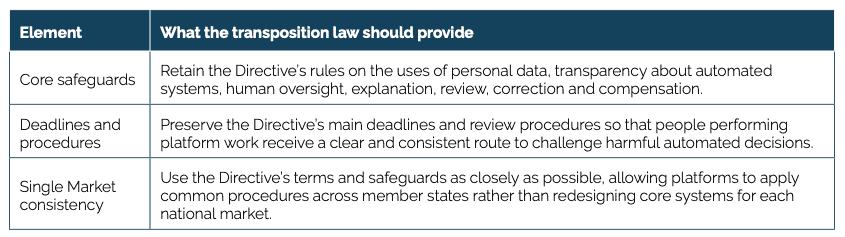 Source: ECIPE.
3.4 Transparency and Information Sharing
3.4.1 Why Reporting Design Matters
The Directive establishes two connected transparency obligations. Firstly, under Article 16, platforms must declare platform work to the relevant authority in the member state where the work is performed. Secondly, under Article 17, they must make specified and up-to-date information available to competent authorities and representatives of people performing platform work. This includes information on the number of people working through the platform, their contractual or employment status, the general terms and conditions that apply to them, and relevant intermediaries.
National transposition should make clear how these two obligations work together. The objective is to ensure that public authorities receive the information necessary for effective supervision, without requiring platforms or intermediaries to submit equivalent information through several channels, in different formats or at different times. A single, well-designed electronic reporting route can make compliance simpler and less costly while giving authorities a clearer basis for enforcement.
Reporting frequency is part of the same proportionality assessment. Article 17 requires core information to be updated at least every six months, but allows member states to provide for annual updates for SMEs. It also limits routine reporting of more detailed information on activity duration, weekly working hours and income: platforms need to provide that information only when it is requested.
3.4.2 Country Comparison
The five drafts adopt different approaches to the reporting route and the interaction between the initial declaration and the continuing information duty.
- Austria provides a central electronic process. Platforms and intermediaries submit reports to the Austrian Tax Office through an electronic form provided by the Federal Ministry of Finance, and the Tax Office shares information with other authorities and coordinates follow-up.
- Sweden does not create a separate platform-work register. Instead, platforms must submit specified information to the Swedish Work Environment Authority and the relevant employee organisation no later than when someone begins performing platform work through the platform in Sweden. This initial notification fulfils the Directive’s declaration requirement, and the information must subsequently be updated at least every six months.
- Czechia combines employer registration, remote disclosure, inspection access and a local contact person, which can require several separate compliance processes.
- Estonia does not yet make clear how its continuing information duty relates to the initial declaration.
- The Netherlands leaves the practical design of its reporting system to later rules.
The drafts also differ in how often platforms must provide information and whether detailed activity data are part of routine reporting.
- Estonia uses the Directive’s flexibility most fully. SMEs may provide annual updates, while detailed activity data are available only on request.
- Austria also allows annual reporting for entities with fewer than 250 employees.
- Czechia and Sweden require six-month updates for all platforms and do not use the Directive’s flexibility for SMEs.
- The Netherlands has not yet stated whether its future rules will allow an annual reporting cycle for SMEs or establish a once-only reporting mechanism.
3.4.3 Recommendation 4: Use One Identifiable Electronic Reporting Route and Avoid Duplication
Member states should provide one identifiable electronic route for the declaration and information required under Articles 16 and 17 of the Directive. The transposition law should explain how the initial declaration of platform work and the continuing information duty work together. It should identify the reporting entity, recipient authority, information required, relevant deadlines and the role of intermediaries. Finally, authorities should reuse equivalent information that has already been supplied where the statutory purpose and data-access rules allow it.
Table 6: Recommendation 4: Use one identifiable electronic reporting route and avoid duplication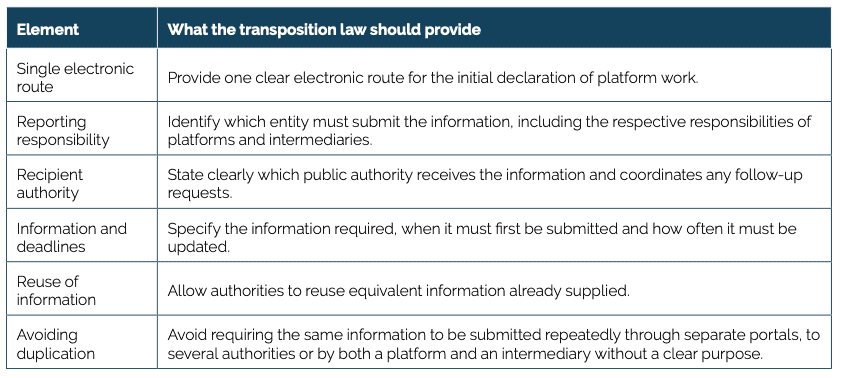 Source: ECIPE.
3.4.4 Recommendation 5: Make Reporting Frequency and Content Proportionate
Member states should use the annual-update option for SMEs where a six-month reporting cycle is not necessary for effective supervision. Detailed information on activity duration, weekly hours and income should remain available on request, rather than form part of every routine update. Changes to general terms and conditions should trigger a new reporting obligation only where they materially affect the information previously supplied, rather than where they are minor or technical.
The frequency and content of reporting should reflect the value of the information requested for supervision. Core information – including the number of people working through the platform, their contractual or employment status, the general terms and conditions that apply to them, and the intermediaries involved – must be updated at least every six months under the Directive. Member states may, however, allow SMEs to provide these updates annually. Information on activity duration, weekly hours and income does not have to be included in routine updates and should be provided only when an authority requests it.
Table 7: Recommendation 5: Make reporting frequency and content proportionate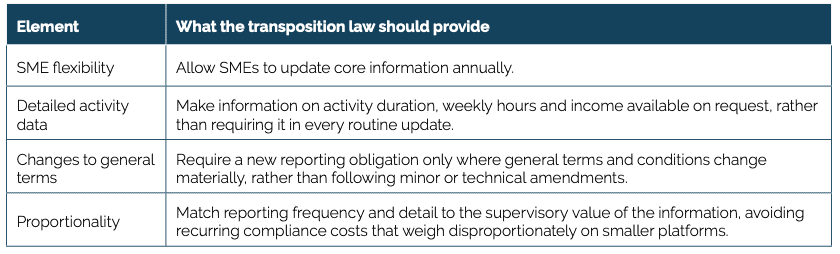 Source: ECIPE.
[1] The factors in Table 3 follow B v Yodel Delivery Network Ltd, Case C-692/19, Order of 22 April 2020, ECLI:EU:C:2020:288, paragraphs 38–45. Official source: https://eur-lex.europa.eu/legal-content/EN/TXT/?uri=celex:62019CO0692.
Country Annexes
These annexes provide the country-level evidence behind Chapter 3. They summarise how Austria, Czechia, Estonia, the Netherlands and Sweden propose to transpose Directive (EU) 2024/2831 on improving working conditions in platform work into national law. Each annex follows the same three policy areas of the Directive (i.e., employment status; personal data and automated systems; and transparency and information sharing) and assesses whether the draft rules are clear and workable, protect people performing platform work effectively, and avoid unnecessary administrative costs or legal uncertainty. This analysis assesses draft measures, not final national law or enforcement practice.
Annex A. Austria
A.1 Employment Status
Clarity and Practical Application. Sections 4–5 of the Austrian draft law assess whether a person works under the direction of the platform by examining how the working relationship operates in practice, rather than the label used in the contract. Relevant factors include whether the person works as part of the platform’s business rather than independently; who determines their time and place of work; whether the platform gives instructions or exercises control; whether the person must perform the work personally; and how much freedom they retain to organise it. Where these facts indicate direction and control, employment is presumed unless the platform or intermediary proves otherwise. Sections 4(1)–(2) identify which entity bears the employer’s responsibilities when an intermediary is involved. This means that a person performing platform work does not have to prove every element of an employment relationship before the platform or intermediary must respond.
Proportionality and Administrative Burden. Austria applies the employment presumption in most administrative and judicial proceedings, including inspections (Section 5(2)). Tax and criminal matters are excluded (Section 5(4)), but social-security matters are not. A finding that a person is an employee could therefore also prompt a review of social-insurance obligations under Sections 30(2)–(4) and 31. This helps authorities apply employment and social-security rules consistently and reduces the risk that misclassification is corrected in one process but ignored in another. However, it also raises the stakes of the initial status decision.
A.2 Personal Data and Automated Systems
Clarity and Practical Application. Austria applies its personal-data safeguards from the recruitment stage onwards, not only after someone has been classified as an employee. Section 14 therefore protects applicants and self-employed people working through platforms, as well as platform workers with an employment relationship. These restrictions operate alongside a separate set of safeguards for decisions made through automated systems. Under Sections 11(2)–(6), affected individuals have a clear route to challenge such a decision: they can request an explanation and review; the platform must respond and correct an unlawful decision within two weeks; and, where correction is no longer possible, provide compensation.
Proportionality and Administrative Burden. The requirements to explain, review and correct automated decisions largely implement the Platform Work Directive itself. Austria adds a separate obligation in Section 12(7): personal data must generally be kept for three years after the working relationship ends. Keeping the data may help individuals and authorities establish what happened if a dispute arises later. However, the organisation responsible for the data must continue to store it securely and delete it at the correct time.
Section 26(2) concerns situations in which worker representatives need specialist advice to understand or assess automated systems. Where a platform has more than 250 workers, it must cover the reasonable cost of that expert assistance. Austria also extends this obligation to intermediaries.
A.3 Transparency and Information Sharing
Clarity and Practical Application. Section 6 creates a single electronic reporting route. Platforms and intermediaries submit reports electronically to the Austrian Tax Office using a web form provided by the Federal Ministry of Finance. The report must state how many people perform work through the platform, their contractual status, the type of work performed and the applicable contractual terms. The Tax Office then shares the information with the relevant public authorities and coordinates follow-up questions. This approach makes the process easy to identify: the draft specifies who must report, what information they must provide and where they must submit it.
Proportionality and Administrative Burden. Under Section 6(4), platforms and intermediaries with fewer than 250 employees may report annually rather than every six months.
Sources: Legal and consultancy reports on the Austrian draft transposition measure (unpublished). The Austrian draft was not publicly available at the time of writing.
Annex B. Czechia
B.1 Employment Status
Clarity and Practical Application. Czechia’s draft connects the rebuttable employment presumption to the existing Labour Code concept of dependent work. Under Section 9 of the draft law, the relevant question is whether the person works personally, for and on behalf of another party, and under that party’s instructions and authority. The draft also refers to factors such as remuneration, responsibility, place of work and working time. If the facts reasonably indicate dependent work, the platform or intermediary must show that at least one of the defining features of dependent work set out in Section 9 is absent. Moreover, the person performing platform work should also be able to submit evidence of genuine independence where they contest an employment classification. Section 9(3) usefully confirms that a platform does not become an employer simply because it complies with legal duties, such as safety, reporting or verification requirements. Those duties do not, on their own, show that the platform directs and controls the work.
Proportionality and Administrative Burden. The Czech draft limits when the employment presumption can be used. It applies in court cases, administrative proceedings and labour inspections that determine whether a person performing platform work is an employee or self-employed. It does not apply to criminal or social-security proceedings, cannot be used for periods before the law enters into force, and generally reaches back no more than three years before the case or inspection begins (Sections 10(1) and 42(1)).
Tax matters remain within scope. In addition, where a final decision finds that a person working through an intermediary is an employee, Section 7(2) requires the platform to ensure compliance with income-tax, social-security-contribution and public-health-insurance obligations.
B.2 Personal Data and Automated Systems
Clarity and Practical Application. The Czech draft broadly follows the Directive’s rules on personal data, automated systems, human oversight and review. Section 19 provides a clear route for challenging an automated decision. A person with suitable authority and expertise must be available to discuss the decision; the affected person or their representative may request a review; and the platform must provide a written and reasoned response within two weeks. If the decision breached the person’s rights, it must be corrected within two weeks of the decision or review. Where correction is no longer possible, the person is entitled to compensation.
Proportionality and Administrative Burden. The draft brings digital labour platforms within the internal reporting-system rules of the Whistleblower Protection Act for specified platform-work-related concerns. This is an additional compliance obligation introduced through national law, rather than a requirement of the Directive’s core safeguards on personal data and automated systems. It may help individuals report suspected breaches and give authorities better information. However, for smaller platforms that are not already covered by the wider whistleblowing regime, it can require a permanent reporting channel and an internal process for handling reports.
B.3 Transparency and Information Sharing
Clarity and Practical Application. Czechia creates a detailed reporting and information system, but it operates through several separate channels. Section 20 requires platforms to register or update their platform status in the employer register. Section 21 then requires platforms and intermediaries to make specified information available remotely in a machine-readable format. This information is available to labour inspectors, the data-protection authority, tax authorities and employee representatives. It covers the number and contractual status of people performing platform work, general contractual terms, intermediaries and certain information about working time, contract duration and income. Section 26 adds a further route during inspections: authorities may request documents, explanations, evidence and access to relevant information systems.
Proportionality and Administrative Burden. The draft limits some routine reporting. Detailed information on average contract duration, working hours and income must be supplied only when requested in writing, with 30 days to respond. Other features may create a significant combined burden. Section 21 requires information to be updated at least every six months for platforms of all sizes; it does not use the Directive’s option to permit annual updating for SMEs. Section 28 requires platforms without a registered office or organisational unit in Czechia to appoint a Czech-based contact person with a national data mailbox. This may help authorities supervise cross-border platforms, but it is a fixed local cost.
Sources: Czech Republic, draft transposition measure available through the Government Legislative Work Portal, https://odok.gov.cz/portal/veklep/material/KORNDSJJKRYG/; Directive (EU) 2024/2831 on improving working conditions in platform work; relevant national legislation cited in the text.
Annex C. Estonia
C.1 Employment Status
Clarity and Practical Application. Estonia’s draft law builds on its existing employment-contract rules rather than creating a separate test for platform work. Under those rules, a relationship is generally treated as employment where a person works for pay under the management and control of an employer. A person who remains substantially free to decide how, when and where to work is not normally covered.
Proportionality and Administrative Burden. Estonia’s decision to use its existing Employment Contracts Act could reduce administrative burden. It avoids creating a separate platform-work tribunal, a new application procedure or a parallel system of status assessments. Platforms and workers can instead rely on legal concepts and institutions that already exist. However, the draft does not clarify whether there are exclusions for tax, social-security or criminal matters, or whether decisions can affect past contractual arrangements.
C.2 Personal Data and Automated Systems
Clarity and Practical Application. Proposed Sections 7–13 of the Estonian draft law cover restrictions on the use of personal data, information duties, human oversight, review and correction. The draft provides a clear process for important automated decisions. Section 10 requires a human to take certain decisions that restrict, suspend or terminate a contractual relationship or account. Section 11 then gives affected individuals a right to an explanation, access to a qualified human contact, review and correction.
The correction deadline in Section 11(4) requires correction without delay and no later than 14 calendar days after the infringement is detected. The Directive sets the outside deadline by reference to the date on which the decision was made. Under the Estonian formulation, the deadline may begin only once the platform identifies the problem. This could make it less clear how quickly an affected person can expect an unlawful decision to be corrected.
Proportionality and Administrative Burden. Section 10(4) requires action where an assessment identifies a risk of discrimination linked to an automated system. The Directive refers to a high risk. Estonia’s lower threshold could offer earlier protection, but it may also require platforms to investigate, modify or stop using systems in a wider range of cases. The final law should make clear what counts as a relevant risk and what response is expected.
C.3 Transparency and Information Sharing
Clarity and Practical Application. Section 14 establishes Estonia’s continuing information obligations. Platforms must provide the Labour Inspectorate and representatives of people performing platform work with information on the number of people working through the platform, their contractual arrangements, working time, income and intermediaries.
Proportionality and Administrative Burden. Estonia uses the Directive’s flexibility for smaller businesses. Qualifying small platforms may update relevant information annually, while larger platforms update it twice a year. Section 14(2) takes a proportionate approach to detailed operational data. Information on activity duration, weekly hours and income must be supplied only on request.
Sources: Estonia, draft transposition measure available through the Draft Acts Information System, https://eelnoud.valitsus.ee/; Directive (EU) 2024/2831 on improving working conditions in platform work; relevant national legislation cited in the text.
Annex D. The Netherlands
D.1 Employment Status
Clarity and Practical Application. The Dutch draft introduces a rebuttable presumption of employment where the facts indicate that the platform directs and supervises the work. This does not mean that everyone working through a platform automatically becomes an employee. Rather, it gives the person performing the work a starting point: once facts suggest that the platform controls the work, the platform or intermediary must show that the relationship is one of genuine self-employment. The person performing platform work should also have an effective opportunity to submit evidence of genuine independence where they contest an employment classification. However, the main indicators of “direction and supervision” will be set later in an Order in Council. The primary legislation does not yet explain what evidence may be used to rebut the presumption.
Proportionality and Administrative Burden. The Dutch approach limits the retrospective effect of the presumption. It applies from the date the law enters into force, but does not reopen earlier periods.
D.2 Personal Data and Automated Systems
Clarity and Practical Application. The Dutch draft sets out rules on automated systems, human oversight and review in Sections 4–9. It requires human involvement in serious decisions affecting access to work, such as decisions to restrict, suspend or terminate an account, and provides an internal review route. However, the draft applies these rules to automated systems that produce “significant consequences” for people performing platform work without defining that term or providing criteria for determining which systems and decisions fall within scope. This creates uncertainty for platforms, people performing platform work and enforcement authorities. The final framework should therefore define “significant consequences” or provide clear criteria for its application. It should also clarify how the platform-work safeguards interact with other applicable legal obligations, including identity-verification requirements, so that compliance with one framework does not create uncertainty about compliance with another.
Under Section 2(2), the Dutch rules on automated systems in Sections 4–9 apply only where the platform’s main or sole establishment, for the purposes of the General Data Protection Regulation (GDPR), is in the Netherlands. A platform providing services in the Netherlands must therefore first determine whether the Dutch rules or another member state’s implementing rules govern these specific obligations. This may be manageable for a domestic platform, but it can be less clear for a platform that operates across several countries. The final framework should make this cross-border allocation of responsibility easy to understand, so that platforms and competent authorities can identify which member state’s implementing rules apply to the relevant obligations.
Proportionality and Administrative Burden. Section 8(3) protects the employee responsible for supervising and evaluating automated systems from adverse treatment when carrying out that role. It also states separately that the employee’s contract may not be terminated. However, the wording should make clear whether protection from dismissal applies only where the dismissal is linked to the employee’s oversight role, or whether it creates a broader prohibition on terminating their employment.
D.3 Transparency and Information Sharing
Clarity and Practical Application. The Dutch draft creates two stages of reporting. First, Section 14 requires a platform to notify the relevant authority before platform work begins in the Netherlands. Second, Section 15 requires continuing information about platform work performed in the Netherlands. This information must be available to the designated public body, supervisory authorities and representatives of people performing platform work.
Proportionality and Administrative Burden. Sections 14 and 15 establish the reporting duties but leave most practical details to later rules (i.e., an Order in Council). Those rules will determine the reporting form, language, information required, deadlines, supporting documents and update frequency. Until the rules are published, platforms cannot assess how often they will need to report, whether small and micro platforms may report annually, or whether information submitted for one purpose can be reused by other authorities.
Sources: Netherlands, Wet platformwerk, public consultation draft, https://www.internetconsultatie.nl/wetplatformwerk/b1; Directive (EU) 2024/2831 on improving working conditions in platform work; relevant national legislation cited in the text.
Annex E. Sweden
E.1 Employment Status
Clarity and Practical Application. Sweden’s draft preserves the existing Swedish approach to determining whether someone is an employee or genuinely self-employed. The assessment remains case-specific and considers the actual working relationship, including who controls when, where and how the work is done; whether the work is performed personally; its duration and continuity; and the practical organisation of the work.
Chapter 2, Sections 1–2 of the draft law create a rebuttable presumption for platform work. A person performing platform work must first show facts that give reason to assume that the platform directs and controls the work. The platform or intermediary must then show, on the basis of the overall relationship, that the person is not an employee.
Proportionality and Administrative Burden. Sweden limits the scope of the presumption. Chapter 2, Section 3 excludes tax, criminal, social-insurance and unemployment-insurance matters. The presumption applies mainly in civil disputes between the person performing the work, or a trade union acting on their behalf, and the platform or intermediary.
This approach avoids creating a separate platform-work tribunal or a new administrative procedure for every possible status dispute. Chapter 2, Section 4 integrates the presumption into the existing supervisory powers of the Swedish Work Environment Authority.
E.2 Personal Data and Automated Systems
Clarity and Practical Application. Sweden closely follows the Directive’s rules on the use of personal data and automated systems. Chapter 4 prohibits specified forms of personal-data collection and processing through automated monitoring and decision-making systems.
The draft also requires important decisions to be made by a human. This includes decisions that restrict, suspend or terminate a contractual relationship or account. Platforms must provide information about the systems they use. Affected individuals can contact a designated person, request reconsideration and receive a reasoned response. If a decision has breached their rights, it must be corrected without delay and no later than two weeks after it was made. Where correction is no longer possible, the individual may receive compensation.
Proportionality and Administrative Burden. Sweden has retained the Directive’s threshold for expert assistance. Where a platform has more than 250 workers, it must cover the reasonable cost of an expert chosen by the employee organisation where that support is necessary to assess automated systems.
Sweden relies mainly on existing enforcement routes. Employment-related disputes, including disputes involving contractors, follow the Labour Disputes Act. However, the proposal imposes a five-year limitation period, which is extensive compared to other employment legislation. Data-protection issues remain subject to the existing data-protection supervisory system.
E.3 Transparency and Information Sharing
Clarity and Practical Application. Platforms must provide the required information to the Swedish Work Environment Authority and the relevant employee organisation when a person begins platform work in Sweden. The same information fulfils both the initial declaration and the continuing information duty, avoiding a separate platform register. It must be updated at least every six months. The Authority and trade unions may request clarification or more detailed information, and the platform must provide a reasoned response without undue delay.
Sweden would not, however, require information on average activity duration, although Article 17(1)(c) of the Directive includes this data point. The public report supporting Swedish regulation considered the concept difficult to define and supervise.
Proportionality and Administrative Burden. The proposal does not use the Directive’s option to allow annual reporting for SMEs. Instead, all platforms must update the core information at least every six months. This provides authorities and employee organisations with regular information, but it may impose a relatively larger fixed administrative cost on smaller platforms with limited compliance capacity.
Sources: Sweden, SOU 2026:3, public inquiry report and proposed measures, https://www.regeringen.se/rattsliga-dokument/statens-offentliga-utredningar/2026/01/sou-20263/; Directive (EU) 2024/2831 on improving working conditions in platform work; relevant national legislation cited in the text.
