
Summary
DOWNLOAD PDFThe transition from 5G to 6G in telecommunications networks will be a game changer for global digital technology. 6G will create a new opportunity for an integrated communications, computing and artificial intelligence (AI) system. While the final technical specifications and commercial proposition of 6G have yet to be settled, it is already clear that this new environment will demand networks that are adaptive and capable of handling the increasingly multidirectional traffic generated by devices, sensors, and autonomous systems. This shift matters for Europe because telecommunications is one of the areas of the ICT industry in which the EU remains a global leader. European firms have the expertise to play an important role in 6G. The challenge for EU policy is to provide a regulatory framework that allows European telecommunications companies to develop and provide the higher-value services enabled by 6G.
Europe starts from a comparatively strong technological base in telecommunications. The economic evidence points to this strength. Using several metrics, our study finds that telecommunications is an ICT domain in which the EU retains significant capabilities and is less structurally dependent on foreign innovation. The sector’s competitiveness has a reciprocal dimension. European firms supply network equipment, engineering expertise, and telecommunications technology that firms outside the EU use to build and run advanced communications networks. This creates economic value for Europe and, in a sector that underpins critical infrastructure and defence capabilities, gives the EU strategic leverage. In R&D spending, the EU’s Revealed Technological Advantage (RTA) for telecommunications – a measure of whether Europe is relatively more specialised in this field than the world as a whole – is substantially stronger than in software and computer services. In patent filings, Europe also holds a stronger relative position in telecommunications than in digital communication, computer technology and IT methods for management.
However, this technological strength has not translated into commercial success – at least not in Europe. European telecommunications equipment makers invest an average of 18 per cent of their net sales in R&D but record operating margins of just 3 per cent. This outcome is not simply dictated by global market forces and industry structures. EU telecommunications policy has deliberately prioritised low prices, network access and service competition. Those objectives might have brought some static benefits to consumers, but the associated constraints on pricing have weakened operators’ capacity and incentive to invest in new infrastructure, while reducing demand and margins for equipment vendors. Low returns for European network suppliers are not merely a commercial outcome. They are also shaped by the EU’s regulatory choices, which undermine Europe’s telecommunications sector and its ability to develop and deploy advanced networks, harming Europe’s wider competitiveness.
6G offers a route to change this outcome. It could allow European telecommunications firms to capture more value in software-, compute- and AI-enabled network services and help Europe regain a leading role in the ICT industry. By shifting networks from passive bandwidth provision to programmable, software-defined services such as network slicing, distributed edge computing and quality-tiered APIs (software interfaces that let applications request a defined level of network performance), 6G introduces capabilities that cannot be replicated in the same way as raw connectivity. For the first time, European equipment makers and operators, which build and manage the physical radio infrastructure, hold a structural advantage over pure cloud companies in coordinating services that process data and run applications close to users and connected devices, rather than in distant data centres.
That opportunity hinges on investment and deployment. Europe’s 5G record shows that operators are not yet building the network capabilities, commercial experience and investment base that 6G will require. 5G standalone networks, which provide the architecture that unlocks network slicing, low-latency services, and the industrial applications that 6G will scale, remain almost entirely absent from European markets. Remarkably, not a single EU member state reached double-digit standalone availability – compared with 32 per cent in the US and 81 per cent in China. The picture for private 5G networks – the closest available market test for the industrial services 6G is expected to support – is equally stark. Out of the 747 recorded EU deployments, 500 were in Germany alone, leaving just 247 across the remaining 26 member states.
These are not merely 5G metrics; they are indicators of 6G readiness – and should be understood as a wake-up call for Europe. Without operational experience of programmable cores, network slicing and enterprise service models, European operators have less real-world experience about which services customers value, what networks can reliably deliver and what prices the market will bear. This greater uncertainty can delay or reduce investment in new network capabilities. That uncertainty adds to an already substantial investment gap. Europe’s mobile networks already face an estimated EUR 200 billion investment shortfall over the next decade, with operators on track to invest only EUR 270 billion of the EUR 475 billion required. If the structural conditions that produced this gap are not addressed, Europe risks entering the 6G era from a position of accumulated weakness.
The investment and deployment gaps have a regulatory dimension. European operators must build the 6G business case within a framework that is more restrictive than those of China and the US. The EU’s regulatory framework for telecommunications – measured against China and the US using the OECD’s Digital Services Trade Restrictiveness Index – is significantly more restrictive than that of either competitor, with an average score of 0.85 against 0.6 for China and 0.2 for the US. The two sub-indicators most directly relevant to the 6G business case (i.e., net neutrality and vertical separation) are precisely those on which the EU diverges most sharply. Net neutrality constrains operators’ ability to price differentiate performance; vertical separation limits their ability to bundle connectivity, edge compute, and software into integrated commercial offerings. Together, they foreclose the business model that 6G is designed to enable.
Sectoral telecommunications rules are only part of the challenge. A growing architecture of cross-cutting regulations (e.g., NIS2, the Radio Equipment Directive, the Open Internet Regulation, the Data Act, and upcoming measures such as the Cyber Resilience Act and the Digital Networks Act) affects every layer of the 6G stack. Each instrument pursues a defensible objective. But their cumulative effect is a dense network of overlapping conformity assessments, data-portability mandates, switching obligations, and supplier-risk evaluations on the very firms expected to lead 6G commercialisation. The accumulation of these requirements raises compliance costs. It can also delay deployment, fragment service architectures and weaken the investment incentives needed to develop viable 6G business models.
The policy lesson is clear. Europe retains a genuine technological position in telecommunications, but it captures too little commercial value from that strength. 6G offers a route into higher-value network, computing and AI-enabled services, yet Europe’s 5G record and regulatory framework risk depriving EU firms of the incentives and capacity needed to seize that opportunity. The following four recommendations set out how the EU can create a more credible route for firms to invest in, deploy, and profit from 6G-enabled services.
- Reframe telecommunications regulation to enable viable 6G business models. The EU’s telecommunications framework was built to open markets and protect consumers. Those objectives remain important, and have been mostly achieved, but they are no longer sufficient as a guide for 6G. Rules should be retained where they clearly protect competition and users, but revised where they prevent operators from building viable business models for advanced network services.
- Reduce regulatory overlap to lower costs across the 6G stack. Before further obligations are added, the EU should conduct a coordinated impact assessment of the combined effect of the EU’s regulation on the 6G value chain, identifying overlaps, opportunities for simplification, and for achieving regulatory objectives at lower cost.
- Scale 5G standalone and private networks as the bridge to 6G. Europe’s weak standalone deployment is an early warning sign. The EU and its member states should promote clearer pathways for 5G standalone migration, local industrial spectrum access, and private-network deployment, treating these as practical testbeds for the operational and commercial capabilities that 6G will require.
- Concentrate public support to build a competitive 6G ecosystem. Public policies and funding should reinforce the parts of the 6G ecosystem where European firms can still shape competition: telecommunications equipment, network software, programmable cores, edge-enabled industrial services, and standards development. EU policy on standard-essential patents (SEPs) should also enable European innovators to obtain fair and timely compensation when others use their technology, both within the EU and in international markets.
The window for action is narrow. 6G standardisation is already under way, and commercial deployment is expected from around 2030. The architectural and business-model templates for the next network cycle are being set now. If Europe’s regulatory environment continues to impose cumulative obligations on the firms expected to build next-generation networks, the opportunity for the EU to lead in 6G could have passed before it was ever taken.
1. The Strategic Imperative of 6G
The next generation of telecommunications networks, 6G, is an opportunity for Europe that unfortunately has become a wake-up call. European companies have led telecom network technology for decades, and 6G offers them an opportunity to expand their role across the broader computing, cloud and AI stack. But global markets are changing rapidly, while European policy has not kept pace with the technological and commercial changes reshaping the sector. Europe is still locking the telecommunications sector into a highly regulated and restricted market – more so than in China. The result is that new network technologies are rolled out more slowly in Europe, while the industry struggles to generate the returns needed to finance investment.
This study puts forward three connected arguments. First, Europe retains a comparatively strong technological position in telecommunications, but its firms capture too little commercial value from that strength. Second, 6G represents Europe’s most credible opportunity to move into higher-value activities across the digital economy and to translate this ICT asset into commercial gains. Third, Europe’s 5G record and regulatory framework risk depriving European firms of the incentives needed to invest in, deploy and commercialise 6G-enabled services, and, ultimately, to benefit from the opportunities that 6G will create.
6G matters because it could change where value is created in the digital economy. Rather than providing bandwidth alone, future networks will combine connectivity with computing and AI services that can be delivered closer to users and connected devices. 5G was built for downlink-heavy consumption, with a typical traffic ratio of 90 per cent downlink to 10 per cent uplink. In this architecture, most computing is provided by large data centres located far from the end device. Nonetheless, the rise of generative AI, AR/XR devices, and distributed sensors is pushing traffic towards a more bidirectional model, currently estimated at 74 per cent downlink and 26 per cent uplink.[1] Meeting the performance requirements of these applications demands that computing and connectivity be delivered closer to the device, reducing latency and ensuring service continuity.
In response to this need, 6G is being engineered specifically to handle these sustained, uplink-intensive workloads. It will require networks to function as a hybrid computing fabric that coordinates tasks across device, edge, and cloud environments, guaranteeing the deterministic latency (a perfectly predictable and lag-free connection) required for autonomous vehicles, industrial robots, or drones. As a result, part of the necessary computing power will be pushed from the cloud to the edge of the network, integrating deeply with physical radio infrastructure. In this architecture, European telecommunications equipment and technology providers have a structural opportunity to expand beyond supplying raw, commoditised connectivity hardware. By providing the software orchestration, specialised network slicing, and edge computing services that manage these advanced networks, European firms can move up the value chain, competing more directly in higher-margin digital and cloud segments.
The importance of 6G extends beyond the telecommunications sector. The technologies designed, built, and deployed by the telecommunications industry provide the bedrock for a vast array of new digital services and a growing number of smart physical goods. For example, 5G-enabled applications have already generated over USD 1 trillion in global economic impact, with projections suggesting cumulative value will exceed USD 6 trillion by 2030 and reach approximately USD 18.2 trillion by 2035.[2]
In the case of 6G, its deployment and application will have profound effects on multiple industrial sectors that are critical for the competitiveness of the EU economy. Across manufacturing, space, and defence, 6G will serve as the connective infrastructure for physical AI (i.e., the deployment at scale of drones, cooperating mobile robots, connected vehicles, and autonomous industrial systems). In the automotive and aerospace industries, for example, connected vehicles and unmanned aerial systems will exchange sensor, video, and radar data to operate safely, and doing so requires latency of less than 10 milliseconds, which is a threshold that current 5G architecture cannot consistently guarantee at scale.[3] Therefore, network performance, data and computing will become core determinants of economic competitiveness.
The defence dimension reinforces this argument. The conflict in Ukraine has demonstrated that digital technology is now a decisive military advantage. The conflict has also revealed how rapidly the boundary between civilian and military technology dissolves. The same connectivity, edge computing, and AI capabilities that power industrial automation also underpin drone coordination, manned-unmanned teaming, and real-time battlefield situational awareness. For the EU, this convergence between industrial and security applications is not merely a policy consideration, but a national security imperative. Europe’s existing technological depth in telecommunications equipment, standards expertise, and network engineering gives it a credible foundation from which to develop the dual-use infrastructure that its industries and its national security require.
However, Europe’s ability to seize this opportunity is threatened by the legacy of its 5G rollout. While European companies pioneered early mobile technologies like GSM, the region’s leadership weakened significantly during the 4G and 5G eras. Europe’s 5G investment has been hampered by fragmented national markets, price competition, and the financial burden of previous spectrum auctions. This environment has severely delayed the deployment of 5G standalone networks, which is the cloud-native architecture essential to unlocking advanced industrial applications. This foundation is vital for the future of 6G. If operators cannot generate stronger returns from 5G, they risk entering the 6G cycle with diminished incentives and less financial capacity to invest in the next generation of telecommunications network infrastructure.
The slow rollout of advanced 5G reflects a wider investment problem. Europe’s mobile networks will require almost EUR 475 billion in investment over the next decade – equivalent to around 2.5 per cent of EU GDP in 2025.[4] The current forecasts suggest that operators are on track to invest around EUR 270 billion, leaving an estimated investment gap of about EUR 200 billion.[5]
Weak deployment is also shaped by the regulatory environment in which European operators must invest. There is a significant risk that regulatory path dependency will discourage the development of 6G in the EU and prevent European telecommunications providers from monetising new capabilities. The commercial promise of 6G relies on offering differentiated performance, such as guaranteed-latency slices for factories or priority bandwidth for critical services. Yet, EU regulations such as the Open Internet Regulation, the Data Act, and the Cyber Resilience Act (CRA) generate profound uncertainty around these new network capabilities.
Europe therefore enters the 6G cycle with a real technological base but a fragile commercial position. Unless EU policy gives firms a clearer route to invest in, deploy and earn returns from differentiated telecommunications network services, Europe will struggle to turn its strengths into leadership in the higher-value activities that 6G will enable.
The remaining chapters develop this argument. Chapter 2 shows that telecommunications is a productive and geographically broad part of the European economy. Chapter 3 assesses Europe’s relative technological position and argues that telecommunications remains one of Europe’s strongest technological strengths in the ICT industry. Chapter 4 explains the gap between the R&D costs borne by European network vendors and the commercial returns captured elsewhere in the 6G ecosystem. Chapter 5 examines how the regulatory framework affects investment and the adoption of the 5G capabilities that 6G will build upon. Chapter 6 sets out the policy response.
[1] Modi, S., Matulionis, S., Kleeman, M., Wandeler, E., Fleury, J., Justin, J., Bernold, H. T., & Holstege, B. (2026, February 26). The 6G network is the future of AI. Boston Consulting Group. p. 15. Available at: https://web-assets.bcg.com/9c/73/4ac7634848a0b0bb31cf8dae40cb/6g-the-network-for-the-future-of-ai-and-immersive-connectivity-report-feb-2026-edit-03-web.pdf
[2] Ibid., p. 10.
[3] Ibid., p. 8.
[4] Eurostat. (2026, August 25). Gross domestic product (GDP) and main components (output, expenditure and income) – annual data [Data set] (nama_10_gdp). European Commission. Retrieved August 26, 2026, from https://doi.org/10.2908/NAMA_10_GDP
[5] GSMA. (2026, June). The mobile economy Europe 2026. Available at: https://www.gsma.com/solutions-and-impact/connectivity-for-good/mobile-economy/wp-content/uploads/2026/06/The-Mobile-Economy-Europe-2026.pdf
2. The EU’s Telecommunications Sector
Europe’s ability to seize the economic opportunities of 6G depends on the strength of its domestic telecommunications sector,[1] which includes the companies building the physical infrastructure and those delivering telecommunications services. Figures 1 and 2 benchmark the telecommunications sector against other major industries using a key measure of economic efficiency: labour productivity.[2] They show that telecommunications outperforms comparable sectors, making it an important engine of economic growth. This matters for 6G because a productive telecommunications sector provides the industrial capabilities and technical skills from which firms can develop and deploy the next generation of networks.
When it comes to telecommunications services (see Figure 1), the sector ranks second only to finance and insurance. It brings in higher levels of productivity per worker than other high-performance service sectors, such as information services and professional or scientific activities.[3] Similarly, the manufacturing of telecommunications equipment (see Figure 2) comfortably outpaces general manufacturing, matching the high labour productivity seen in advanced sectors like the auto industry.[4]
Figure 1: Labour productivity in the telecommunications services sector (thousand euros, average 2021–2023)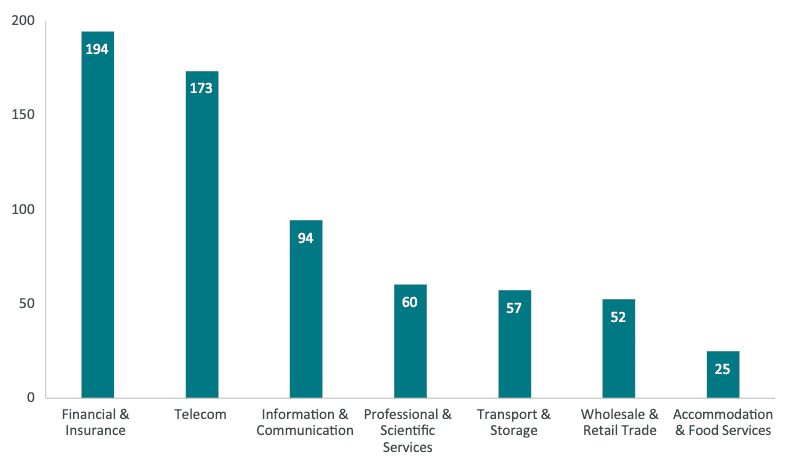 Source: ECIPE calculations based on Eurostat.
Figure 2: Labour productivity in the manufacturing of telecommunications equipment sector (thousand euros, average 2021–2023)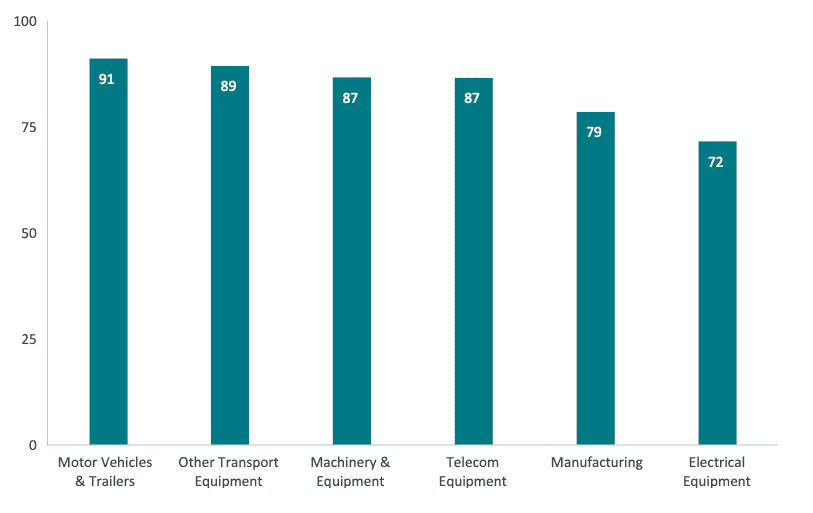 Source: ECIPE calculations based on Eurostat.
At the heart of this strong economic performance are Europe’s telecommunications firms such as Ericsson and Nokia which develop critical infrastructure and technology. However, it would be a mistake to view the EU’s telecommunications sector as a two-horse race. The broader ecosystem of European companies building telecommunications equipment and providing services includes businesses of all sizes across every single EU member state. Figure 3 illustrates the scale of this ecosystem.[5] Panel A tracks the total number of companies operating within the EU’s telecommunications sector, while Panel B adjusts this figure for population. Whether measured in absolute numbers or per capita, the network of telecommunications companies spans the entire EU, and is frequently larger in other member states than in Sweden and Finland.
Figure 3: Number of enterprises in the EU telecommunications sector (average 2021–2023)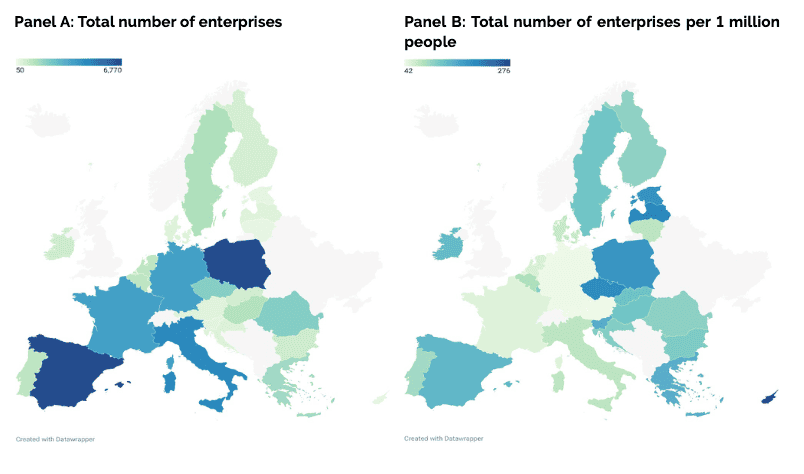 Source: ECIPE calculations based on Eurostat.
A similar pattern emerges when examining the European organisations shaping global telecommunications standards within Standard Development Organisations (SDO) such as ETSI and 3GPP. Ericsson and Nokia are key players, deploying their deep technical expertise to steer standard development. Yet they are far from alone. European participants in these SDOs, whose shared objective is to draft 6G standards, come from every EU country within ETSI[6] and from EU companies based in 18 member states in the case of 3GPP.[7]
Taken together, the evidence shows that Europe has a productive and geographically distributed base in both telecommunications services and network-equipment manufacturing whose strength does not rest solely on the two Nordic champions. This gives Europe a strong starting point for 6G. The challenge is not to create a telecommunications sector from scratch, but to ensure that Europe’s existing capabilities can expand into new services and markets. The next question is whether this base also gives Europe a stronger technological position than in other digital fields.
[1] Throughout this report, ‘telecommunications sector’ does not refer only to network operators, nor does it have a single fixed statistical definition. Its coverage follows the relevant source. For the Eurostat indicators used in this chapter, we distinguish telecommunications services, classified under NACE Rev. 2 J61, from manufacture of communication equipment, classified under C26.30; the broader enterprise measure in Figure 3 combines both activities. In Chapter 3, the R&D analysis uses the European Commission’s Joint Research Centre (JRC) Scoreboard definition, which covers fixed-line telecommunications, mobile telecommunications and telecommunications equipment, while the patent analysis uses the World Intellectual Property Organization’s (WIPO) telecommunications technology field within electrical engineering. Finally, Chapter 4 uses firm-level data to distinguish the functions that different companies perform across the 6G ecosystem, including network infrastructure, connectivity, cloud services and downstream applications. The term therefore captures both service providers and equipment producers, but its precise boundaries vary depending on the data source and analytical focus.
[2] In accordance with Eurostat, labour productivity is measured as apparent labour productivity, calculated as sectoral value added divided by the total number of persons employed in that sector.
[3] Telecommunications services sector is defined using the following code of the NACE Rev 2 industrial classification: J61 Telecommunications.
[4] The manufacturing of telecommunications equipment is defined using the following code of the NACE Rev 2 industrial classification: C26.30 Manufacture of communication equipment NACE Rev 2.
[5] The EU telecommunications sector is defined using the following codes of the NACE Rev 2 industrial classification: J61 Telecommunications and C2630 Manufacture of communication equipment. Other manufacturing sectors also contribute to the EU telecommunications sector, in addition to the broader electronic sector, such as C2611 (Manufacture of electronic components); C2611 (Manufacture of loaded electronic boards); C2731 (Manufacture of fibre optic cables); and C2732 (Manufacture of other electronic and electric wires and cables). If these sectors are included, the broader EU telecommunications ecosystem would appear even more geographically dispersed across member states.
[6] ETSI (2023). ETSI Membership. Available at: https://www.etsi.org/membership. Original data has been adjusted to avoid double-counting subsidiaries belonging to the same company. The country of origin for each company refers to the country’s parent company headquarters.
[7] ETSI (2023). 3GPP Membership. Available at: https://webapp.etsi.org/3gppmembership. Original data has been adjusted to avoid double-counting subsidiaries belonging to the same company. The country of origin for each company refers to the country’s parent company headquarters.
3. Europe’s Revealed Technological Advantage
The evidence in this chapter answers a simple question: does Europe have a stronger technological position in telecommunications than in other digital fields? The answer is yes. R&D and patent indicators show that telecommunications ranks amongst the EU’s strongest digital domains and provides a credible base for the development of 6G technology in the region.
Within the ICT industry, the telecommunications sector has historically been one of Europe’s strongest suits. Table 1 displays Europe’s Revealed Technological Advantage (RTA) (see Box 1) – a metric that evaluates the EU’s strength in telecommunications relative to its aggregate performance across all sectors. An RTA index value above 1 indicates that the EU enjoys a comparative technological advantage, while a value below 1 represents a comparative disadvantage.
Clearly, the telecommunications sector stands out as one of the ICT areas in which the EU retains a comparatively strong technological position, approaching parity. The RTA metric looks at two distinct dimensions, R&D spending and patents. The spending metric is derived from the EU Industrial R&D Investment Scoreboard published by the European Commission’s Joint Research Centre (JRC) and the patent data is compiled by the World Intellectual Property Organization (WIPO). While both indicators focus on telecommunications, they employ different analytical lenses: the JRC gathers firm-level data and classifies telecommunications as an economic sector that includes fixed-line, mobile, and equipment manufacturing,[1] whereas WIPO’s data is gathered at the country level and defines telecommunications as a technological field.[2]
On R&D spending, the RTA for telecommunications has fallen from a position of relative strength in 2014 (1.22) to below unity in 2024 (0.84), as we see in Table 1.[3] However, it remains significantly more robust than the values recorded for software and computer services and technology hardware equipment. On the patent side, the data offers a similar conclusion: telecommunications remains one of the technological domains in which the EU presents a credible global footprint.[4]
Table 1: The EU’s Revealed Technological Advantage (RTA) for the ICT sector and ICT technologies (2014 and 2024)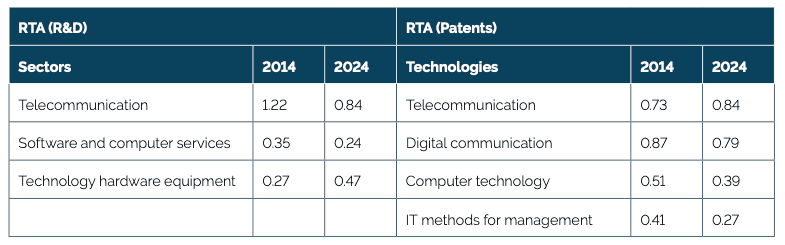 Source: ECIPE calculations based on R&D spending from the EU Industrial R&D Investment Scoreboard (JRC) and patent data compiled by the World Intellectual Property Organization (WIPO).
RTA shows Europe’s technological position relative to the world, but it does not reveal how much of the relevant innovation comes from outside the EU or whether foreign sources are concentrated in a small number of providers. The next two indicators address these questions. They measure, first, the foreign share of R&D or patent activity (i.e., the Foreign Technology Dependency Ratio (FTDR)) and, second, whether that foreign activity is spread across many sources or concentrated in a few (i.e., the Foreign Technology Concentration Index (FTCI), see Box 1 for a full description of these two indicators).
The data place Europe’s telecommunications sector in a comparatively resilient position. Figure 4 explains how that position is measured. It maps economic sectors across four distinct quadrants based on their respective FTDR and FTCI profiles:
- Quadrant I (High Dependency, High Concentration): Sectors/Technologies exhibiting external reliance coupled with a narrow base of global suppliers.
- Quadrant II (Low/Moderate Dependency, High Concentration): Sectors/Technologies where Europe retains substantial domestic capacity, yet foreign R&D spending or patent filing remains concentrated in a narrow base of external providers.
- Quadrant III (Low/Moderate Dependency, Low/Moderate Concentration): Sectors/Technologies characterised by low external reliance and highly diversified R&D spending and patent creation.
- Quadrant IV (High Dependency, Low/Moderate Concentration): Sectors/Technologies that depend heavily on foreign innovation but benefit from a diversified supplier ecosystem.
Figure 4: Conceptual framework for R&D and patent concentration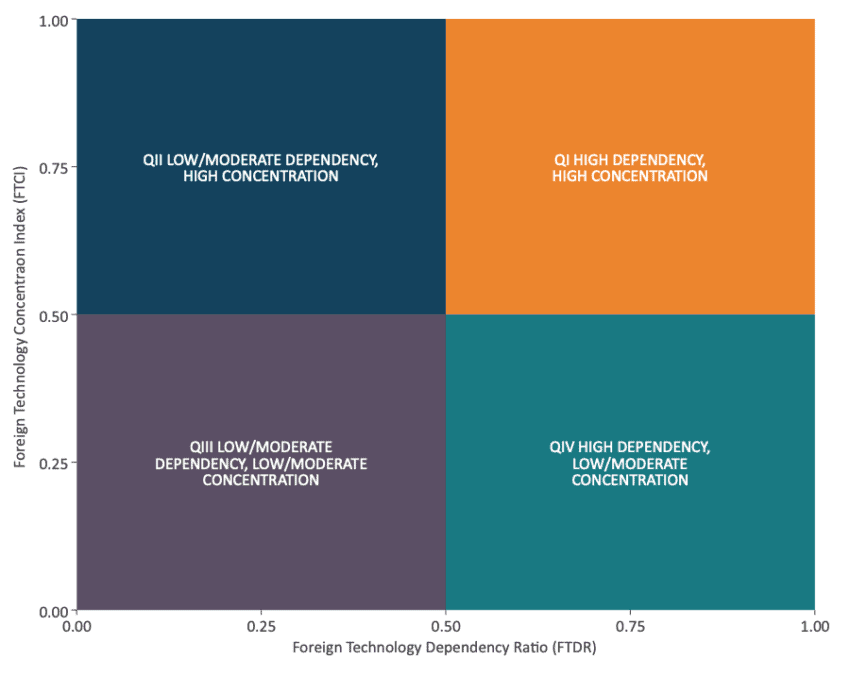 Source: ECIPE.
Figures 5 and 6 present this framework for R&D spending and patents. The horizontal axis presents the FTDR and the vertical axis presents the FTCI; both are averages for the period 2014–2024 to smooth any potential cyclicality. Each dot corresponds to one of the 32 economic sectors (in the case of R&D spending, Figure 5) or one of the 35 technologies (in the case of patents, Figure 6). To facilitate interpretation, the axes on both charts are divided at the median values of the FTDR and FTCI, delineating the four quadrants outlined previously.
Figure 5 shows that the telecommunications sector stands out as the only ICT-related sector where the EU successfully anchors itself in Quadrant III, a position characterised by below-median foreign technology dependency and diversified supply lines. Moreover, given the cross-border nature of the telecommunications sector, this strength suggests that other countries may remain dependent on European goods and services to power their own telecommunications infrastructure. By contrast, the other two core digital sectors, i.e., software and computer services and technology hardware and equipment, are located within Quadrant I.
Figure 5: Foreign Technology Dependency Ratio (FTDR) and Foreign Technology Concentration Index (FTCI) for R&D spending (average 2014–2024)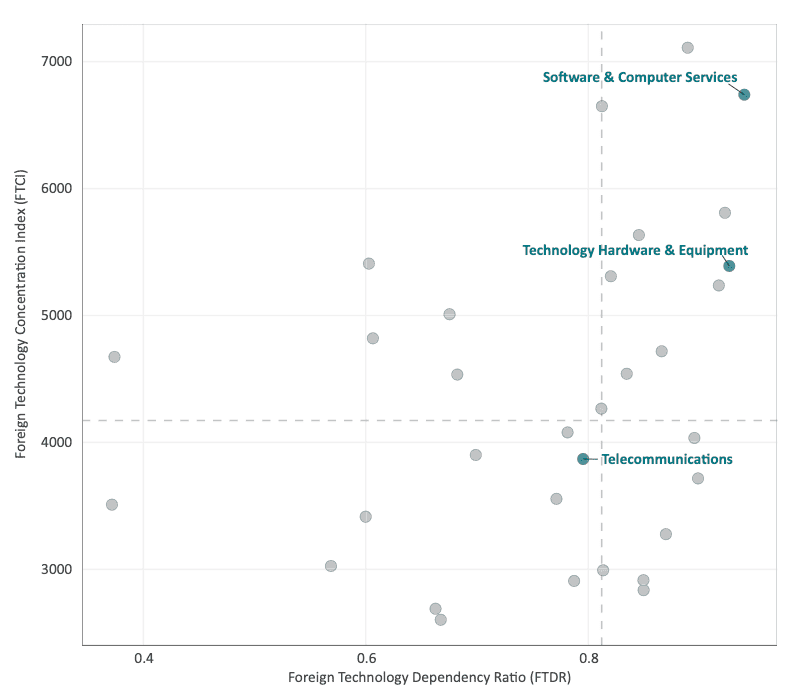 Source: ECIPE calculations based on R&D spending from the EU Industrial R&D Investment Scoreboard (JRC).
Global patent filings offer a similar conclusion. As shown in Figure 6, telecommunications sits in Quadrant IV, alongside IT methods for management (although IT methods present the highest foreign dependency ratio (FTDR)). Computer technology and digital communication, by contrast, fall within Quadrant I, where high foreign dependency coincides with high levels of market concentration.
Figure 6: Foreign Technology Dependency Ratio (FTDR) and Foreign Technology Concentration Index (FTCI) for patents (average 2014–2024)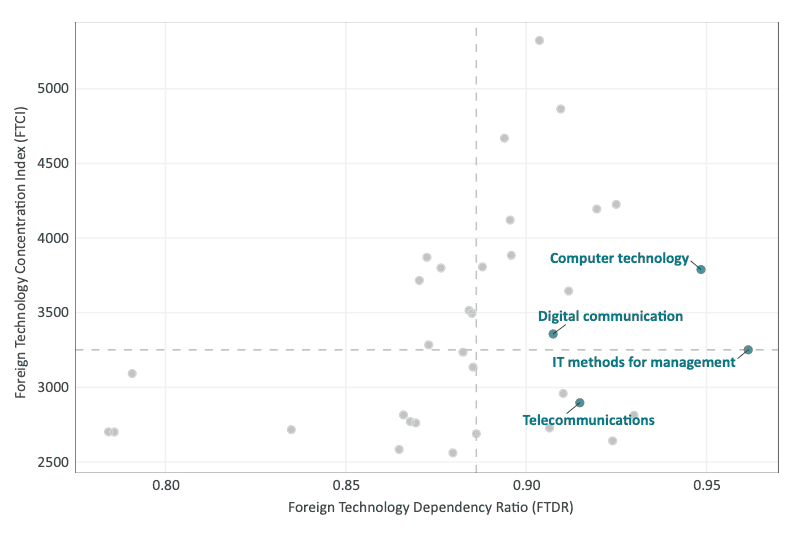 Source: ECIPE calculations based on patent data compiled by the World Intellectual Property Organization (WIPO).
The previous two figures point to a clear conclusion: the EU’s relative strength in the ICT sector is anchored in telecommunications. Europe’s telecommunications sector is not independent of foreign innovation, but it has a comparatively more balanced profile than the other digital fields examined. This conclusion is crucial not only for Europe’s telecommunications policy but also for its industrial policy. To maintain its competitiveness in ICT, the EU should not spend resources developing technology where it is already on the backfoot. For example, it should avoid subsidising data centres that run established cloud infrastructure, where the bulk of capital spending has already been undertaken by US hyperscalers. Instead, the EU’s strategic interest should focus on competing for tomorrow’s market. On that front, 6G represents a credible bet because it builds on a sector of the digital economy where European firms retain broad experience and technical know-how.
Box 1: Technological advantage and dependency metrics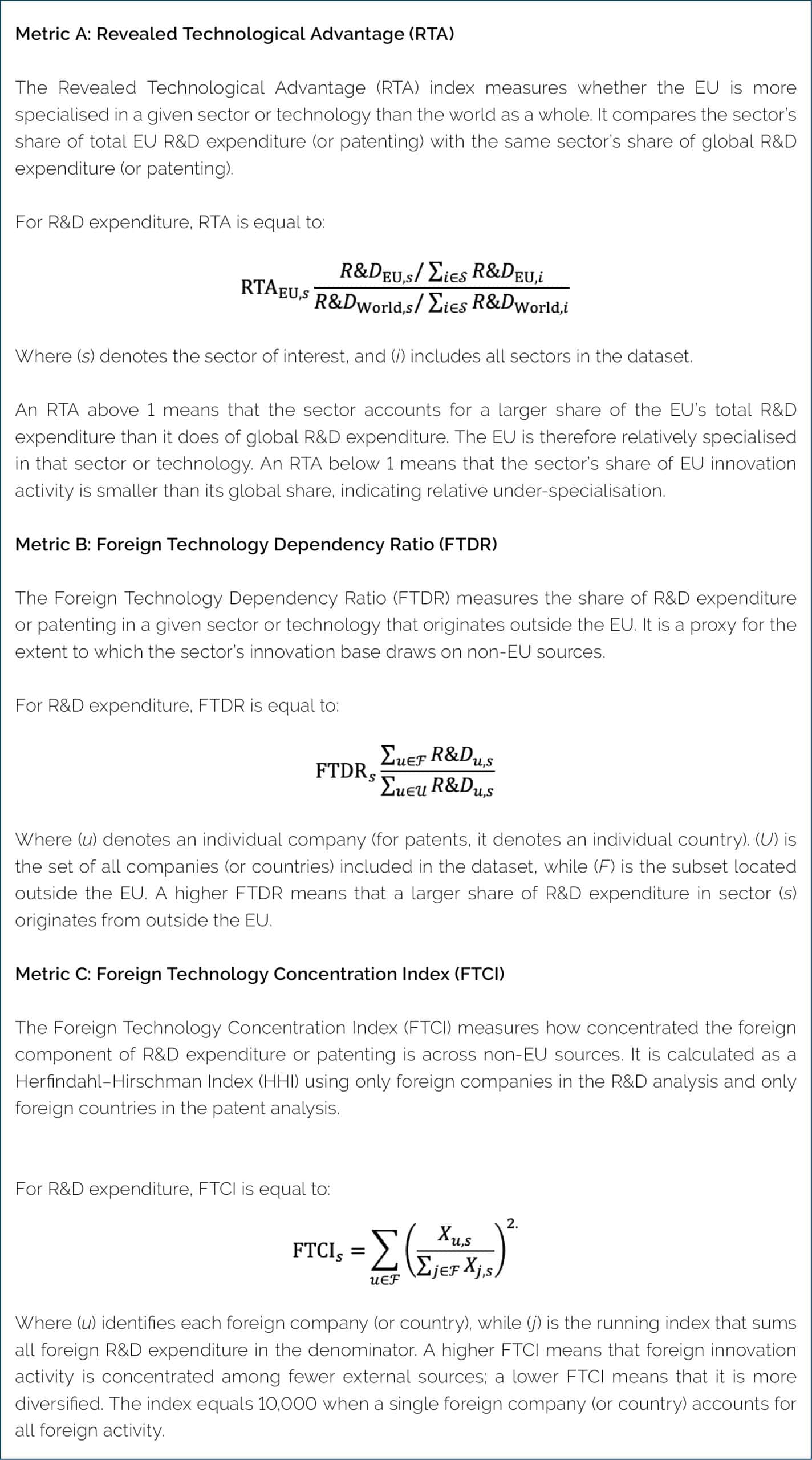 Source: ECIPE.
[1] EU Industrial R&D Investment Scoreboard (JRC) classifies companies across ICB4 codes. The telecommunications sector is defined as three sectors: fixed line telecommunications, mobile telecommunications and telecommunications equipment.
[2] The World Intellectual Property Organization (WIPO) IPC-Technology Concordance Table, which establishes 35 standard fields of technology. ‘Telecommunications’ is designated as Field 3 within the Electrical Engineering sector.
[3] Europe’s RTA for R&D spending over time reveals an erosion of competitiveness. In 2003, Europe recorded a comparative advantage, with an RTA approaching 1.7. Over the subsequent two decades, this advantage has experienced a downward trajectory. Meanwhile, the EU’s RTA for patent filings has hovered consistently below parity since 2003. It experienced a mild decline from a baseline of roughly 0.85 to a low of nearly 0.68 in 2017. By 2024, the two measures converge at around 0.84.
[4] A note of caution is that the RTA metric relies on a raw count of patent filings. It may suffer from volumetric bias, treating all patents identically regardless of their underlying commercial value, quality, or technological impact.
4. R&D Costs vs. Market Rewards
Figure 7 reveals the commercial problem at the centre of this paper: European network-infrastructure vendors invest heavily in R&D but capture the lowest margins in the 6G ecosystem. These firms design and build the physical infrastructure on which digital services depend, yet a larger share of the resulting value accrues to firms that provide cloud, platform and downstream services. 6G could change this outcome by allowing network vendors and operators to offer differentiated, higher-value services, but only if they can develop and commercialise them at scale.
Table 2 maps the main functions performed across the 6G ecosystem, from semiconductors and network infrastructure to connectivity, cloud services and connected industrial applications. The analysis focuses on Nokia and Ericsson as the two major EU-headquartered network-infrastructure vendors. The other firms provide comparison groups, allowing us to examine how R&D intensity and profitability vary across the ecosystem. The ordering of the sectors is analytical rather than sequential and does not imply that value flows in one direction through the categories.
Table 2: Sample firms by 6G ecosystem function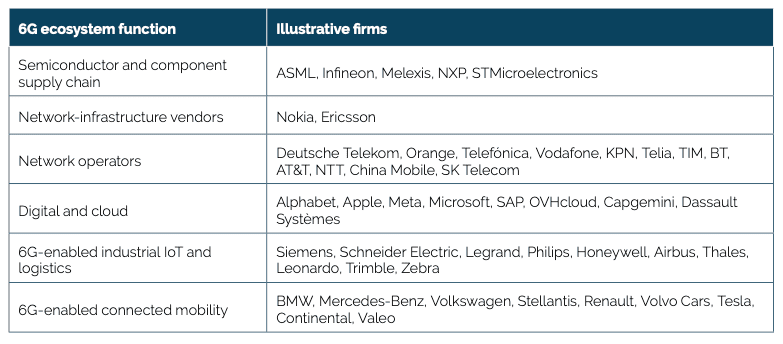 Source: ECIPE.
Figure 7 presents R&D intensity (i.e., research spending as a share of net sales) and profitability (i.e., operating margins as a share of net sales) between 2016 and 2024. Across the six ecosystem categories presented in Table 2, European network-infrastructure vendors record the highest R&D intensity but the lowest profitability. Nokia and Ericsson invest an average of 18 per cent of their net sales in R&D, yet record operating margins of just 3 per cent. At the other end of the spectrum, downstream digital and cloud platforms combine a comparable R&D intensity of 15 per cent with operating margins of 28 per cent. Network operators and 6G-enabled industrial IoT and logistics firms likewise earn substantially higher operating margins than network-infrastructure vendors, despite spending far smaller shares of sales on R&D. The contrast is less pronounced in connected mobility, but here too profitability exceeds that of network-infrastructure vendors while R&D intensity is markedly lower. Finally, companies in the semiconductor industry dedicate a substantial 13 per cent of sales to R&D, but enjoy a robust average profit margin of 18 per cent.
In part, this profitability gap is driven by fundamentally different cost structures. Hardware manufacturers and software platforms operate different business models: building and deploying physical infrastructure is inherently capital-intensive and yields thinner margins than scaling digital software subscriptions. This structural reality is precisely the problem for Europe’s digital economy: European telecommunications vendors are anchored in the physical, commoditised layer of connectivity, constrained to low margins, regardless of their R&D investments.
It is also entirely possible that the thin margins recorded by Ericsson and Nokia stem from poor corporate strategy rather than their position in the ecosystem. Price competition from Chinese vendors and hold-out by implementers in standard-essential-patent licensing negotiations may also have put pressure on margins. Yet, extending the same analysis to their Chinese peers suggests that low profitability in the industry is not necessarily a European phenomenon. For Chinese telecommunications equipment giants such as Huawei and ZTE, average profitability over the same period stood at 7 per cent. While this was higher than their European rivals, it was still far behind the returns enjoyed by downstream digital and cloud platforms.
Figure 7: R&D intensity and profitability across the telecommunications ecosystem (average 2016–2024)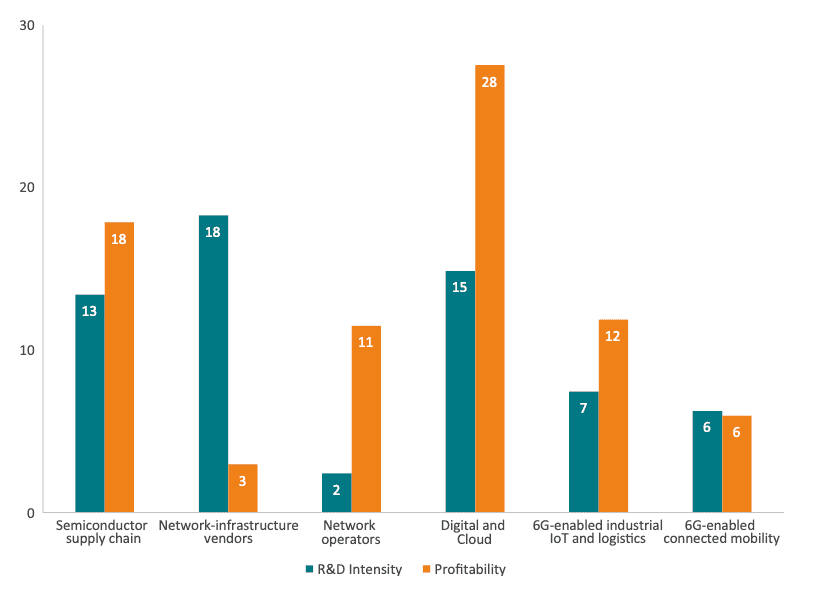 Source: ECIPE calculations based on the EU Industrial R&D Investment Scoreboard (JRC).
6G could help European telecommunications companies break free from the path of high R&D spending and low profitability. Hardware vendors have been constrained because basic connectivity was easily commoditised. 6G changes this paradigm because it introduces programmable, differentiated network capabilities, such as network slicing, distributed edge computing, and quality-tiered APIs (software interfaces that let applications request a defined level of network performance). These are software-driven services that cannot be commoditised in the same way as raw bandwidth.
This gives the EU economy a potential advantage since its telecommunications sector is uniquely positioned to capture this new value. While US digital and cloud giants currently dominate centralised data processing, 6G requires computing power to be pushed to the “edge” of the network, integrating deeply with the physical radio infrastructure itself. Because European equipment makers and operators actually build and manage this physical infrastructure, they possess an inherent structural advantage over pure cloud companies in coordinating services that process data and run applications close to users and connected devices. However, this transition is not guaranteed. Europe’s commercial opportunity with 6G depends heavily on whether the EU regulatory framework enables equipment makers to seize this opportunity and allows telecommunications operators to profit from higher-value network services.
5. The EU Regulatory Framework for Telecommunications
5.1 Sectoral Regulation
As previously explained, 6G will allow operators to offer services with higher levels of speed and reliability, and lower latency to meet the needs of industrial users and other customers. However, if operators cannot charge for better and differentiated performance, they have weaker incentives to invest in the network capabilities required to provide it. This effect runs directly through the ecosystem: operators are the principal buyers of advanced network equipment, so weaker investment incentives reduce the demand and returns on which telecommunications equipment vendors depend.
The EU’s telecommunications framework, built on long-standing interconnection mandates and non-discrimination principles, has served the European economy well by dismantling state-backed monopolies and fostering a competitive market that delivered affordable, high-quality services to consumers. Yet some features of the current rulebook make it harder for operators to develop, test and earn returns from the differentiated services on which the 6G business case will depend.
Table 3 compares this regulatory framework with those of China and the US, using five indicators drawn from the OECD’s Digital Services Trade Restrictiveness Index (DSTRI).[1] These indicators show the extent to which regulation limits operators’ freedom to deliver and price network services. This matters for 6G because differentiated network performance, edge computing and integrated software services will require operators to develop new commercial offerings rather than sell generic connectivity alone.
The EU’s average score is 0.85, compared with 0.6 for China and 0.2 for the US. The figures reflect different regulatory approaches. The EU relies more heavily on ex-ante rules designed to promote access and service competition. The US places greater weight on the commercial returns of network builders, while China applies interconnection and pricing controls but does not impose vertical separation or net neutrality requirements on its dominant operators.[2]
For the 6G business case, the most important differences concern net neutrality and vertical separation. Vertical separation can limit operators’ ability to combine connectivity, edge computing and software in a single commercial offering. Net neutrality rules can limit their ability to charge for differentiated performance. These restrictions do not formally prohibit all specialised telecommunications services, but they make the commercial conditions for offering such services less certain.
Regulatory variation across member states adds a further obstacle. Although the European Electronic Communications Code (EECC)[3] establishes a common framework, national implementation still produces different rules on interconnection, reference offers, vertical separation and network optimisation. An operator seeking to develop a pan-European 6G service will need to adapt the same commercial model to several regulatory environments. This increases compliance costs and weakens the scale economies that should make new network services more viable. As mentioned previously, the effect extends beyond operators. Lower network investment reduces demand for advanced equipment and makes it harder for European vendors to recover the R&D costs of developing the technologies that 6G will require.
Table 3: Mobile telecommunications infrastructure regulation restrictiveness (2025)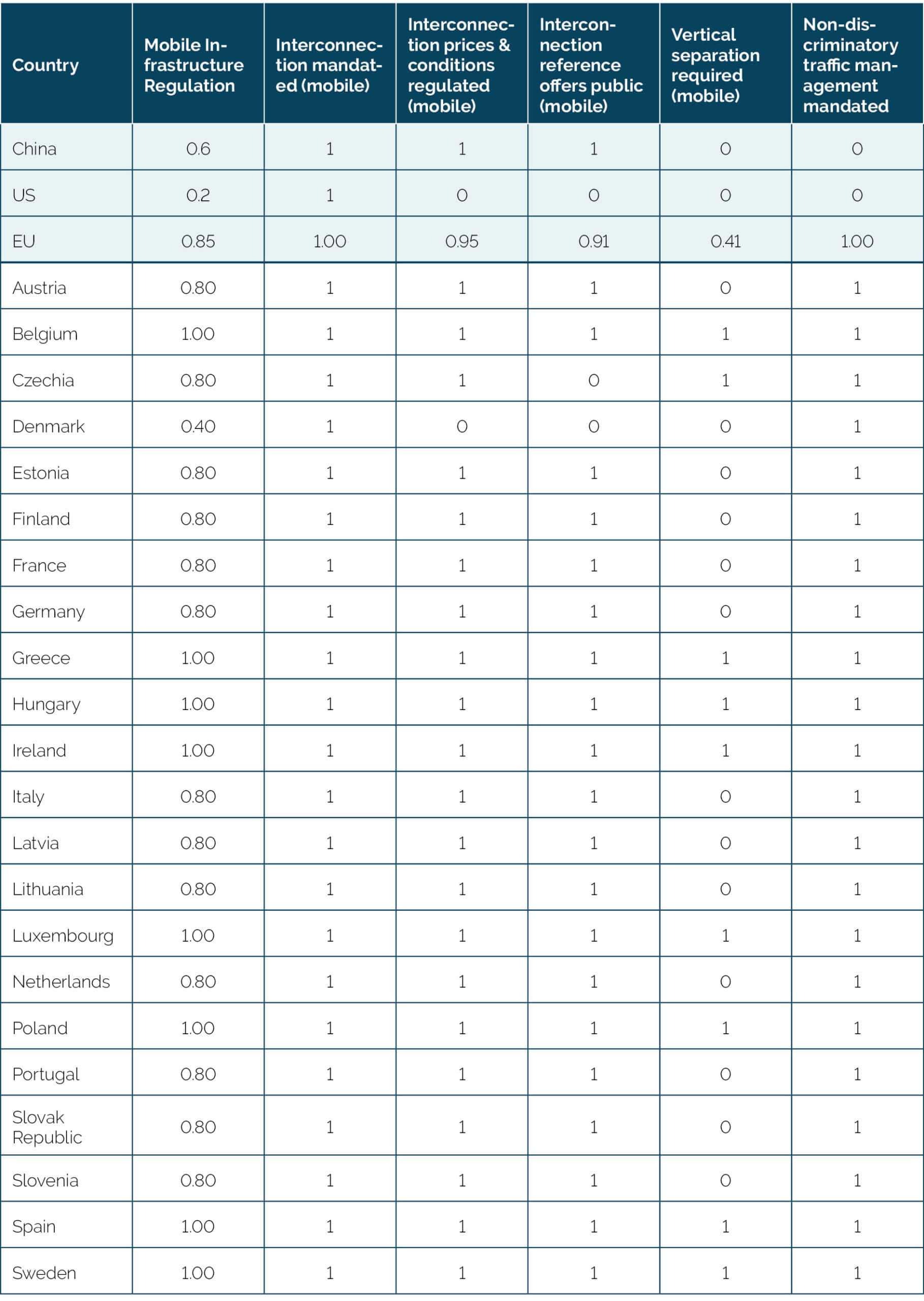 Source: ECIPE calculations based on sub-indicators of the OECD Digital Services Trade Restrictiveness Index (DSTRI). “EU” represents the unweighted average of the 22 member states included in the database. “Mobile Infrastructure Regulation” is calculated as the average of the five underlying indicators. Data refer to the year 2025, where a value of 1 denotes a binary “yes” (presence of restriction) and 0 denotes “no”.
5.2 Cross-Cutting Regulation
6G services will combine network infrastructure, cloud and edge computing, data processing, software and connected devices. An industrial 6G application may therefore involve a network operator, an equipment vendor, a cloud or edge provider, a manufacturer and a provider of connected hardware. This creates a different regulatory challenge from earlier mobile generations, because a single service can fall within several legal frameworks at once.
Each of the EU instruments examined in this section pursues a legitimate objective, including cybersecurity, consumer choice and fair competition. The issue is not that these objectives should be abandoned. It is that the combined implementation of these rules can impose design, documentation, data-governance and testing costs before firms know which 6G services will be commercially viable. This can raise the cost and uncertainty of experimentation at a point when Europe needs firms to test new technical architectures and business models.
The discussion that follows considers the commercial effect of these rules at three points: integrated network infrastructure, data and distributed computing, and connected devices and endpoint hardware.
Integrated Network Infrastructure Layer
At the network layer, the commercial question is whether operators can offer and charge for differentiated performance. Network slicing, guaranteed-latency services and priority connectivity can be delivered only if operators have a sufficiently clear and predictable regulatory route to provide them. The Open Internet Regulation[4] and the proposed Digital Networks Act (DNA)[5] define the conditions under which these services can be offered on public networks.
Article 3(3) of the Open Internet Regulation requires equal treatment of all internet access traffic, explicitly limiting blocking, throttling (the intentional slowing down of internet speeds for specific websites or services), prioritisation, or commercial discrimination among data streams except under narrowly defined legal exemptions. True, Article 3(5) permits operators to offer optimised services other than general internet access, but only where sufficient baseline network capacity is continuously maintained so that the general quality of public internet access is not impaired.
This creates a legal bottleneck at the control layer. Network slicing, guaranteed-latency services, priority connectivity, and quality-of-service APIs may be lawful where structured as specialised services, private-network services, or enterprise offerings. However, the commercial monetisation of differentiated network capabilities on public networks remains legally conditional and dependent on regulatory interpretation. The proposed DNA preserves this tension rather than resolving it. Articles 93 and 94 of the DNA largely retain the existing distinction between internet access services and optimised services, while Article 93(6) would empower the European Commission to adopt Implementing Acts specifying the conditions under which optimised services may be offered. Article 94 adds supervisory obligations around network capacity, traffic management, and quality-of-service parameters, which may eventually clarify the framework for network slicing and industrial low-latency services. Until that framework is settled, operators cannot reliably forecast the long-term returns on capital investment in programmable network capabilities. The result is not a formal prohibition on 6G optimisation, but a reduced zone of commercially safe experimentation for the public-network services through which 6G investment is supposed to be monetised.
Data and Distributed Computing Layer
Many of the higher-value services associated with 6G will depend on the ability to combine connectivity with data, cloud and edge computing. A manufacturer, logistics provider or mobility firm may use network data to monitor assets, automate processes or provide real-time services. The Data Act[6] matters because it determines how that data can be shared, combined and transferred.
Articles 3 and 4 of the Data Act require connected products and related services to make specified product and related-service data available to users in a structured and machine-readable format. For firms, this can mean building data interfaces, permissions systems, metadata structures and governance processes into products and services. In a 6G context, these are not minor technical adjustments: they may shape the design of industrial assets, vehicles, robots, wearables and smart-city systems before the relevant data-driven services have reached commercial scale.
Chapter VI of the Data Act seeks to reduce customer lock-in in cloud computing by requiring providers to remove switching obstacles, support data portability and allow customers to change provider without prohibitive costs. These rules can also apply to edge computing services. For 6G providers seeking to bundle connectivity with edge analytics, private-network management or network-as-a-service, this may require them to design for portability before they know whether customers will value an integrated service. The concern is not that switching should be impossible; it is that rules designed for established cloud markets may fragment the service architectures through which emerging 6G providers hope to combine connectivity, computing and data analytics.
Device and Endpoint Layer
6G will connect a far wider and more diverse range of endpoints than earlier mobile generations. Industrial sensors, self-driving vehicles, XR headsets, health wearables and connected machinery will all become part of the network. This makes cybersecurity and conformity assessment commercially relevant because firms must design, test and document compliance before these devices can be deployed at scale.
The Radio Equipment Directive (RED)[7] establishes the immediate conformity requirement for specified categories of connected radio devices. Article 3(3)(d) mandates the protection of networks and their resources; Article 3(3)(e) requires personal data and privacy safeguards for devices processing personal, traffic, or location data; and Article 3(3)(f) targets equipment handling financial transactions or transfers of monetary value. The significant point for 6G is not that every connected device is automatically covered, but that many industrial endpoints will need to demonstrate conformity before large-scale deployment. This adds testing, certification and design requirements at an early stage of market development.
The Cyber Resilience Act (CRA)[8] extends this logic from certain radio devices to a horizontal cybersecurity regime for products with digital elements.[9] Crucially, the CRA’s reach extends to the programmable core and cloud-edge layers of the 6G stack, making it relevant for precisely the integration layer where 6G is expected to generate most of its commercial value. Under Article 13, manufacturers must conduct and document exhaustive risk assessments, embed security throughout the design and development phases, exercise due diligence over third-party and open-source software, and establish vulnerability-handling processes. Article 14 complements these obligations by mandating the reporting of actively exploited vulnerabilities, while Annex VII demands comprehensive technical documentation covering architecture, security testing, and software bills of materials. Again, the business consequences are clear: firms developing the integrated software, network and edge components of 6G must build compliance, documentation and supplier oversight into their products before the market has established which technical configurations and services will succeed.
Network and Information Security Directive (NIS2)[10] completes the regulatory picture by regulating the entities that will operate the 6G ecosystem, rather than only the products within it. Its obligations cover public electronic communications networks and services, as well as digital infrastructure providers such as cloud computing services, data centres, content delivery networks and managed service and security providers. This is especially relevant to 6G because the network will increasingly integrate these actors into a single service architecture. NIS2 Article 21 requires entities to adopt comprehensive cybersecurity risk-management measures, including supply-chain security, incident handling, vulnerability management, and access controls. Article 22 allows Union-level security risk assessments of critical ICT supply chains – including assessments of provider dependency and third-country influence – while Article 23 adds staged incident-reporting requirements.
The cumulative effect of these rules will spread throughout the 6G ecosystem. An operator or industrial user considering a new service may face uncertainty over network optimisation, data access, cloud switching, product conformity, cybersecurity and supplier risk at the same time. This increases the cost and uncertainty of adoption, weakening the incentive to invest in and deploy advanced networks. Slower adoption then reduces demand for equipment and weakens the case for vendors to invest in the R&D needed to develop and commercialise 6G. The next section examines this dynamic through Europe’s record on 5G standalone and private networks.
5.3 Standalone and Private 5G Networks: A Test of 6G Readiness
There is not yet a commercial 6G market against which Europe’s progress can be measured directly. However, 5G provides the clearest available test of whether Europe is developing the capabilities that 6G will require. In particular, 5G standalone and private networks show whether operators can deploy, operate and commercialise programmable network capabilities, rather than merely provide conventional mobile coverage.
The regulatory framework described above is an important factor shaping Europe’s ability to offer these services. The net neutrality principle, which features across the EU framework, is especially relevant because it affects the commercial case for the differentiated services that cloud-native networks can provide. Guaranteed-latency slices for smart factories, priority bandwidth for emergency services and quality-tiered APIs all depend on operators being able to offer distinct levels of performance. Existing net neutrality rules do not explicitly prohibit these configurations, but they can create legal and commercial uncertainty around their deployment and monetisation.
5G standalone is the first of these readiness indicators. Unlike early iterations of 5G, it relies on a dedicated 5G Core – a cloud- and software-driven architecture that manages data traffic rather than simply increasing network speeds.[11] Table 4 reveals a clear gap in Europe’s readiness to operate programmable network cores at scale. In 2025, 5G standalone accounted for roughly 81 per cent of China’s 5G samples and around 32 per cent in the US; by contrast, not a single EU member state reached double-digit availability. Without material standalone traffic, European operators risk accumulating less operational expertise, weaker enterprise demand and fewer tested business models for cloud-based cores that can customise performance, allocate capacity and slice services without changing physical hardware. These are precisely the capabilities that 6G will require at a greater scale.
Private 5G networks provide a second, complementary test of 6G readiness. Whereas 5G standalone concerns network architecture, private 5G concerns deployment, ownership and control. These networks offer one of the closest available market tests for the industrial services that 6G is expected to support, including low-latency automation, secure campus connectivity, machine communications and locally tailored network performance. On this front, the problem is that demand has translated into uneven deployment. As Table 4 shows, the EU had 747 recorded 5G private networks, but Germany alone accounted for 500 of them.[12] This means that roughly two-thirds of the EU total was concentrated in a single member state, leaving only 247 deployments across the other 26 countries.
Table 4: 5G Standalone and 5G private networks across China, the US and the EU (2025)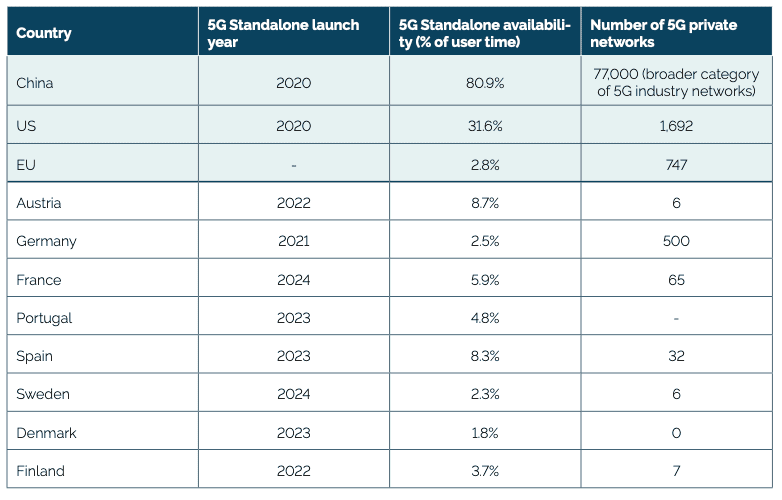 Source: European 5G Observatory. Note: Chinese data encompass a broader definition of 5G industrial networks. While private 5G networks serve as an approximate proxy for 6G capabilities and national tracking methodologies vary, the cross-border structural divergence in deployment trajectories remains robust and statistically significant.
The regulatory framework in Sections 5.1 and 5.2 helps explain Europe’s slower rollout of 5G standalone and private networks. Regulation shapes the commercial environment in which operators and industrial users decide whether to invest in and adopt advanced network services. By prioritising open access, consumer protection, price discipline, cybersecurity, data portability and limits on traffic differentiation, the EU has constrained market power and strengthened user rights. Yet the same framework can narrow the commercial space in which firms test, bundle and earn returns from advanced network capabilities. This trade-off will become more significant as the industry moves towards 6G. If operators and enterprises cannot confidently develop differentiated quality-of-service offerings, industrial network slices, cloud-edge services and secure enterprise applications, they will have weaker incentives to buy telecommunications equipment and build the operational experience and commercial ecosystems that 6G will require.
[1] These indicators are: mandated interconnection, regulated interconnection prices, public reference offers, vertical separation requirements and net neutrality mandates, which are consolidated into a single benchmark indicator, ‘Mobile Infrastructure Regulation’. This methodology follows the work of Koski, H., & Rouvinen, P. (2025). The global 5G/6G race: Regulation, markets, and innovation dynamics (Etla Report No. 170). ETLA Economic Research. https://pub.etla.fi/ETLA-Raportit-Reports-170.pdf
[2] Within the EU average of 0.85, there is variation across EU member states. Denmark scores 0.40, closer to the US than to the EU average, owing to the absence of price regulation and public reference offer requirements in its mobile interconnection regime. At the other end, Belgium, Greece, Hungary, Ireland, Luxembourg, Poland, Spain, and Sweden all score one, imposing the full complement of restrictions across all five sub-indicators.
[3] Directive (EU) 2018/1972 of the European Parliament and of the Council of 11 December 2018 establishing the European Electronic Communications Code (Recast), OJ L 321, 17 December 2018.
[4] Regulation (EU) 2015/2120 of the European Parliament and of the Council of 25 November 2015 laying down measures concerning open internet access and retail charges for regulated intra-EU communications and amending Directive 2002/22/EC and Regulation (EU) No 531/2012, OJ L 310, 26 November 2015.
[5] Proposal for a Regulation of the European Parliament and of the Council on digital networks, amending Regulation (EU) 2015/2120, Directive 2002/58/EC and Decision No 676/2002/EC and repealing Regulation (EU) 2018/1971, Directive (EU) 2018/1972 and Decision No 243/2012/EU (Digital Networks Act), COM(2026) 16 final, 21 January 2026.
[6] Regulation (EU) 2023/2854 of the European Parliament and of the Council of 13 December 2023 on harmonised rules on fair access to and use of data and amending Regulation (EU) 2017/2394 and Directive (EU) 2020/1828 (Data Act), OJ L, 2023/2854, 22 December 2023.
[7] Directive 2014/53/EU of the European Parliament and of the Council of 16 April 2014 on the harmonisation of the laws of the Member States relating to the making available on the market of radio equipment and repealing Directive 1999/5/EC, OJ L 153, 22 May 2014, pp. 62–106; Commission Delegated Regulation (EU) 2022/30 of 29 October 2021 supplementing Directive 2014/53/EU, OJ L 7, 12 January 2022, pp. 6–10; Commission Delegated Regulation (EU) 2023/2444 of 20 July 2023 amending Delegated Regulation (EU) 2022/30 as regards the date of application of the essential requirements for radio equipment and correcting that Regulation, OJ L, 27 October 2023.
[8] Regulation (EU) 2024/2847 of the European Parliament and of the Council of 23 October 2024 on horizontal cybersecurity requirements for products with digital elements and amending Regulations (EU) No 168/2013 and (EU) 2019/1020 and Directive (EU) 2020/1828 (Cyber Resilience Act), OJ L, 2024/2847, 20 November 2024.
[9] Delegated Regulation (EU) 2022/30 will be repealed with effect from 11 December 2027, when the Cyber Resilience Act becomes fully applicable.
[10] Directive (EU) 2022/2555 of the European Parliament and of the Council of 14 December 2022 on measures for a high common level of cybersecurity across the Union, amending Regulation (EU) No 910/2014 and Directive (EU) 2018/1972, and repealing Directive (EU) 2016/1148 (NIS 2 Directive), OJ L 333, 27 December 2022.
[11] Ericsson. (n.d.). 5G standalone (5G SA). Available at: https://www.ericsson.com/en/5g/5g-sa and Andrade, M., & Wickboldt, J. A. (2025). A study on 5G network slice isolation based on native cloud and edge computing tools. Journal of Network and Systems Management, 33, Article 90. https://doi.org/10.1007/s10922-025-09958-5
[12] Germany’s outlier position is not accidental. It reflects a dedicated spectrum pathway for local industrial users, allowing enterprises to apply for local assignments in the 3.7–3.8 GHz band for business, commercial, and industrial premises. Digital Regulation Platform. (2025, April 20). Spectrum licensing: Local and private networks. Available at: https://digitalregulation.org/spectrum-licensing-local-and-private-networks/
6. Policy Recommendations
The findings of this paper point to a clear policy conclusion. Europe has technological assets in telecommunications, but its regulatory and commercial environment does not yet provide a credible route for firms to deploy and profit from the next generation of 6G telecommunications services. The recommendations below focus on creating the conditions for European firms to invest in, test and commercialise higher-value 6G services.
- Reframe telecommunications regulation to enable viable 6G business models. The EU’s telecommunications framework was built to open markets, constrain legacy monopoly power and protect consumers. Those goals remain important, but they are no longer sufficient as a guide for 6G. The next network cycle will be less about general connectivity and more about differentiated performance, industrial services, edge computing and software-defined network capabilities. The EU should therefore review telecommunications regulation through a 6G-readiness lens: rules should be retained where they clearly protect competition and users, but revised where they prevent operators and equipment providers from building viable business models for advanced network services. This also requires greater consistency across member states. A pan-European 6G business case cannot emerge if operators must adapt the same service architecture to different national rules on interconnection, reference offers, vertical separation and network optimisation.
- Reduce regulatory overlap to lower costs across the 6G stack. The proposed Digital Networks Act, the Data Act, the Radio Equipment Directive’s cybersecurity provisions, the Cyber Resilience Act and NIS2 each interact across the same operators, equipment makers and service architectures. Their combined effect is the layering of overlapping conformity assessments, reporting obligations, switching mandates, data-portability requirements and supplier-risk evaluations on the very firms expected to lead 6G commercialisation. In a market such as 6G, these ex-ante obligations may entrench current assumptions about product design, interoperability, data governance and service differentiation before 6G’s technical architecture and commercial models are developed. Before any further obligations are added, the EU should conduct a coordinated impact assessment of the cumulative regulatory burden on the 6G value chain. This assessment should identify overlaps, sequence implementation deadlines and consolidate obligations wherever possible, so that firms are not forced to absorb simultaneous compliance costs during the critical pre-commercial phase of 6G development.
- Scale 5G standalone and private networks as the bridge to 6G. Europe’s weak 5G standalone availability and uneven private-network deployment are not just 5G problems; they are early warning signs for 6G. Operators and firms need practical experience with programmable cores, local industrial connectivity, network slicing and enterprise service models before 6G arrives. The EU and member states should therefore promote clearer pathways for 5G standalone migration, local industrial spectrum access and private-network deployment. Germany’s stronger private-network performance suggests that targeted spectrum and licensing frameworks can help translate industrial demand into actual deployments. These networks should be treated as practical testbeds for the operational, commercial and regulatory capabilities that 6G will require.
- Concentrate public support to build a competitive 6G ecosystem. The evidence in this paper suggests that telecommunications is one of the digital domains where Europe retains a comparative technological advantage. Public funding and policy attention should reinforce the parts of the 6G ecosystem where European firms can still shape competition: telecommunications equipment, network software, programmable cores, edge-enabled industrial services and standards development. This should include support for the R&D, prototyping and validation work that allows European firms to make credible contributions to 3GPP and other standard-setting bodies. It should also ensure that EU policy on standard-essential patents (SEPs) enables European innovators to obtain fair and timely compensation when others use their technology both within the EU and in international markets.