
Summary
DOWNLOAD PDFQuantum technologies are increasingly becoming part of technology sovereignty debates, as governments seek greater control over critical capabilities linked to national security, economic competitiveness, and strategic autonomy. However, the emerging policy debate, in Europe and elsewhere, risks framing sovereignty too narrowly – as a means of achieving self-sufficiency across the entire quantum computing stack. Such an approach is unlikely to deliver the outcomes policymakers seek. Instead, Europe should pursue a model of managed interdependence: reserving direct control for the narrow set of dependencies that pose genuine and severe strategic risks, while strengthening the international connections, partnerships, and capabilities that allow European ecosystems to innovate, commercialise, and benefit from quantum computing.
The sector is particularly important because of its potential applications across areas including drug discovery, materials science, logistics, finance, cryptography, energy optimisation and defence-related use cases. At the same time, quantum computing is expected to create economic value primarily through adoption and diffusion across the wider economy rather than through direct ownership of quantum hardware by most firms. The central economic objective is therefore not simply to build European quantum companies, but to ensure that European industries can access, adopt, and benefit from quantum capabilities.
This paper shows that quantum is particularly ill-suited to a self-sufficiency model because its development depends on international collaboration, specialised expertise, and globally distributed capabilities. Research in quantum information science is more internationally collaborative than other strategic technologies, including AI and cloud computing. Moreover, this openness is not a temporary feature of an immature technology but a structural characteristic of the field.
Quantum capabilities accumulate within specialised clusters that depend on global networks rather than within isolated national ecosystems. This has important implications for Europe’s policy approach. The relevant unit of competition in quantum is increasingly the cluster. Leading quantum ecosystems succeed because they are connected nodes in a global innovation network, combining scientific excellence, industrial capability, talent, and access to complementary expertise. Policies that prioritise reducing external dependencies at all costs risk weakening Europe’s strongest assets by disconnecting them from the networks that enable progress.
Openness is not only a requirement for building quantum capabilities; it is also central to creating and capturing economic value from them. The ecosystems best positioned to benefit from quantum technologies are not those that are the most self-contained, but those that combine strong international connectedness with commercial capability and absorptive capacity. International partnerships provide access to specialised expertise, industrial partners, markets, and complementary capabilities that enable technologies to move from research into practical applications. The most successful ecosystems therefore combine scientific strength with the ability to commercialise, adopt, and scale quantum technologies across the wider economy. For Europe, the objective should be to strengthen its position within global quantum networks and improve its capacity to capture value from them, rather than attempt to recreate every element of the quantum ecosystem domestically.
A more effective sovereignty strategy requires distinguishing between different layers of the quantum computing stack. Dependencies and risks are not evenly distributed. At the software, execution and integration layer, priorities should focus on openness, interoperability, portability, and avoiding vendor lock-in. At the control, calibration and enabling systems layer, the objective should be operational resilience: ensuring that systems can be maintained, adapted, and operated without dependence on a single supplier. At the layer of physical qubits, processors and fabrication, where some dependencies are more concentrated and difficult to substitute, the priority is supply security: building on European strengths and securing complementary inputs through trusted partners and diversified supply. Concentration alone does not justify direct control, which should be reserved for the narrow set of cases in which a dependency runs through a potential adversary, cannot be substituted in time or at acceptable cost, and would cause severe and rapid harm if denied.
The paper identifies a fundamental distinction between controlling inputs and securing outcomes. Sovereignty debates often focus on ownership of specific technologies, manufacturing capacity, or components of the quantum stack. Yet the outcomes that matter for Europe are broader: maintaining access to quantum capabilities, developing competitive ecosystems, protecting critical functions, and ensuring that European firms can capture value from adoption. These goals do not always require domestic ownership of every element of the technology stack.
The appropriate policy response is therefore to replace an ambition of technological independence with a model of managed interdependence. This approach does not seek to eliminate external dependencies, which would be unrealistic and potentially counterproductive. Instead, it aims to govern dependencies strategically by strengthening areas where Europe has competitive advantages, reserving control for the few genuinely sensitive dependencies that meet a demanding threshold, and building trusted partnerships for capabilities that are globally distributed. Managed interdependence allows Europe to remain integrated into global quantum innovation networks while improving resilience, influence, and strategic choice.
For European policymakers, the implication is clear: the objective should not be to reproduce the entire quantum ecosystem within national or European borders. It should ensure that Europe remains an indispensable participant in the global quantum network, protects critical capabilities, develops world-class clusters, and enables widespread industrial adoption. Ultimately, a sovereignty strategy focused on capability, access, resilience, and influence is more likely to deliver outcomes than one centred on self-sufficiency.
This study was made possible with support from Microsoft.
1. Introduction
There is a growing shift towards the pursuit of technological sovereignty, and this trend is increasingly visible in quantum technologies.[1] In broad terms, quantum technology sovereignty concerns the degree of control states seek to exercise over the development, access, and use of quantum capabilities – especially where these intersect with national security, economic competitiveness, and strategic autonomy. Most often, these policies are expressed as a drive to reduce external dependencies across the quantum stack.
Sovereignty is ultimately about capacity: the ability to make independent choices and access the best available technologies. Measured against this standard, many policies pursued in the name of sovereignty fall short. This risk is becoming increasingly apparent in the EU’s approach to quantum technologies. By equating sovereignty with self-sufficiency across the entire technology stack, the EU risks overlooking both what meaningful control requires in a deeply interdependent ecosystem and where that control is actually at stake.
In this paper, we focus on quantum computing, whose significance is at once computational, strategic, and economic. According to the ECIPE Quantum Database, quantum computing companies account for a disproportionate share of investment and market value across the quantum technologies sector – which also includes quantum communication and sensing. Although they represent less than half of all quantum technology companies in the database (with 319 out of over 680 firms, or around 47 per cent), they account for over 75 per cent of both the total funding raised across the sector and the market capitalisation of publicly listed quantum companies.
Quantum computing is also expected to have cross-sectoral applications. Its prospective applications span drug discovery, materials science, chemical catalyst design, financial modelling, cryptography and energy-grid optimisation, among others. Many of these uses are also inherently dual-use: the same advances in simulation and optimisation that serve civilian ends also support defence logistics, military systems, and national-security objectives. Nor is it a self-contained field. Although its technology stack is not identical to those of quantum communication and sensing, the three draw on overlapping scientific foundations, hardware, control systems, and engineering capabilities. Therefore, capability built in one strengthens the others. Quantum computing is thus both a strategic technology in its own right and part of a wider quantum technological base.
Quantum computing is expected to be a user-driven sector. The value created downstream by applications enabled by quantum capabilities is expected to exceed the revenues of the quantum industry itself – even by an order of magnitude.[2] The gains are expected to be concentrated in the computationally intensive sectors that already anchor Europe’s industrial base. The economics of quantum computing is based on diffusion rather than widespread direct use: value is generated through the technology’s outputs – improved materials, new products and optimised processes. These outputs will reach firms that may never operate or directly access a quantum computer themselves. Direct access to quantum computation is instead concentrated among a comparatively narrow set of specialised, high-value, and often security-relevant users. A capability whose broad economic value is realised primarily through its outputs rather than through universal direct use does not call for economy-wide provisioning, and treating it as though it overstates the scope of the sovereignty problem from the outset.
This distinction matters because the sovereignty debate currently neglects it. Current policy instead appears to be informed by a perceived failure to innovate and commercialise technologies in previous waves of technology change. Quantum, therefore, represents a fresh window to deploy the region’s scientific strengths rather than lose them once again. However, this is a caricature of the benefits of technological change – and it sits awkwardly with the realities of quantum technology development and how this field will be commercialised. A policy framework that works with models of self-sufficiency is almost certain to hamstring Europe’s ability to develop and capitalise on its quantum advantages.
It is precisely for this reason that sovereignty becomes difficult to translate into policy, because it can mean different things at once. This paper identifies seven distinct aspects of what sovereignty can mean: ownership, jurisdictional control, supply security, freedom from coercion, operational self-sufficiency, strategic optionality and resilience. The objectives underlying these aspects do not always point in the same direction. Measures intended to strengthen one can undermine another. Greater domestic control can replace a diversified foreign dependence with a concentrated domestic one, trading a manageable risk for a more fragile one. Underlying all this, however, is a fundamental distinction between controlling inputs and securing outcomes.
Sovereignty debates often focus on inputs: owning hardware, fabrication capacity, or particular parts of the technology stack. But what ultimately matters is what Europe can do with quantum technology: whether it can access and use quantum computing, develop capabilities in Europe, and benefit from their adoption. These objectives are related, but they are not the same. Policy has to be clear about what Europe is trying to protect, where the relevant dependency lies in the quantum stack, and what makes that dependency a problem. The policy response will consequently vary across the stack, and also ultimately depend on determining and justifying the degree of control warranted in each case.
In the first place, quantum research depends on cross-border collaboration more than any other strategic technology examined here, including AI and cloud. Moreover, the dependence is structural, and the capability it generates accumulates not within national borders but in a small number of specialised clusters, several of them European, whose developmental capacity depends on their position within a distributed global network. A self-sufficiency agenda would disrupt the connections through which Europe’s strongest clusters reach the frontier and through which European firms adopt quantum tools. This is the reality that Europe should accept. A defensive, autarky-minded approach is therefore poorly suited to securing, shaping and scaling Europe’s quantum development.
In fact, most layers of the quantum stack make domestic control the exception rather than the rule. The quantum computing hardware stack itself illustrates why a uniform sovereignty strategy is unlikely to work. It comprises distinct but highly interdependent components, from quantum processing units, cryogenics, and control electronics to calibration, middleware, and high-performance computing integration. This paper groups these into three analytical layers – Software, Execution and Integration; Control, Calibration and Enabling Systems; and Physical Qubits, Processors and Fabrication. Dependencies differ across these layers, as do the costs and benefits of reducing them.
The outcomes policymakers want do not even require ownership of the underlying inputs. Standards, certification, procurement, and adoption can give Europe influence over how technologies are developed and used without requiring domestic ownership of every component. This leads to what we refer to in this paper as the “sovereignty trap”: treating control over an input as an end in itself even when it does not secure the outcome that policy is intended to achieve.
Self-sufficiency is both unrealistic and, on this logic, unnecessary: achieving independence would demand expertise and mastery of a specialised field whose elements are unevenly distributed across the quantum base. A new approach is needed for the EU to make economic and technological use of its quantum advantages, grow its competitiveness, and reserve control for where it is genuinely needed. The more useful policy distinction is between aspirational sovereignty and “managed interdependence” (as we show in Section 4).
This is why managed interdependence does not require eliminating external dependencies; it requires governing them strategically, strengthening areas of existing industrial and scientific advantage, retaining control only over the narrow set of genuinely sensitive dependencies that meet the conditions set out in Section 4.3, and securing externally concentrated capabilities through trusted partnerships. Managed interdependence provides a practical way to pursue this goal. Rather than seeking technological isolation, it means governing dependence so that cooperation and collaboration are diversified, reliable, and resistant to coercion. This would allow the EU to remain engaged in global quantum innovation while preserving resilience, bargaining power, and room for strategic decision-making.
The argument for managed interdependence as a more effective framework for EU quantum policy unfolds in three steps. Section 2 examines the collaborative nature of quantum information science, showing that cross-border cooperation is a structural and persistent feature of the field rather than a temporary characteristic of its early development. It also demonstrates that specialised clusters are increasingly the key units of quantum innovation and competition. Section 3 examines the quantum computing stack, identifying where dependencies arise, which of them could become strategic vulnerabilities, and why existing policy instruments are often ill-suited to addressing them. Section 4 builds on these findings to develop managed interdependence as a capability-based framework for EU quantum sovereignty, distinguishing where control, influence and managed access are appropriate. The central policy implication is that Europe should pursue its quantum objectives at the level of the bloc rather than the individual Member State, with a focus on indispensability and structured access. And Section 5 concludes with a forward-looking agenda for EU quantum policy.
[1] European Commission. (2025, July 2). Quantum Europe strategy (COM(2025) 363 final). https://digital-strategy.ec.europa.eu/en/library/quantum-europe-strategy. The Strategy commits the Union to a “resilient, sovereign quantum ecosystem,” and the forthcoming European Quantum Act, expected in Q3 2027, is set to translate that ambition into binding measures on industrial capacity and the security and resilience of quantum supply chains with the Commission’s preparatory work explicitly targeting Europe’s dependence on enabling technologies such as cryogenics and lasers ‘from outside the EU” and “the risk of foreign chokepoints.” Also see: European Commission. (2025, October 31). Commission invites contributions to shape future EU Quantum Act. https://digital-strategy.ec.europa.eu/en/news/commission-invites-contributions-shape-future-eu-quantum-act
[2] McKinsey & Company. (2026, April 28). McKinsey Quantum Technology Monitor 2026: A commercial tipping point. https://www.mckinsey.com/capabilities/mckinsey-technology/our-insights/mckinsey-quantum-technology-monitor-2026-a-commercial-tipping-point
2. Why Quantum Is Especially Ill-Suited to a Technological Sovereignty Agenda
Three features of the quantum ecosystem explain why access, specialisation and cross-border connectivity may matter more than control:
- First, quantum research relies more heavily on cross-border collaboration than other strategic technologies, including AI and cloud. This reflects something structural about how quantum innovation works, rather than simply the fact that the field is still young.
- Second, the key organisational unit of quantum innovation is increasingly the cluster. Quantum capability is built in specialised local, subnational ecosystems, but these clusters do not operate in isolation. Their strength comes from the collaborations they form with other clusters across borders, making quantum innovation a networked process rather than a purely national one.
- Third, international openness is not a weakness. It is how quantum capabilities are built, brought to market and diffused into the wider economy. The most internationally connected ecosystems are also the most commercially advanced, and downstream adoption will depend on access to specialised providers, knowledge and industrial partners that are distributed across countries.
These characteristics also suggest that the problem with self-sufficiency is not simply one of scale. This section discusses the limitations of national self-sufficiency, whether pursued by individual countries, or by the EU as a whole. Policies that systematically prioritise reducing external dependence can encourage duplication, weaken specialisation and make it harder to access leading capabilities elsewhere.
2.1 Quantum Is Exceptionally Collaborative, Even Among Strategic Technologies
Quantum computing constitutes an ecosystem in its own right within the broader quantum technology landscape. It is distinct from quantum communication and quantum sensing in its technological objectives, industrial structure, and development pathways, even though the three domains remain connected through a shared scientific base, overlapping enabling technologies, and common pools of specialised talent. Within quantum computing itself, progress depends on the interaction of several highly specialised capabilities, including quantum physics, computer science, electronic and cryogenic engineering, materials science, device fabrication, and control software. These capabilities are scarce, costly to develop, and distributed unevenly across firms, research institutions, and countries.
The relevant constraint is that no national ecosystem has an equally strong position across all of the frontier capabilities, technologies, and inputs required to develop and scale quantum computers. Advances consequently depend on combining specialised knowledge, components, infrastructure, and expertise drawn from an internationally distributed research and industrial base.
A field constituted in this way should, in principle, depend on cross-border collaboration more than technologies that can be developed in a more self-contained way. As the evidence below shows, it indeed does. To compare collaboration levels across technologies, we use the international co-authorship rate: the share of a field’s research publications written by authors from institutions based in more than one country. We rely on publications rather than patents because patents capture innovation at its more commercial stage, and would therefore understate a still mostly pre-commercial field like quantum, whereas the cross-border collaboration of interest here takes place upstream, in the published research itself.
Drawing on OpenAlex[1], an open-source repository of scholarly outputs, the comparison examines the collaboration levels of quantum information science[2] alongside those of the other strategic technologies most often invoked in sovereignty debates: primarily AI and cloud computing, but also semiconductors, biotechnology, fusion power, and next-generation (6G) wireless. To ensure the analysis is not distorted by the overall global increase in collaboration over the past two decades, we also benchmark these technologies against the average across all scientific fields on OpenAlex.
On this measure, quantum stands out. As Figure 1 shows, in 2024,[3] around 30 per cent of articles in quantum information science were co-authored across borders, the highest share among the technologies compared here, against just under 25 per cent for cloud, roughly 22 per cent for AI, and an all-field average of about 21 per cent. Although not shown in the chart, quantum technologies as a whole, including quantum sensing and simulation, are even more collaborative, with a co-authorship rate of around 31 per cent.
Figure 1: International co-authorship rate: quantum information science versus AI, cloud and other strategic technologies, 2024 (% of articles)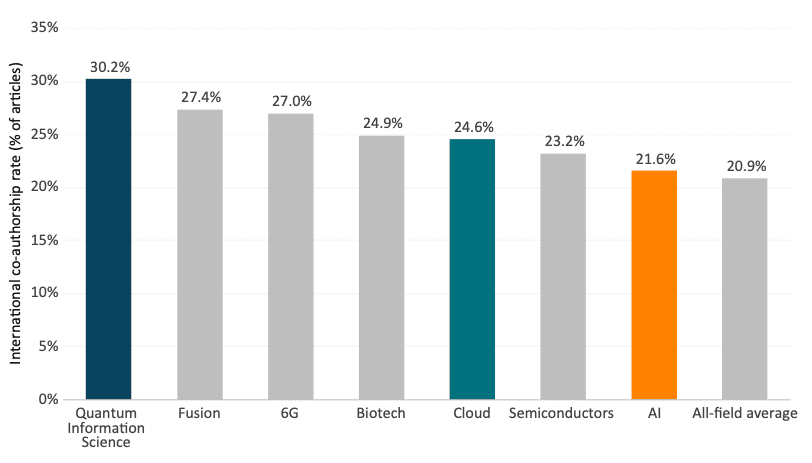 Source: ECIPE elaboration based on OpenAlex data, retrieved June 2026. Note: International co-authorship rate is defined as the share of journal articles with authors affiliated with institutions in more than one country, among articles with at least one identified country. Technology domains are defined as curated sets of OpenAlex topics (full lists in the methodological annex).
The same constraint applies, however, to attempts to pursue self-sufficiency at the European rather than national level. If quantum collaboration were predominantly taking place within the EU, high international co-authorship rates could still be consistent with a relatively self-contained European ecosystem. The evidence does not support this interpretation. When collaboration is defined more strictly as requiring authors to span at least two major geographic blocs, 23.7 per cent of quantum information science articles still qualify, compared with 18.7 per cent for AI, 18.3 per cent for cloud and an all-field average of 16.4 per cent. Moreover, 78 per cent of quantum’s international collaborations cross these blocs. Quantum’s exceptional internationalisation is therefore not primarily an artefact of intra-EU collaboration: its research base is genuinely dependent on connections extending beyond Europe.
Some might argue that quantum’s higher collaboration rate is largely a by-product of its earlier stage of development compared with more mature technologies such as AI and cloud. Comparing collaboration levels across fields is indeed challenging, as patterns naturally shift with maturity. A useful way to address this is to examine co-authorship rates over the past two decades, a period during which AI, cloud, and many other technologies were, at some point, at a similar stage of development to quantum today. Tracking the trajectory over time not only reinforces the point but also pre-empts the objection that quantum appears open simply because it is young, and might “close” as it matures.
Figure 2 shows that the evidence points precisely in the opposite direction. From 2000 to 2024, quantum information science remained consistently and substantially above both the all-field average and nearly all other technologies compared. By contrast, AI and cloud started slightly below the average and rose above it as they matured and commercialised; as these digital technologies scaled, their reliance on international collaboration increased rather than declined. The fields often cited in sovereignty debates did not nationalise as they matured, and quantum, already far more open than either, shows no sign of doing so.
The cross-technology evidence therefore establishes the first element of the argument: quantum’s dependence on cross-border collaboration is not a temporary feature of an early-stage field, but an extraordinary and lasting characteristic, far more pronounced than in the digital technologies that originally triggered sovereignty concerns. This also means that replacing national self-sufficiency with European self-sufficiency would not remove the underlying constraint: the knowledge networks on which quantum progress depends extend well beyond the EU itself.
Figure 2: International co-authorship relative to the all-field average: quantum information science versus AI, cloud and other strategic technologies, 2000–2024 (percentage points)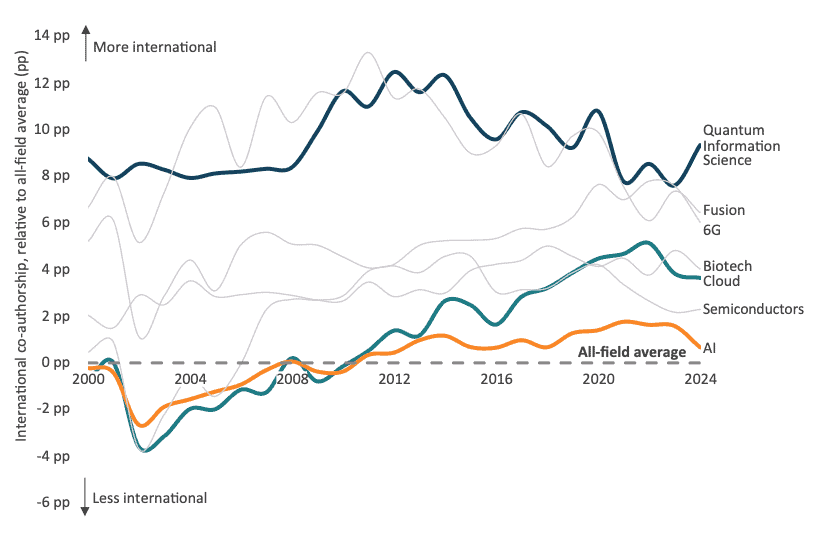 Source: ECIPE elaboration based on OpenAlex data, retrieved June 2026. Note: The figure shows each domain’s international co-authorship rate relative to the all-field average (the same rate computed across all journal articles in each year) in percentage points; the dashed line marks the all-field average, so values above it indicate above-average international co-authorship. Technology domains are defined as curated sets of OpenAlex topics (full lists in the methodological annex).
2.2 The Cluster Is the Unit of Quantum Innovation
If quantum capability is assembled from scarce, specialised, and costly inputs, it follows that genuine innovation can emerge only where the necessary capabilities and institutions coexist. That is exactly what we observe in practice. Quantum activity is highly concentrated in a limited number of innovation clusters: geographically dense ecosystems in which startups, established firms, universities, research institutes, and public agencies co-locate and interact. ECIPE’s 2025 ranking of the world’s quantum clusters identified 45 such ecosystems, led by Cambridge, Greater Helsinki, Oxford, the San Francisco Bay Area, and Greater Glasgow.[4] The EU is well represented: Helsinki and Karlsruhe sit in the top tier, with Copenhagen, Paris, the Randstad and Munich close behind. Whatever assumptions underlie the sovereignty debate, Europe is far from a laggard in quantum, hosting several of the world’s most capable clusters.
Concentration, however, does not imply self-sufficiency. The very complexity that drives capabilities to cluster also prevents any single location from holding them all: no cluster commands the full range of physics, engineering, materials, and software expertise that quantum systems require. Clusters therefore advance by connecting to, drawing from, and contributing to capabilities elsewhere.
The most successful cluster is not the most self-contained, but the best-connected: the most effective node in a global and distributed network rather than an autonomous hub. This is borne out by where collaboration leadership actually sits. Unlike funding or ecosystem maturity, which concentrate in a handful of regions, the most collaboratively active clusters are spread across China, India, Australia, Europe, and North America – no single region dominates. That dispersion is itself a signature of an innovation system that is distributed and cross-border by nature rather than organised around national centres, with a few clusters acting as the global connectors that hold the broader ecosystem together.
This has direct implications for the sovereignty frame. Thinking in terms of self-sufficiency assumes that a country, or even the EU as a whole, could in principle assemble a complete quantum capability within its borders and shield it from the outside. But quantum innovation does not work that way. Capability accumulates in clusters whose productivity depends on their position within global, cross-border networks. The structure of collaboration makes this concrete: cluster-to-cluster links account for close to 60 per cent of all quantum collaboration worldwide – even though clusters represent only a fraction of active regions – and cluster-to-non-cluster links for a further 37 per cent, so that even peripheral regions plug into the global system through clusters rather than through national frameworks. The operative unit of quantum competition is therefore the cluster-as-node, within a global network.
A policy of self-sufficiency misidentifies the very unit it is trying to act on. Pursued fully, it could undermine its own objective: by prioritising containment over connection, it would isolate Europe’s strongest clusters from the networks that make them productive, weakening the very assets (Helsinki, Karlsruhe, and the rest) it aims to protect. The relevant question for European policy is not how to wall off capabilities inside national or EU borders, but how to ensure Europe’s clusters remain highly connected and indispensable nodes in the global quantum network.
2.3 In Quantum, Openness Is the Route to Commercialisation and Adoption, Not a Vulnerability
The situation described so far might, from a radical sovereignty perspective, be read as a set of vulnerabilities: if no single cluster or country commands the full range of frontier capabilities required to develop and scale quantum technologies, then every ecosystem depends on others, and dependence is precisely what a sovereignty agenda seeks to minimise. Yet this reading mistakes the role openness plays in quantum. International connection is not merely a consequence of the fact that capabilities are distributed across ecosystems; it is the mechanism through which ecosystems acquire complementary capabilities, connect research with industrial partners, and bring quantum technologies into productive use. Openness is not a vulnerability to be reduced, but the route to both commercialisation and adoption.
The evidence comes directly from the mapping of the global structure of quantum collaboration.[5] Figure 3 covers 18,400 bilateral quantum partnerships involving more than 4,100 institutions across over 110 countries between 2018 and 2024, spanning universities, research institutes, government agencies, startups and large firms. National ecosystems can be characterised along two dimensions: their global connectedness, meaning the breadth of their cross-border partnerships, and their commercial orientation, proxied by the intensity of industry participation in quantum collaborations relative to the size of the economy. The logic is straightforward: basic research is necessary but not sufficient, and the ecosystems that move fastest from science to market are those able to reach beyond their borders for the specialised capabilities and industrial partners that commercialisation requires.
Figure 3: Quantum collaboration archetypes: international openness and commercial orientation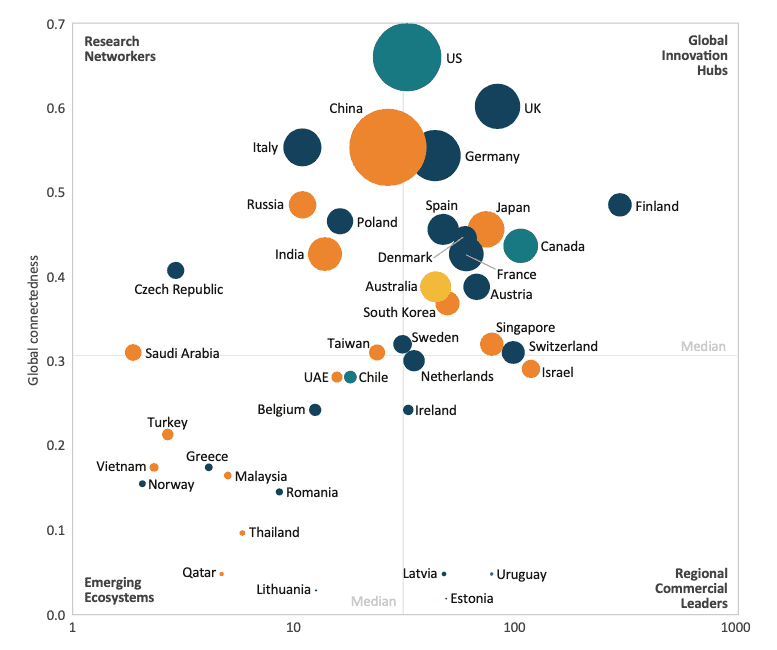 Source: ECIPE Quantum Database. Note: Industry-involving collaborations are measured per trillion USD of GDP. Only countries with an industry-to-GDP collaboration ratio of at least 1 were included in the chart.
Plotting countries on these two dimensions yields four archetypes. In the top-right quadrant sit the Global Innovation Hubs, including the US, the UK, Canada, and Finland. These ecosystems combine strong international partnerships with dense industrial collaboration, and are therefore well positioned to shape emerging quantum standards, value chains, and applications. Their openness also has a demand-side rationale. Access to larger markets allows quantum firms to scale, while access to a wider range of providers and industrial partners gives potential users more opportunities to identify, test and adopt commercially relevant applications. Domestic markets alone are unlikely to generate the volume, variety of use cases or specialised inputs needed to sustain competitive firms across the quantum stack.
The other quadrants are defined by what they lack. Research Networkers, such as China, Italy, and India, are well integrated into global scientific networks but commercially less developed. Regional Commercial Leaders, such as the Netherlands, Ireland and Israel, show strong commercial engagement relative to their size but are less internationally connected. Emerging Ecosystems are still building both capabilities.
Commercialisation, however, captures only one part of quantum’s economic significance. The value generated by the quantum industry itself through the sale of hardware, software and services may ultimately be much smaller than the value created when firms elsewhere in the economy adopt quantum capabilities. McKinsey, for instance, distinguishes between an internal quantum-technology market, projected to reach between USD 60 billion and USD 100 billion worldwide by 2035, and between USD 1.3 trillion and USD 2.7 trillion in potential economic value from quantum-computing applications across affected industries. The latter estimate concerns possible additional revenues and cost savings rather than an equivalent increase in GDP. It is also an approximate assessment rather than a definitive forecast, but the scale of the difference illustrates where much of the economic opportunity may lie.[6]
The potential gains are concentrated in sectors facing computationally intensive problems in simulation, optimisation and risk analysis. McKinsey estimates that quantum-computing applications could generate between USD 450 billion and USD 800 billion in value in chemicals, between USD 400 billion and USD 600 billion in financial services, between USD 200 billion and USD 500 billion in travel, transport and logistics, and between USD 80 billion and USD 400 billion in pharmaceuticals by 2035.
Further opportunities are identified in electric power, oil and gas, insurance, automotive, aerospace, semiconductors, advanced electronics and telecommunications.[7] These figures are uncertain and partly overlap with value attributed to AI,[8] but they demonstrate that the economic stakes extend far beyond the revenues earned by companies building quantum technologies. In most of these cases, the economic benefit would not require the adopting firm to own or operate a quantum computer. It would come from integrating quantum-enabled tools into existing research, production and decision-making processes, often through hybrid classical-quantum systems, cloud access or partnerships with specialised providers.
This is already reflected in enterprise adoption patterns: the IQM State of Quantum 2026 survey finds that 56 per cent of industry respondents access quantum computing through public cloud platforms and a further 27 per cent use hybrid models, compared with only 4 per cent operating dedicated quantum hardware on-premises. The emerging model is therefore less one of firms acquiring standalone quantum computers than of incorporating quantum capabilities into broader computing and organisational workflows.[9]
This distinction changes the policy question. The economic objective is not simply to create successful European quantum producers. It is also to ensure that European companies in chemicals, pharmaceuticals, energy, finance, transport and advanced manufacturing can experiment with, acquire and apply the strongest available quantum capabilities. In principle, a country might host successful quantum research while capturing relatively little of its broader economic value if domestic firms lack the skills, partnerships, infrastructure or incentives needed to adopt it. Conversely, firms may obtain significant productivity and innovation gains without their country reproducing every layer of the quantum technology stack.
Openness is important on both sides of this process. On the supply side, cross-border partnerships help quantum firms obtain scarce expertise, improve their technologies, find industrial collaborators and reach markets large enough to support commercial scale. On the demand side, openness gives adopting firms access to a broader selection of providers, applications and knowledge. It also allows sector-specific expertise held by European companies to be combined with quantum capabilities developed elsewhere. Restricting these connections in pursuit of technological self-sufficiency could therefore impose two economic costs: it could weaken European quantum suppliers by reducing their access to capabilities and markets, while simultaneously slowing the diffusion of useful quantum applications throughout European industry.
There is consequently a critical insight for policy. The ecosystems best positioned to create and capture economic value are not the most self-contained, but those that combine international connectedness with strong commercial and absorptive capacity. Openness and commercial maturity travel together. The relationship shown in Figure 3 is not strictly causal, since well-resourced economies may be more able both to collaborate and to commercialise. Nevertheless, the underlying mechanism is clear: cross-border partnerships connect dispersed scientific and technological capabilities with the sector-specific knowledge, users and markets required to turn quantum research into economic value.
For Europe’s policy approach, the implication is straightforward. Europe’s interest lies not only in producing quantum technologies, but also in ensuring that they are commercialised, diffused and adopted across the economy. Policies that treat openness primarily as a vulnerability risk cutting off the channels through which Europe’s strong clusters reach international markets and through which European firms access the capabilities needed to improve productivity and innovation. The objective should be to strengthen Europe’s position within the global quantum network and its capacity to absorb the technologies that network produces, not to separate Europe from it.
These three observations point in the same direction. Quantum research is more dependent on cross-border collaboration than the other strategic technologies examined here, including the digital technologies whose external dependence first prompted Europe’s sovereignty concerns. The resulting capability has accumulated in specialised clusters whose productivity depends on their position within a distributed global network. The openness that connects these clusters allows capabilities to be acquired, technologies to be brought to market and applications to reach the wider economy. Yet this openness does not eliminate the dependencies that exist within quantum computing, and not every dependency is a strategic vulnerability. These dependencies differ across the technology stack, as do the policy responses they require. Section 3 examines these differences by looking at the quantum computing stack.
[1] Priem, J., Piwowar, H. & Orr, R. (2022). OpenAlex: A fully-open index of scholarly works, authors, venues, institutions, and concepts. arXiv. https://arxiv.org/abs/2205.01833
[2] Quantum information science here refers to research on quantum computing and quantum communication, including cryptography, operationalised through the two corresponding OpenAlex topics (“Quantum Computing Algorithms and Architecture” and “Quantum Information and Cryptography”), both of which OpenAlex classifies within computer science. This is distinct from broader “quantum technologies”, which additionally take in quantum sensing, simulation, and the underlying physical platforms. Full topic definitions are provided in the methodological annex.
[3] The analysis refers to 2024 to ensure consistency and comparability. Although OpenAlex data was retrieved in June 2026, 2025 was excluded because records for that year remain incomplete and are still being indexed, and 2026 is still ongoing.
[4] Erixon, F., Dugo, A., Pandya, D., & Sisto, E. (2025, December). Quantum clusters: Ranking the world’s deep‑tech epicentres. ECIPE Occasional Papers.https://ecipe.org/publications/quantum-clusters-ranking-deep-tech-epicentres/
[5] Erixon, F., Dugo, A., Pandya, D., & Sisto, E. (2025, September). Mapping the quantum ecosystems: How are economies positioning themselves for innovation success. ECIPE Occasional Papers. https://ecipe.org/publications/mapping-the-quantum-ecosystems/
[6] McKinsey & Company. (2026, April 28). McKinsey Quantum Technology Monitor 2026: A commercial tipping point (pp. 11, 17–25). https://www.mckinsey.com/capabilities/mckinsey-technology/our-insights/mckinsey-quantum-technology-monitor-2026-a-commercial-tipping-point
[7] Ibid.
[8] Ibid., industry analyses also note that some of the economic value associated with quantum will overlap with advances in AI. In areas such as drug discovery, for example, the two technologies are likely to be complementary, making it difficult to attribute projected gains in economic value to either one in isolation.
[9] IQM Quantum Computers, & The Quantum Insider. (2026). State of quantum 2026. https://iqm.tech/reports/IQM-State-of-Quantum-2026.pdf
3. Understanding the Quantum Computing Stack
In quantum computing, the dependencies that matter strategically do not arise principally at the application layer. They are concentrated in the physical and operational layers that determine whether a quantum computer can be built, operated, and maintained. This becomes clearer when access to quantum hardware is separated from the capability to use it effectively. Access is available through cloud platforms, but capability is not: large organisations report widespread experimentation but limited real-world use, and the main constraints are now shortages of specialised skills, algorithms and the expertise needed to connect quantum and conventional systems, rather than access to hardware.[1] The hardware itself, meanwhile, differs fundamentally from one type of quantum computer to the next (Section 3.3); cloud platforms and contracts make these systems available to users, but they do not remove the underlying physical dependencies.
Users interact with a quantum computer through software, but what it can do is set by its physical hardware. In this paper, a quantum computer means the whole system: the processor, where the qubits sit, together with the control, cooling and other equipment that runs it. The type of qubit – the basic unit of quantum information, which can be built from superconducting circuits, trapped atoms or particles of light, among others, determines the environment the system needs, the equipment used to control it, how it must be tuned and maintained, and what software can run on it reliably.
We distinguish between three interconnected layers: software, execution and integration, through which users access and run quantum programs; control, calibration and enabling systems, which turn software instructions into physical operations and keep the system running; and physical qubits, processors and fabrication, which determine whether quantum computers can be built at all. This division mirrors the European reference model for quantum computing, CEN/CLC/TR 18202:2025, which separates architecture-specific hardware layers from software layers expected to be common across systems, with the hardware abstraction layer (HAL) marking the boundary between them.[2] Most reference models also include a top application or service layer; this paper folds it into the software layer because, as Section 3.1 shows, dependencies there are generally more contestable and easier to manage.
Three things are often conflated in discussions of quantum access: how users reach a quantum computer (remotely through the cloud or locally), how it is integrated with conventional computing, and where it is physically deployed. They overlap but are not interchangeable. Integration is a technical necessity in every case: quantum computers cannot work on their own, and conventional computers – increasingly high-performance computing (HPC) systems, prepare, steer and interpret their calculations, whether the system is reached through the cloud or on site. Hybrid quantum-classical systems are, in short, how quantum computing is being implemented in practice, and this link will become more important as complex applications emerge, particularly in areas such as chemistry and materials science, where further integration with AI is also expected. Deployment is a separate choice. Industry surveys suggest that roughly twice as many buyers expect on-premises (on-prem) systems to form part of their access model over the coming years as expect to rely on public cloud alone.[3] This reflects the current maturity of the technology: today’s quantum computers have yet to reach the scale required for widespread industrial applications, and much of the demand for on-prem systems comes from the need to develop algorithms, advance error correction (techniques that detect and fix the errors quantum computers are prone to) and build expertise. Governments and research institutions need to realise that access to best-in-class hardware is essential for building capabilities across their research and industrial ecosystems.
Quantum sovereignty requires neither on-prem infrastructure nor domestic production of the full technology stack, but it involves more than access to software platforms or quantum-computing-as-a-service (QCaaS). It depends on access to leading hardware and on the expertise needed to develop applications and integrate quantum and classical systems. Because that capability depends on access to the best available systems, policies that restrict access on the basis of origin risk undermining the capability they aim to build. Dependencies become more specialised and harder to substitute further down the stack. Moreover, these layers are analytical rather than self-contained: technical, operational and policy dependencies extend across them, so restrictions targeting one layer: on hardware, components or foreign participation – can disrupt the development and collaboration throughout the stack. Such control is therefore justified only in exceptional cases that meet the conditions set out in Section 4.3. Table 1 summarises the resulting policy priorities; the sections that follow set out the basis for each.
Table 1: Policy priorities by layer of the quantum-computing stack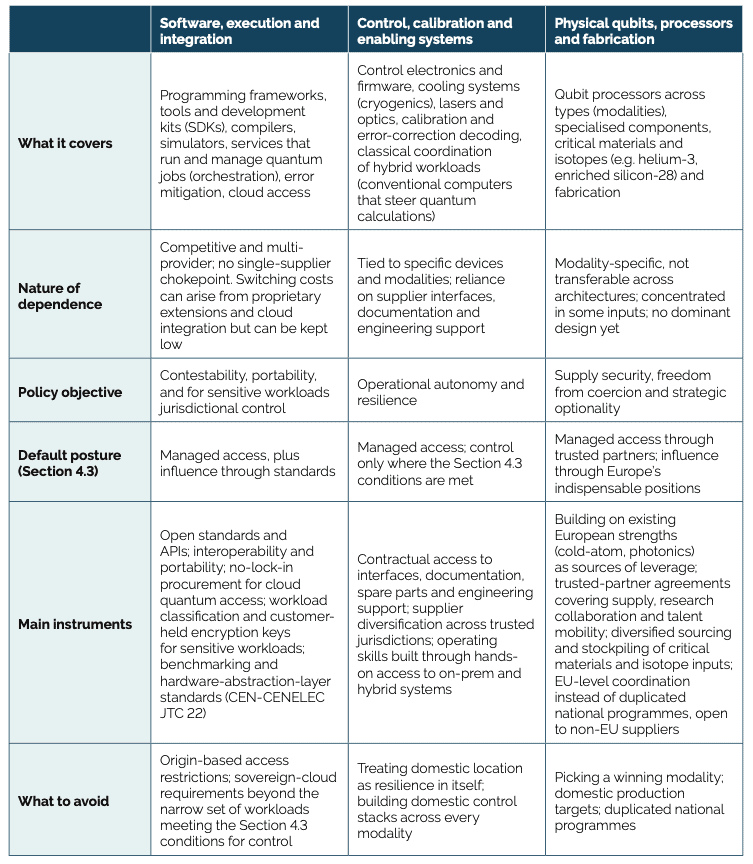 Source: ECIPE elaboration
3.1 Software, Execution and Integration
The software layer – programming tools, compilers, simulators, and services – allows users to run applications on quantum computers without managing the underlying hardware. It is the most portable layer, but not fully independent of the hardware: every program must ultimately be translated to fit a specific device, so how well it runs depends on that device. This layer also includes error mitigation: software techniques that filter out some of the effects of the errors (or “noise”) to which today’s quantum computers are susceptible, making them more useful for experiments and limited applications.[4] Mitigation works around noisy hardware rather than fixing it, so its results remain only as good as the underlying hardware. Error correction, which detects and fixes errors as they occur, depends on the hardware itself (Section 3.2).
Not all quantum software raises the same policy questions. Software that gives users access – frameworks, development kits, orchestration services and administrative interfaces – raises questions of interoperability, portability and contestability.[5] Software coupled to how a specific device operates, such as hardware-specific optimisation (tuning a device to make it perform well),[6] raises questions of operational autonomy, and is treated with the control layer because for policy purposes it behaves more like hardware. Conflating the two leads to the wrong instrument being applied to each.
At the access end, there is no obvious single-supplier chokepoint: multiple tools and providers compete, including European ones.[7] This makes it the part of the stack most amenable to conventional digital governance. Open standards and APIs, interoperability and portability, reproducible benchmarks and no-lock-in procurement keep the layer contestable. Concrete instruments are emerging. CEN’s pre-standard on the quantum computing HAL (EAS 18435-1:2026) aims to give higher software layers a unified, vendor-neutral interface to different hardware, and open intermediate representations such as OpenQASM 3 and the Quantum Intermediate Representation (QIR) play a similar role for programs.[8] Interface standards of this kind turn portability into a specification, and are an area where European standardisation can shape outcomes without owning the hardware (Section 4.3).
Portability should not be overstated, however; proprietary add-ons, managed runtime services and integrated cloud offerings can raise switching costs even when the core tools are open source, so a user can reach quantum hardware through open tools yet still depend on a particular provider’s platform. The response to this is to keep those switching costs low, not to restrict access by origin. Software dependencies are therefore not absent, but they are more contestable than those further down the stack, and more manageable through standards, portability and procurement. Where sensitive workloads raise jurisdictional concerns, workload classification and customer-held encryption keys address much of the risk without requiring dedicated sovereign infrastructure. Residual risks are assessed against the control conditions in Section 4.3, which few workloads meet.
3.2 Control, Calibration and Enabling Systems
Between the processor and the software layer sits a layer of control electronics, firmware and signal processing that turns digital instructions into the precise physical signals – microwave or laser pulses, depending on the quantum computer – that operate the qubits and read out quantum states,[9] together with the cooling (cryogenic), optical and cabling systems that the processor needs to function. The layer is central to device performance: in superconducting systems, tiny errors in the timing or strength of a control pulse are enough to introduce mistakes into a calculation.[10] The continuous tuning of the quantum computer (calibration) belongs here too, as does error correction. Correcting errors means repeatedly measuring the qubits and feeding fixes back while the calculation is still running, typically within millionths of a second, which ties error correction closely to the control hardware rather than to software alone. The boundary with the physical layer is also shifting: control electronics are increasingly being moved into the cryostat itself, operating at millikelvin temperatures alongside the processor.[11] This reinforces that the layers are analytical rather than self-contained.
This layer also extends into conventional computing. Most near-term uses of quantum computers are hybrid:[12] the quantum processor performs part of a calculation and sends the result to a conventional computer, which decides what the quantum processor should do next, repeating the cycle until a solution is reached. Current quantum computers also cannot store results (they have no persistent memory) the way conventional computers do: each calculation is run, measured and lost, so the useful results exist only because classical systems capture and process measurement outcomes between runs.[13] The conventional computers that steer the calculations are therefore as integral to the system as the quantum processor itself, which is why linking quantum computers to supercomputing centres, as is the EuroHPC model,[14] is central to how Europe builds the capability to operate quantum systems.
Much of this layer looks software-like but is tightly coupled to the specific qubit technology beneath it. Control systems designed for superconducting qubits do not transfer directly to trapped-ion, neutral-atom or photonic platforms,[15] and even for the same type of qubit, control systems are often closely integrated with the manufacturer’s own processor designs and tuning procedures. Operators therefore depend on the supplier’s documentation, interfaces, spare parts and engineering support.
Because control remains architecture-specific, self-sufficiency here would mean either backing one type before the technological competition is settled or reproducing control capabilities across several. Neither is necessary simply because dependency exists. What the policy response should pursue is operational resilience: ensuring that the systems Europe actually deploys can be operated, adapted and maintained if access to a particular supplier is disrupted. That calls for contractual access to interfaces, documentation, replacement components and engineering support; supplier diversification across trusted jurisdictions; and the in-house skills to diagnose faults, retune performance and integrate new hardware. Europe does not need to reproduce the entire control layer, but it should avoid a position in which the systems it deploys can only be operated with one supplier’s continued cooperation. Stronger control over calibration or classical coordination is warranted only where a dependency meets the conditions set out in Section 4.3. Europe starts from a position of strength: this is one of the layers in which it holds some of its strongest specialised positions,[16] although supply in several segments remains concentrated among a small number of firms.
3.3 Physical Qubits, Processors and Fabrication
At the base of the stack is the physical qubit. Several competing types exist and none has yet emerged as the winner: superconducting circuits and trapped ions are among the most mature hardware approaches; those based on neutral atoms, light (photonics) and silicon (semiconductor spin qubits) are advancing rapidly; and other approaches, such as topological qubits, remain exploratory. Each involves different trade-offs between stability, speed and how easily it can be scaled up. Because qubits are extremely sensitive to their surroundings yet must remain controllable, the central engineering challenge is keeping their operations reliable as systems grow, and each modality does so with a very different set of equipment (Table 2). Avoiding extreme cooling does not make an architecture hardware-light: trapped-ion systems, for example, shift the requirement towards precision lasers and optics, vacuum chambers and ion-trap engineering.
Table 2: What each type of quantum computer needs to operate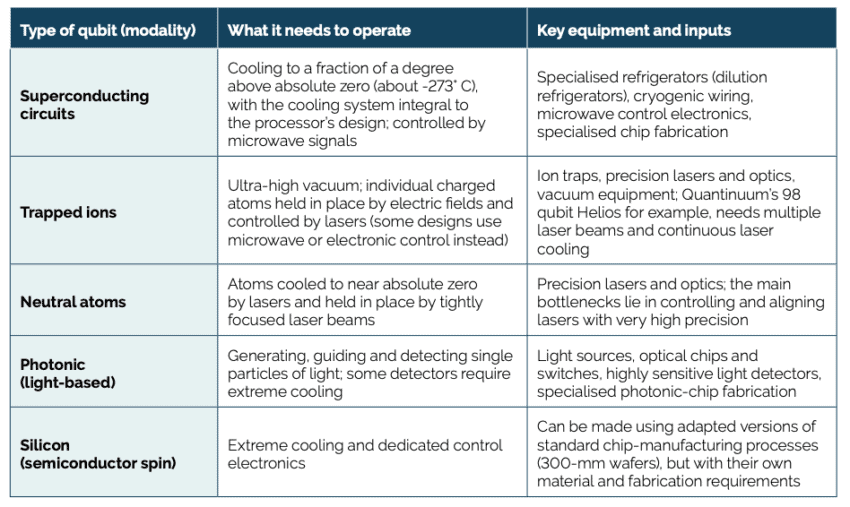 Source: ECIPE elaboration[17]
The physical layer is therefore not a single supply chain. Each type of qubit relies on different specialised inputs, and the layer contains distinct industrial roles – companies that build complete systems, those that design quantum chips, component suppliers and manufacturing facilities – each exposed to different dependencies. Factories, supply chains and skilled workforces built around one type of qubit cannot simply be deployed to another. Two distinct issues follow from this. The first is technological uncertainty: with no dominant design and little basis for expecting the field to converge on a single winner soon, concentrating resources on one architecture prematurely is risky, which argues for strategic optionality. The second is supply-chain dependence, each architecture relies on specialised inputs, some sourced from outside Europe, which raises questions of access, substitutability and resilience rather than of which technology to back.
Access to software, cloud services or computing capacity does not remove dependence on hardware components and infrastructure needed to build and maintain quantum computers. Beneath the components sits a further tier of critical materials and isotopes- helium-3 for dilution refrigerators, isotopically enriched silicon-28 for spin qubits, and specialised optical and photonic materials. Some of these inputs are concentrated – helium-3, for example, is in short supply and needed by most dilution refrigerators – but their supply conditions and substitution possibilities differ, so each needs to be assessed on its own terms rather than treated as a single vulnerability.[18]
As systems scale by connecting several processors rather than building ever-larger single chips, interconnect technologies, including cryogenic links and microwave-to-optical converters, are becoming important.[19] Yet reliance on non-EU suppliers should not be automatically equated with strategic vulnerability. Europe’s position in this layer is neither uniformly strong nor weak: it has specialised positions across several types of qubit and in key components.[20] The policy task is therefore not to reproduce every architecture in Europe, but to deepen those positions while securing complementary inputs through trusted partners and diversified supply.
The stack points to a key distinction for policy: access to quantum-computing capacity is not the same as dependence on the physical inputs that make the capacity possible, and each layer calls for a different priority. At the software layer, the priority is keeping the market open and contestable. At the control layer, it is operational resilience – the ability to operate, adapt and maintain the systems Europe deploys. At the physical layer, it is supply security: building on Europe’s competitive positions while keeping reliable access to complementary inputs elsewhere. Section 4 turns to what sovereignty should mean in quantum policy: it separates the distinct objectives the term bundles together and sets out when the policy response calls for control, influence or managed access.
[1] IQM Quantum Computers, & The Quantum Insider. (2026). State of quantum 2026. https://iqm.tech/reports/IQM-State-of-Quantum-2026.pdf
[2] CEN-CENELEC. (2025). Layer model of quantum computing (CEN/CLC/TR 18202:2025). CEN-CENELEC Joint Technical Committee 22 ‘Quantum Technologies’. https://www.cencenelec.eu/news-events/news/2025/eninthespotlight/2025-10-23-tr-18202-2025/
[3] IQM Quantum Computers, & The Quantum Insider. (2026). State of quantum 2026. https://iqm.tech/reports/IQM-State-of-Quantum-2026.pdf
[4] The importance of error mitigation reflects a more fundamental challenge in quantum computing: the need to control the errors produced by inherently noisy quantum hardware. In 2025, IBM CEO Arvind Krishna identified demonstrating effective error correction as one of the two critical steps needed to scale quantum computing. In the nearer term, however, error-mitigation techniques allow useful information to be extracted from noisy processors before fully fault-tolerant systems are available. IBM itself describes error mitigation as crucial to achieving near-term quantum advantage. The recent IBM–Algorithmiq experiment illustrates this role, using error mitigation to obtain stable results in a quantum simulation that could not be reliably reproduced by leading classical methods across the full problem. Riverlane similarly treats error management as central to the field, distinguishing mitigation, which can extend the usefulness of present-day devices, from error correction, which will ultimately be required for quantum computing at scale. See: WSJ Podcasts. (2025, September 12 ). Why IBM’s CEO Thinks His Company Can Crack Quantum Computing. https://www.wsj.com/podcasts/wsj-the-future-of-everything/why-ibm-ceo-thinks-his-company-can-crack-quantum-computing/411a8140-f157-441f-9fb4-c1c0d928db4d; Monaco, L. M. (2026, July 30). IBM CEO says quantum computing will have a ‘measurable impact’ on earnings by 2028 or 2029. CNBC. https://www.cnbc.com/2026/07/30/ibm-ceo-quantum-computing-measurable-impact-earnings-2028-2029.html; Dargan, J. (2024). Riverlane CEO Asks: ‘What Will We Do With Error-Corrected Quantum Computers? Quantum Insider. https://thequantuminsider.com/2024/10/30/riverlane-ceo-asks-what-will-we-do-with-error-corrected-quantum-computers/
[5] Wang, Q., Zhukas, L. A., Miao, Q., Dalvi, A. S., Love, P. J., Monroe, C., … & Ravi, G. S. (2026). An end-to-end workflow for executing a classically bootstrapped variational quantum algorithm on an academic quantum computer. npj Unconventional Computing, 3(1), 28.
[6] Sivak, V., Morvan, A., Broughton, M., Cortiñas, R. G., Bausch, J., Senior, A. W., … & Lange-Dei, T. (2026). Reinforcement learning control of quantum error correction. Nature, 1-6.
[7]European firms active in this layer include Multiverse Computing (Spain), which develops quantum and quantum-inspired optimisation software and AI model compression; ParTec (Germany), whose software is used to connect quantum computers to European supercomputing centres under the EuroHPC-supported HPCQS project; and Terra Quantum (Switzerland) and Phasecraft (UK), which develop quantum and hybrid algorithms, Phasecraft particularly for materials simulation. Algorithmiq (Italy) develops error-mitigation methods integrated with IBM’s Qiskit. Source: ECIPE Quantum Database.
[8] DIN Media. (2026, August). Quantum computing – Hardware abstraction layer – Part 1: Descriptions and functional requirements (EAS 18435-1:2026-08). https://www.dinmedia.de/en/pre-standard/eas-18435-1/405636688 ; Cross, A., Javadi-Abhari, A., Alexander, T., de Beaudrap, N., Bishop, L. S., Heidel, S., … & Johnson, B. R. (2022). OpenQASM 3: A broader and deeper quantum assembly language. ACM Transactions on Quantum Computing, 3(3), 1–50; QIR Alliance. (n.d.). Quantum Intermediate Representation. https://www.qir-alliance.org/
[9] van den Brink, R. F., Boschero, J. C., & Amoretti, M. (2026). Layer model for gate-based modular quantum computers.Quantum Information Processing, 25(4), 103.
[10] Gely, M. F. (2020). Measuring and controlling radio-frequency quanta with superconducting circuits. arXiv preprint arXiv:2004.09153.
[11] Jordan, C., Bernhardt, J., Rahamim, J., Kirichenko, A., Bharadwaj, K., Fry-Bouriaux, L., … & Han, S. J. (2026). A quantum computer controlled by superconducting digital electronics at millikelvin temperature. Nature Electronics, 9(3), 287–294.
[12] Yalovetzky, R., Schuetz, M. J., He, Z., Shen, J., Sun, Y., Raymond, R., … & Otter, R. (2026). Quantum-Informed Portfolio Selection: An End-to-End Pipeline Validated on Trapped-Ion Hardware with Real Market Data. arXiv preprint arXiv:2607.01037.
[13] Conventional computing is involved at every stage: preparing and compiling workload, generating the control signals, processing measurement results and feeding them back, and turning raw outcomes into usable results.
[14] European High Performance Computing Joint Undertaking. (n.d.). Quantum computing & access. https://www.eurohpc-ju.europa.eu/quantum-technologies/quantum-computing-access_en
[15] van den Brink, R. F., Boschero, J. C., & Amoretti, M. (2026). Layer model for gate-based modular quantum computers: RFM van den Brink et al. Quantum Information Processing, 25(4), 103.
[16] In calibration and error correction: Riverlane (UK), real-time error-correction systems that combine decoding software with dedicated classical hardware; and QuantrolOx (Finland/UK) and Qruise (Germany), automated calibration software. In control and enabling hardware: Bluefors (Finland), the global market leader in the refrigerators used to cool superconducting machines; kiutra (Germany), cooling technology that avoids the scarce isotope helium-3; Zurich Instruments (Switzerland, owned by Rohde & Schwarz) and Qblox (Netherlands), control electronics; Delft Circuits (Netherlands) and Isentroniq (France), cryogenic cabling; Orange Quantum Systems (Netherlands), test and measurement equipment; TOPTICA Photonics (Germany) and Vexlum (Finland), precision lasers; and PLASSYS Bestek (France), vacuum equipment. Source: ECIPE Quantum Database.
[17] Sources: Jordan, C., Bernhardt, J., Rahamim, J., Kirichenko, A., Bharadwaj, K., Fry-Bouriaux, L., … & Han, S. J. (2026). A quantum computer controlled by superconducting digital electronics at millikelvin temperature. Nature Electronics, 9(3), 287-294. Ransford, A., Allman, M. S., Arkinstall, J., Campora, J. P., Cooper, S. F., Delaney, R. D., … & Roman, C. (2026). A 98-qubit trapped-ion quantum computer with all-to-all connectivity. Nature, 655(8121), 81-86. Chauhan, N., Caron, C., Isichenko, A., Song, M., Wei, Z., Helaly, N., … & Blumenthal, D. J. (2026). Chip scale coil stabilized Brillouin laser driving a room temperature trapped ion qubit. Nature Communications, 17(1), 3982. Manetsch, H. J., Nomura, G., Bataille, E., Lv, X., Leung, K. H., & Endres, M. (2025). A tweezer array with 6,100 highly coherent atomic qubits. Nature, 647(8088), 60-67. Bluvstein, D., Geim, A. A., Li, S. H., Evered, S. J., Bonilla Ataides, J. P., Baranes, G., … & Lukin, M. D. (2026). A fault-tolerant neutral-atom architecture for universal quantum computation. Nature, 649(8095), 39-46. Zhu, H., Chen, T., Ma, H., Zhao, Z., Guo, J., Liang, Q., … & Yang, J. (2026). Recent progress towards large-scale integrated photonic quantum computation. npj Nanophotonics, 3(1), 20. PsiQuantum Team. (2025). A manufacturable platform for photonic quantum computing. Nature, 641, 876–883. Available at: https://www.nature.com/articles/s41586-025-08820-7.pdf Koch, T., Godfrin, C., Adam, V., Ferrero, J., Schroller, D., Glaeser, N., & Wernsdorfer, W. (2025). Industrial 300 mm wafer processed spin qubits in natural silicon/silicon-germanium. npj Quantum Information, 11(1), 59.
[18] Recent supply-chain assessments nonetheless treat critical materials, together with the enabling technologies, as first-order strategic priorities; this is the dependency that the recommendations on allied sourcing and stockpiling in Section 5 address. See: MIT Center for Transportation & Logistics. (n.d.). Mapping risks in the quantum computing supply chain. https://ctl.mit.edu/mapping-risks-quantum-computing-supply-chain
[19] van den Brink, R. F., Boschero, J. C., & Amoretti, M. (2026). Layer model for gate-based modular quantum computers. Quantum Information Processing, 25(4), 103.
[20]Superconducting: IQM (Finland) and OQC (UK), complete systems, including on-premises machines for supercomputing centres; QuantWare (Netherlands), quantum chips and manufacturing services for other system builders; and Alice & Bob (France), a design intended to reduce the cost of error correction. Silicon: Quobly (France), Quantum Motion (UK) and Equal1 (Ireland), using standard chip-manufacturing processes. Neutral atoms: Pasqal (France) and planqc (Germany). Trapped ions: Alpine Quantum Technologies (Austria), eleQtron (Germany) and Oxford Ionics (UK), owned by IonQ (US) since September 2025. Photonic: Quandela (France), QuiX Quantum (Netherlands) and ORCA Computing (UK), with SMART Photonics (Netherlands) and Ephos (Italy) manufacturing photonic chips. Interconnects: QphoX (Netherlands), microwave-to-optical converters for linking superconducting processors over optical networks. Microsoft’s largest quantum site globally, in Denmark, contributes to its topological-qubit programme. Source: ECIPE Quantum Database.
4. Quantum Sovereignty Models
The feasibility of sovereign objectives depends less on abstract assertions of autonomy than on identifying where in the quantum stack dependencies are genuinely strategically sensitive. Some can be shaped through regulation and standards, and others must be secured through trusted partnerships and allied agreements.
This is why the stack analysis matters for the sovereignty debate, and not merely as technical background. Each layer carries a different dependency profile and therefore admits a different kind of sovereign objective. At the physical and supply-chain layers, the relevant question is supply security and freedom from coercion, because supply of some inputs is concentrated and physical, although concentration raises a supply-security question, not automatically a case for control. At the control and calibration layers, it is operational autonomy: the ability to inspect, adapt, and maintain the running system. At the software layer, it is jurisdictional control and contestability, exercised through standards and interoperability rather than ownership. A single demand for “sovereignty” flattens these distinctions, treating a problem that is different at every layer as though it had one answer.
This flattening is why the term is so often unhelpful. Debates over quantum sovereignty proceed as though everyone agrees what sovereignty is. In practice, the term bundles at least seven distinct objectives: ownership, jurisdictional control, supply security, freedom from coercion, self-sufficiency, optionality, and resilience. These neither coincide nor reliably reinforce one another. A policy that maximises one routinely erodes another: building a domestic champion in the name of self-sufficiency can leave Europe more exposed, not less, by replacing a diversified foreign dependence with a single fragile national one. Used without specification, “sovereignty” is therefore not a strategic objective but a placeholder for several, and it licenses contradictory policies under a single reassuring word. The task of this section is to take the bundle apart.
4.1 Unbundling Sovereignty
The language of sovereignty has moved into EU quantum policy carrying several intellectual traditions with it. At the maximalist end sits classical sovereignty, understood as self-sufficiency and freedom from external dependence. EU documents have converged on softer formulations. The Quantum Europe Strategy speaks of “technological sovereignty”; broader Commission discourse invokes “strategic autonomy” and “open strategic autonomy”. These framings are not interchangeable. Table 3 maps their core claims, with this paper’s proposed framework, managed interdependence, included for comparison.[1]
Table 3: Overview of technology governance concepts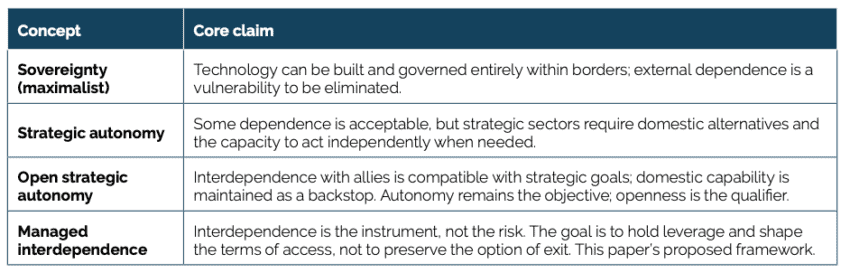 Source: ECIPE elaboration.
Every framing in Table 3 promises control over something. The question is: control over what? In practice, the word “sovereignty” bundles at least seven objectives, each pointing towards a different policy instrument and several in direct tension with one another (Table 4).
Table 4: Key sovereignty objectives in EU technology policy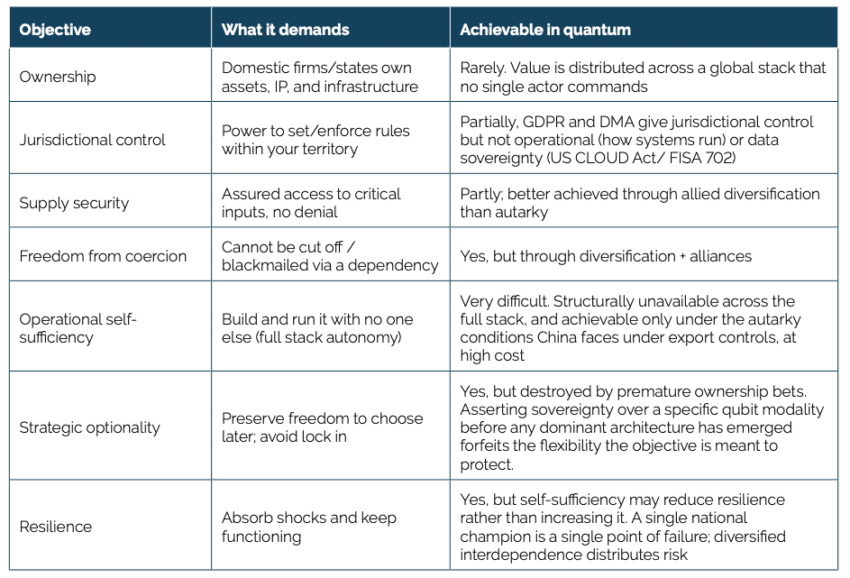 Source: ECIPE elaboration.
The tensions between these objectives are what make sovereignty incoherent as a single policy guide. Pursuing self-sufficiency to maximise ownership can reduce supply security and resilience simultaneously: swapping a diversified foreign dependence for a fragile domestic monopoly replaces a manageable risk with a concentrated one. The cluster data in Section 2 point to the same structural limit: the top European quantum nodes reach the frontier through international collaboration networks, not through self-sufficiency. A strategy that prioritises hardware ownership over ecosystem connectivity risks inverting the causal mechanism that generates quantum capability in the first place.
Seeking jurisdictional control does not require ownership. This principle is not specific to quantum: the EU already regulates digital markets it does not own, and the same logic carries over directly to quantum-mediated services. GDPR and the DMA, for example, govern US hyperscaler behaviour in European markets without a single line of infrastructure ownership. Treating jurisdictional control as if it required ownership would therefore direct policy towards the wrong instrument, in quantum as much as in cloud.
But jurisdictional control has limits, in quantum terms as elsewhere. It can determine the legal conditions under which quantum services are offered in Europe, but it does not by itself guarantee operational or data sovereignty. Where quantum workloads remain mediated by a foreign cloud provider, the provider may remain subject to foreign legal obligations. Where jurisdictional control matters, the more precise instrument is workload classification combined with customer-held encryption keys, not a blanket presumption that any foreign-parented platform is unavoidably exposed.
Freedom from coercion is better secured through countervailing dependence than through autarky. The Netherlands demonstrates the principle in semiconductors: ASML’s EUV position delivers more durable geopolitical leverage than defensive self-sufficiency in any other layer would. It makes others depend on Europe as much as Europe is dependent on others, rather than simply reducing Europe’s own dependence.[2] Bluefors, a Finnish company, supplies the dilution refrigerators used by most superconducting quantum programmes, including those of Rigetti, D-Wave, and IQM.[3] Recognising these tensions is not an argument against strategic objectives in quantum. It is an argument for specifying which objective, at which layer, before designing an instrument.
4.2 From Input Control to Outcome Sovereignty
Beneath the confusion over which objective is being pursued lies a second, more fundamental conflation: the difference between controlling inputs and securing outcomes. Sovereignty discourse often fixates on inputs such as owning the hardware, the fab, the stack. But what matters are the outcomes: that communication stays secure, that the economy can use the capability, that Europe cannot be coerced and that it has a say in the rules.
Input control and outcome security are related, but they are not the same. The gap between them is where much of European quantum policy risks going wrong. First, outcome sovereignty does not require input sovereignty. Communications security, economic value capture, and freedom from coercion can each be secured through instruments other than hardware ownership: standards participation, certification regimes, procurement rules, and adoption strategies are all instruments of influence rather than ownership. Europe does not need to seek to control quantum computing through input sovereignty to secure its communications. Instead, it should focus on adopting quantum-resistant encryption standards.
The catch is timing: as adversaries could already be recording today’s encrypted traffic, intending to decrypt it once a quantum computer is available. This means the switch to quantum-resistant encryption needs to happen now. This is already the direction of travel. National authorities (including US and French guidance) point to quantum-safe adoption around 2030 for high-risk systems, and major technology providers have set migration timelines, with several committing to move critical products and services to post-quantum cryptography by 2029. Together, this confirms that PQC migration is a present-day engineering programme rather than a future contingency.[4] Second, and more critically, input sovereignty does not guarantee outcome sovereignty. Owning the quantum hardware is of limited strategic value if value and control have migrated to the cloud-orchestration and AI-integration layers that sit above it. Even maximal input ownership can fail to deliver the outcomes that motivate the sovereignty objective in the first place.
Table 5: Low–high sovereignty matrix for input-output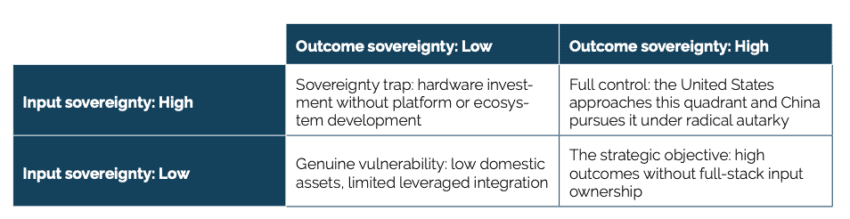 Source: ECIPE elaboration.
The full-control quadrant is accessible to very few states. The US comes closest among market economies, commanding leading positions across quantum hardware (Google, IBM, Microsoft Quantum, start-ups), software platforms (Qiskit, Cirq, Microsoft Quantum, AWS Braket), and talent pipelines, while still depending on allied partners for cryogenic components and isotope inputs. Federal investment in quantum information science reached USD 1.006 billion in FY 2024 under the National Quantum Initiative, with USD 1.8 billion proposed for the following five-year period.[5] Five US clusters appear in the ECIPE global top twenty, led by the San Francisco Bay Area ranking first on market orientation.[6]
China represents the autarky extreme: state investment is estimated to exceed USD 1 billion for the National Laboratory for Quantum Information Sciences alone. US export controls on quantum computing equipment, expanded in 2022 and tightened in 2024, have forced Chinese teams to develop domestic dilution refrigerators and control electronics; despite this, USTC has replicated frontier-level error correction results.[7] The lesson for the EU is not to imitate either path. The US route rests on a market and talent base of continental scale that the EU could only assemble collectively. The China route trades efficiency for autarky at a cost most EU Member States, individually, cannot bear. For states at a smaller scale, this quadrant is structurally unavailable.
The US treats its allies differently. The September 2024 rules include exemptions for countries implementing equivalent controls. The updated AUKUS arrangements (effective September 2024) granted Australia and the UK sweeping exemptions from export licensing requirements – explicitly including quantum computing as a Pillar 2 technology – while Japan and Canada also benefit from D:1 country carve-outs. The posture towards China is zero-licensed access and comprehensive entity-list restrictions versus collaborative exemption frameworks for the allied bloc.
China’s standards engagement is shaped by the same strategic logic it applies to hardware. Chinese representatives have chaired working groups in ISO/IEC JTC 1 and ITU on quantum technologies, and national standardisation directives since 2021 have explicitly targeted quantum as a domain for international standards influence. The risk that analysts identify is a fragmented global standards ecosystem, with a US/EU/allied bloc and a China-aligned bloc developing parallel frameworks with limited interoperability, a dynamic that would constrain the allied openness that Europe’s influence posture depends on.[8] China’s Hefei cluster ranks eighth globally in the ECIPE quantum cluster index and Shanghai ranks first on collaboration intensity, suggesting that hardware-level export controls have not yet translated into research-level isolation from the global frontier.
The sovereignty trap is the risk that nationally focused hardware programmes run when software, orchestration, and application layers do not develop in parallel. Gaia-X, the EU’s 2019 initiative to build a federated cloud infrastructure and reduce dependence on non-European providers, is instructive here. It was a substantial governance and standards effort, but it did not translate into competitive cloud infrastructures or displace the hyperscalers from the value-generating layers that determine market outcomes. The initiative succeeded as a standards project but fell short as a sovereignty instrument precisely because it conflated governance with ownership. In quantum, a national hardware programme that treats domestic fabrication as its primary metric while leaving software frameworks, orchestration, and application layers to non-domestic platforms faces the same structural gap.
Most states without dedicated quantum programmes sit in the genuine vulnerability quadrant, as do most individual EU Member States considered alone. Of the forty-five clusters in the ECIPE global quantum cluster ranking, only Helsinki and Karlsruhe reach the top third. The EU’s other clusters, including Copenhagen, Paris, Grenoble, Munich, Stuttgart, Berlin, the Randstad region, and two Spanish clusters, sit in the middle and lower tiers. The case for EU-level pooling rests precisely on this: a national cluster in the middle of a global ranking is not yet a strategic asset. The quadrant that is difficult to escape at the national level becomes achievable at collective scale, where resources, talent, and standards authority can be aggregated.
The strategic objective quadrant is where the EU should aim, and where several close partners already operate. The UK illustrates this most clearly: five UK clusters appear in the ECIPE global top fifteen, led by Cambridge at rank one, with Oxford third and Glasgow fifth. The English-speaking world accounts for ten of the top fifteen clusters globally. Government commitment to quantum reached GBP 2.5 billion over 2024–2034, with over GBP 1 billion already deployed through the National Quantum Technologies Programme across four research hubs, fifteen universities, and 130 industry partners. Quantinuum, formed in 2021 through the merger of Cambridge Quantum Computing and Honeywell Quantum Solutions, represents the commercial anchor of the UK ecosystem in trapped-ion hardware.[9] Canada’s Waterloo-Toronto corridor ranks twelfth globally in the ECIPE cluster index, with Metro Vancouver nineteenth and Greater Montréal twenty-ninth.
Canada’s Federal National Quantum Strategy, launched in January 2023, committed USD 360 million across research (USD 141 million), talent (USD 45 million), and commercialisation (USD 169 million). This builds on cumulative public investment exceeding USD 1 billion in quantum since 2012.[10] Canada and Japan lead globally in industry-research quantum collaboration intensity, and Xanadu is the leading industry partner in the Toronto-Waterloo cluster.[11] Finland’s Greater Helsinki cluster ranks second globally, matching Cambridge on market orientation, while IQM and Bluefors provide domestic input depth in quantum hardware and cryogenic systems respectively. Their high outcome rankings reflect ecosystem depth, allied integration, and standards participation, not only hardware ownership.
This is the consistent pattern: high outcome sovereignty is achievable through ecosystem strategy, allied integration, and governance authority, without full-stack input control. The EU collectively, through standards leadership, PQC governance, and trusted-partner agreements, can target this quadrant without the full-stack input ownership that is structurally unavailable across most of the quantum stack. This is the logic of managed interdependence: securing outcomes through the governance of relationships rather than through their elimination. It is achieved not by matching the US or China layer for layer, but by selecting a small number of layers where the EU can become an indispensable node and developing those with intent.
Table 5 makes visible a risk that purely input-focused policy cannot see: it is possible to spend very large sums achieving high input sovereignty and end up with low outcome sovereignty. Not despite the investment, but because it was directed at the wrong layer. The EU Chips Act’s 20 per cent domestic production target is an instructive precedent. It is a sovereignty-framed numerical objective that may allocate resources towards semiconductor manufacturing capacity rather than the integration, design, and application capabilities where European firms hold their actual competitive advantages. Importing the same input-ownership reflex into quantum – targeting hardware ownership rather than software ecosystems, standards authority, and outcome governance – risks reproducing the same misallocation at a stage when the outcome-shaping instruments are still available and less expensive than the hardware ones.
The level of analysis matters as well. National quantum sovereignty programmes commit a fallacy of composition: each Member State pursuing its own hardware programme duplicates infrastructure, fragments standards, and produces sub-scale ecosystems. In aggregate, twenty-seven national programmes may sum not to European sovereignty but to European fragmentation. European cloud policy provides a clear precedent: the proliferation of national cloud certification schemes, sovereign cloud initiatives, and procurement frameworks created a fragmented market that strengthened the hyperscalers’ comparative advantage over any unified European alternative.
The risk for quantum is identical. The collective-level objective only becomes coherent when pursued at the EU or allied-bloc scale, where pooled procurement, shared research infrastructure, and common standards authority provide the leverage that individual Member States cannot assemble alone. This collective logic applies as much to adoption as to production. A region that successfully deploys and integrates quantum technologies across industry, science, and public services can capture substantial economic value even without owning every layer of the underlying stack. Pooling adoption efforts, shared benchmarking, common procurement standards, joint training pipelines, carries the same collective-action logic as pooling hardware investment.
4.3 Control, Influence, and Managed Access
Recognising the limits of maximalist sovereignty claims, EU policy discourse has increasingly turned towards intermediate concepts such as strategic autonomy or open strategic autonomy. These framings are useful because they acknowledge interdependence while preserving the need for political control. However, they often leave unresolved a central question: control over what, at which layer, and for what strategic purpose?
This ambiguity is especially visible in quantum computing. If the value of quantum systems depends on their integration with classical computing, AI infrastructures, software ecosystems, and specialised supply chains – then hardware ownership alone cannot deliver meaningful sovereignty. The feasibility of sovereignty therefore depends less on abstract claims of autonomy than on identifying which layers of the ecosystem are strategically sensitive, which can be influenced through regulation or standards, and which must be secured through trusted partnerships.
This is where managed interdependence becomes analytically useful. Section 4.1 found that sovereignty bundles at least seven distinct and often conflicting objectives. Consistent with that finding, managed interdependence does not treat sovereignty as a policy objective, but reframes it as a question of capability, access, and leverage across specific layers of the quantum ecosystem. The following framework assesses quantum policy across three strategic postures, each appropriate to a different part of the stack. They apply to specific dependencies and workloads rather than to whole layers, although each layer has a default posture, as summarised in Table 1.
Control refers to a narrow posture, justified only where a defined set of conditions is simultaneously met. The dependency is on a potential adversary rather than an ally; the underlying asset is non-substitutable within a relevant timeframe; switching costs are prohibitive; and the harm from denial would be severe and fast. Most layers of the quantum computing stack do not meet these conditions, including many that Section 3 identifies as concentrated or architecture-specific: concentration among allied or substitutable suppliers is a question of resilience, which is why control should be the exception rather than the default posture. Certain defence-related quantum sensing applications partially meet these criteria; for most commercial, scientific, and research workloads they do not.
On-premises deployment within EU infrastructure is the clearest instrument where a control posture genuinely is warranted. The IQM Euro-Q-Exa system at the Leibniz Supercomputing Centre illustrates what that looks like in practice: on-premises possession and operation, direct integration of hardware and software. It also lets Europe build domestic capability through operating, testing and developing the system rather than relying on cloud access alone.[12] This illustrates the form control can take; it does not itself demonstrate that a control posture is analytically justified. IQM’s own supply chain for control electronics, specialised isotope inputs, and fabrication materials runs through allied rather than adversarial jurisdictions. The benefits usually cited for it, the ability to inspect and adapt the running system, continuity of access independent of a vendor’s commercial or geopolitical decisions, are general resilience gains rather than a response to a specific, severe, and fast denial risk from an adversary. Read this way, Leibniz is a model of what maximal physical control looks like, not a case that clears the bar set out above. Most of the quantum stack, including much of what this example represents, does not need to.
Influence refers to areas where Europe can shape outcomes without owning the underlying technology: through standards, certification, procurement, benchmarking, and regulatory credibility. Quantum engineering standards are the clearest example. CEN-CENELEC’s Joint Technical Committee 22 on Quantum Technologies, established in March 2023, operates four working groups covering quantum computing, quantum communication and cryptography, quantum sensing, and cross-cutting foundations. Its first deliverable – a layer model of quantum computing – was published in September 2025. This kind of technical standard-setting shapes how quantum systems are benchmarked, certified, and integrated, without requiring Europe to own the hardware those standards apply to.
The European Commission’s Rolling Plan for ICT Standardisation explicitly tracks quantum technologies and mandates EU bodies to align with and influence ETSI, ISO/IEC, and ITU processes. This institutional presence is not automatically leveraged, however. Effective standards influence requires sustained technical expertise, coordinated EU-level representation across multiple bodies, and early engagement before positions consolidate – all of which are work-intensive and depend on Member-State capacity that is unevenly distributed. A further complication is China’s deliberate strategy to chair working groups in ISO/IEC JTC 1 and ITU on quantum technologies as part of a state-directed effort to embed domestic standards internationally. Europe’s influence posture is therefore not an optional add-on to hardware investment: it is a strategic instrument that must be actively funded and coordinated.
Managed access refers to the default posture for the large majority of quantum workloads: external dependence that is unavoidable or efficient, but manageable through trusted partnerships, supply-chain diversification, contractual safeguards, and domestic absorptive capacity. Cloud-mediated quantum access sits primarily here, and for most commercial, scientific, and research workloads it is the appropriate posture, not a fallback from control. Unlike the control and influence postures, managed access does not seek to eliminate or override the dependency. It seeks to structure it. Because quantum capability depends on integrated cross-border ecosystems (Section 2), managed access should also preserve research collaboration, talent mobility and technical interoperability. Safeguards should be targeted and proportionate, and designed not to fragment development teams or foreclose emerging architectures (Section 3.3).
For most commercial and research quantum workloads, the relevant policy challenge is not ownership of the cloud platform but the governance of data, interoperability, portability, and switching costs. For particularly sensitive workloads, additional controls may be appropriate; these are workload-specific responses rather than general requirements for quantum access. The EU’s experience with cloud sovereignty is instructive, though not in the way the sovereignty camp typically reads it. Europe’s answer to cloud dependence, Gaia-X, pursued ownership and produced slow, and underwhelming results, while the hyperscalers extended their leads.
Where Europe has reduced cloud vulnerability, the instruments have been rules and contractual leverage rather than infrastructure ownership. Existing cloud and data rules already apply to quantum services, and no quantum-specific regime is needed for most workloads: the instruments that matter are data-protection and portability rules, contractual leverage, customer-held keys and procurement conditions.
For most quantum-compute workloads, the operative instruments are workload classification and customer-held encryption keys, not migration to a dedicated sovereign cloud. Properly managed, customer-controlled keys offer sufficient protection, and there are no workloads at this stage that clearly warrant that step. Sovereign-cloud arrangements – where European entities retain encryption keys and operational control atop hyperscaler infrastructure, or on-premises systems with no US parent-company jurisdiction – remain appropriate only for the narrow set of workloads that meet the control criteria set out earlier in this section. Beyond that narrow set, the priority is interoperability and portability, standards and open APIs that keep switching costs low, not pre-empting a market concentration that has not materialised.
A further reason to resist the sovereignty reflex at the quantum stage, specifically at the physical qubit and hardware layer discussed in Section 3, is the absence of a dominant architecture. Superconducting qubits, used by Google, IBM, and IQM, remain the most mature in terms of chip fabrication and have continued to attract steady investment. Trapped-ion systems, used by IonQ and Quantinuum, have emerged as a significant focus for hardware funding in recent years, particularly for applications requiring high gate fidelity. Neutral-atom platforms, photonic approaches, topological qubits (the architecture underlying Microsoft’s Majorana approach), and spin-qubit architectures each have distinct performance profiles and are attracting serious development activity.[13] As Section 3 established, each modality creates a different dependency profile and a different sovereignty-relevant design decision, and none has yet resolved that choice in its favour. Asserting sovereignty now therefore means picking a winner before any dominant design has been established, destroying precisely the strategic optionality that sovereignty is meant to protect. A managed-access posture preserves the flexibility to engage with whichever architecture proves most capable for a given application, rather than committing to a modality that may be superseded.
[1] European Commission. (2025). Quantum Europe Strategy: Quantum Europe in a Changing World. COM(2025) 363 final. https://eur-lex.europa.eu/legal-content/EN/TXT/HTML/?uri=CELEX:52025DC0363
[2] Gehrke, T., & Ringhof, J. (2023, September 12). Indispensable leverage: How the EU can build its technological edge. European Council on Foreign Relations.
[3] Bluefors. (2024, April 26). Bluefors partners with Rigetti Computing in the Novera™ QPU Partner Program. https://bluefors.com/news/bluefors-partners-with-rigetti-computing-in-the-novera-qpu-partner-program/
[4] The White House. (2026, June 22). Securing the nation against advanced cryptographic attacks (Executive Order 14412).
Agence nationale de la sécurité des systèmes d’information. (2026, April 9). Publication de la feuille de route des efforts prioritaires en matière de sécurité numérique de l’État 2026-2027.
Westerbaan, B. (2026, April 7). Cloudflare targets 2029 for full post-quantum security. Cloudflare Blog.
[5] National Science and Technology Council. (2024, December). National Quantum Initiative supplement to the President’s FY 2025 budget. White House Office of Science and Technology Policy. https://www.quantum.gov/wp-content/uploads/2024/12/NQI-Annual-Report-FY2025.pdf. The National Quantum Initiative Reauthorization Act (H.R. 6213) proposes $1.8 billion over 2025–2029; see Congressional Budget Office. (2024). H.R. 6213, National Quantum Initiative Reauthorization Act. https://www.cbo.gov/publication/60891
[6] Erixon, F., Dugo, A., Pandya, D., & Sisto, E. (2025). Quantum clusters: Ranking the world’s deep-tech epicentres (Occasional Paper No. 15/2025). European Centre for International Political Economy.
[7] Information Technology and Innovation Foundation. (2024, September 9). How innovative is China in quantum? ITIF. https://itif.org/publications/2024/09/09/how-innovative-is-china-in-quantum/. On export control escalation see also: Merics. (2024). China’s long view on quantum tech has the US and EU playing catch-up. https://merics.org/en/report/chinas-long-view-quantum-tech-has-us-and-eu-playing-catch
[8] Omaar, H., & Makaryan, M. (2024, September 9). How innovative is China in quantum? Information Technology and Innovation Foundation. https://itif.org/publications/2024/09/09/how-innovative-is-china-in-quantum/
[9] UK Research and Innovation. (2025). Our programme. National Quantum Technologies Programme. https://uknqt.ukri.org/our-programme/. The £2.5 billion ten-year commitment (2024–2034) was announced in the UK National Quantum Strategy: HM Government. (2023). National quantum strategy. https://www.gov.uk/government/publications/national-quantum-strategy
[10] Government of Canada. (2023, January). Canada’s National Quantum Strategy. Innovation, Science and Economic Development Canada. https://ised-isde.canada.ca/site/national-quantum-strategy/en/canadas-national-quantum-strategy
[11] Erixon, F., Dugo, A., Pandya, D., & Sisto, E. (2025). Mapping the quantum ecosystems: How are economies positioning themselves for innovation success (Occasional Paper No. 08/2025). ECIPE. https://ecipe.org/publications/mapping-the-quantum-ecosystems/
[12] European High Performance Computing Joint Undertaking. (2026, February 12). Inauguration of Euro-Q-Exa: Expanding the European quantum computing infrastructure. European Commission.
Leibniz Supercomputing Centre. (2026, June 15). Euro-Q-Exa in the experimental phase. Bavarian Academy of Sciences and Humanities.
[13] Microsoft. (2025, February 19). Microsoft unveils Majorana 1, the world’s first quantum processor powered by topological qubits. Microsoft Azure Quantum.
Wintersperger, K., Dommert, F., Ehmer, T., Hoursanov, A., Klepsch, J., Mauerer, W., Reuber, G., Strohm, T., Yin, M., & Luber, S. (2023). Neutral atom quantum computing hardware: Performance and end-user perspective. EPJ Quantum Technology, 10, 32.
5. Conclusion: From Sovereignty to Managed Interdependence: A Forward-Looking Agenda for EU Quantum Policy
The Quantum Europe Strategy published by the European Commission in July 2025 sets as its objective a “resilient, sovereign quantum ecosystem” that “fuels startup growth and transforms breakthrough science into market-ready applications”.[1] The Regulation establishing the European High Performance Computing Joint Undertaking supports the development of a competitive European quantum ecosystem and supply chain, with an emphasis on technologies made and designed in Europe.[2] The Draghi Report on EU competitiveness describes quantum as “the next trailblazing innovation in the computing field” and frames it as a domain of “industrial competitiveness and technological sovereignty”.[3] These are the right objectives in the wrong frame.
The concern behind sovereignty language is entirely legitimate: ensuring Europe can access, use, and shape quantum capabilities without being coerced or locked out. The frame of sovereignty, understood as ownership and self-sufficiency, is the wrong instrument for securing it. A more productive formulation targets three complementary objectives: accumulating indispensability where Europe is already strong; securing trusted access where domestic capability is unavailable; and specialising at the EU level rather than duplicating at the national level. All three objectives become self-defeating if pursued by individual Member States in isolation, where the fallacy of composition converts individually rational strategies into collective fragmentation.
The standard sovereignty debate casts Europe as the dependent party seeking protection from stronger players. This misreads Europe’s actual position. Europe already holds chokepoint assets in the quantum ecosystem. Bluefors supplies the cryogenic systems on which superconducting quantum programmes worldwide depend; European cold-atom and photonic hardware companies occupy distinct positions in the frontier hardware landscape; and ETSI and CEN-CENELEC anchor Europe’s role in quantum standards governance. Several of Europe’s clusters, too, are placed in the world’s top tier by the ECIPE cluster rankings. In the adjacent semiconductor layer, ASML’s EUV lithography near-monopoly demonstrates that Europe already knows how to accumulate the kind of structural indispensability the quantum agenda requires.
But holding chokepoints is only half the story. Europe is also well positioned to adopt quantum technology and use it to drive the next wave of scientific and industrial innovation in the sectors where it already leads. The objective is not ownership of quantum technology for its own sake, but ensuring that European researchers, firms, and public institutions are among the first and most effective users of quantum technologies, capturing economic and scientific value regardless of where every component of the stack originates. The adoption draws on the absorptive and integration capacity that firms in related computationally intensive sectors have built for other technologies. This includes the domain expertise to identify which problems quantum methods can actually help with, the in-house technical talent to test and adapt them, and existing R&D relationships with universities and national labs that shorten the distance from pilot to deployment. ECIPE’s mapping of quantum-industry collaborations by sector shows that France’s existing strength in aerospace and defence, Germany’s in automotive and chemicals, and Finland’s in precision technology hardware already show up as the sectors where their quantum-industry partnerships concentrate. This suggests that adoption follows existing industrial capability rather than requiring it to be built from scratch.
The strategic imperative is to deepen Europe’s positions, making it indispensable in the domains where it is already strong, so that others depend on European capability rather than the reverse. This repositions the sovereignty question: rather than closing down dependencies, the EU can build structural indispensability in the domains where it is already strong – so that others depend on European capability as much as Europe depends on theirs. Structural position in a global network of dependencies is itself a form of strategic power, one that operates through asymmetry.[4] Managed interdependence is the arrangement that makes this position durable: Europe deepens its chokepoints, diversifies its dependencies, and secures access through trusted partners to capabilities that are best sourced elsewhere. This is preferable to the welfare-destroying reflex of trying to replicate what it does not have.
Where critical capabilities lie beyond European reach (exotic isotope processing, certain precision control electronics, and some cryogenic component categories), the response should not be domestic replication at prohibitive cost and uncertain outcome. It should be structured access through allied partners, diversified across trusted jurisdictions to avoid single-point dependencies.
This is the logic of the Five Eyes quantum collaboration and the EU-Japan digital partnership.[5] It also underpins the bilateral science-and-technology agreements that link European clusters to Cambridge, Toronto-Waterloo, the San Francisco Bay Area, and the other top-ranked global quantum hubs identified in the ECIPE cluster analysis. The objective is not to eliminate dependence but to make it politically reliable, technically verifiable, and resistant to weaponisation. Supply-chain agreements with allied governments, strategic stockpiling of critical materials, and no-lock-in procurement requirements for cloud quantum access are the instruments, all of which sit outside the digital-regulation toolkit that current EU quantum governance relies on. Tech sovereignty is to quantum innovation what tariffs are to trade: politically seductive, welfare-reducing, retaliation-inducing, and ultimately forfeiting the gains from specialisation that come from deep integration with allied ecosystems. The correct response to weaponised interdependence is not autarky but asymmetric interdependence: hold your own chokepoints, diversify your dependencies, and deepen the alliance networks that convert structural position into political reliability.[6]
The appropriate instruments differ by layer and by Europe’s actual position in each. Influence governance fits standards, where institutional participation is achievable and already substantial. Managed access structuring fits cloud quantum services, where the policy window to shape lock-in conditions is still open. And chokepoint investment is needed for the hardware domains – cryogenics, cold-atom platforms, photonic components – where Europe already holds structural positions worth deepening. As the commercialisation evidence of Section 2.3 confirms, the ecosystems closest to market are also the most internationally connected: managed interdependence is the structural condition for the quantum growth the Quantum Europe Strategy targets, not a concession to dependence. Policies that treat openness as a vulnerability risk severing precisely the channels through which European clusters acquire the capabilities and partnerships that convert science into products.
Operationalised, this agenda has six components:
- First, pool resources at the EU level rather than the national level, using EuroHPC as the template. The Euro-Q-Exa at the Leibniz Supercomputing Centre is a working proof of concept for EU-level pooling delivering on-premises access and operating capability without requiring autarky across the supply chain. QuNorth is the Nordic joint venture through which Denmark’s state investment fund EIFO and the Novo Nordisk Foundation are investing in a logical-qubit quantum system for researchers and companies across the Nordics. It shows the same pooling logic working at a smaller and faster-moving scale.
- Second, lead quantum benchmarking and interface standards through active engagement in CEN-CENELEC, ETSI, and ISO/IEC: this is where the influence posture generates real strategic outcomes.
- Third, lead post-quantum cryptography (PQC) standards and migration through ETSI, NIST and ISO processes, so that EU migration timelines align with the 2029–2030 horizon set by national authorities and major providers.
- Fourth, build trusted-partner agreements with the US, UK, Japan, Canada, Australia, South Korea and other like-minded partners, using existing science-and-technology partnerships as the vehicle and extending them to supply-chain and procurement arrangements and covering research collaboration, talent mobility and technical interoperability.
- Fifth, invest in absorptive and integration capacity: the ability to operate, adapt, and develop domestically on quantum systems matters more than ownership of those systems for building the technical expertise that will determine Europe’s long-run position. This depends on the ecosystem around the hardware as much as the hardware itself: access to trained talent, and quantum engagement embedded inside Europe’s large, R&D-intensive companies rather than confined to labs and pilots. The wider goal is adoption leadership, not just construction. That means linking quantum systems into the EuroHPC network, backing industrial experimentation across priority sectors, and clearing the practical barriers – cost, skills, procurement complexity – that keep businesses and researchers from capability that already exists.
- Sixth, shape quantum cloud access governance to prioritise interoperability, portability, benchmarking standards, customer-controlled security mechanisms, and risk governance while preserving access to globally integrated quantum ecosystems.
[1] European Commission. (2025). Quantum Europe strategy: Quantum Europe in a changing world (COM(2025) 363 final). European Commission.
[2]Council Regulation (EU) 2026/150 of 16 January 2026 amending Regulation (EU) 2021/1173 on establishing the European High Performance Computing Joint Undertaking. (2026). Official Journal of the European Union, L 2026/150.
[3] Draghi, M. (2024). The future of European competitiveness. European Commission.
[4] Farrell, H., & Newman, A. L. (2019). Weaponized interdependence: How global economic networks shape state coercion. International Security, 44(1), 42-79. https://doi.org/10.1162/isec_a_00351
[5] European Commission. (2025, May 13). EU and Japan strengthen Research and Innovation cooperation in quantum science and technology. Shaping Europe’s Digital Future. https://digital-strategy.ec.europa.eu/en/news/eu-and-japan-strengthen-research-and-innovation-cooperation-quantum-science-and-technology
[6] Ibid.