
Summary
DOWNLOAD PDFBy Ambassador Teimuraz Janjalia, Senior Fellow, EU Awareness Centre
The South Caucasus is a strategic crossroad of Europe, Asia, and the Middle East, and its geopolitical significance has grown markedly in the past six years. The development is driven by regional and systemic shocks such as the 2020 Karabakh war, Russia’s full-scale invasion of Ukraine, and the rapid reconfiguration of transit and energy corridors, most notably the Trans-Caspian Middle Corridor. At the same time, regional powers such as Turkey, China, and Iran have become more assertive, and the United States is clearly renewing its strategy for the region. These transformations elevate the region’s importance for Europe and its ambitions for connectivity, supply-chain resilience, and energy diversification. They introduce complex challenges but also present opportunities for the European Union’s traditional framework of engagement.
Currently, the European Union has a broad and diverse range of instruments and institutional frameworks for regional interaction. These mechanisms encompass bilateral relationships with Armenia, Azerbaijan, and Georgia, the long-standing multilateral architecture of the Eastern Partnership, the high-leverage Global Gateway Strategy with its connectivity platform, and the recently prioritised Black Sea Strategy. Even if these separate instruments hold distinct value and programmatic purpose, their collective application has failed to produce a coherent regional strategy capable of matching the rapid developments unfolding within and around the region. They remain valuable but isolated pieces of a broader geopolitical puzzle, and these instruments do not provide a clear understanding of the EU’s long-term objectives and its intended role in the South Caucasus.
The absence of a unified regional policy significantly diminishes the Union’s capacity to shape outcomes. Specifically, it reduces the EU’s ability to manage competing bilateral priorities among the three South Caucasus countries, leverage cross-border connectivity gains, shape regional security, and present a credible posture vis-à-vis external competitor. To rectify these vulnerabilities, a new European approach must move away from fragmented programmes and become regionally coherent while remaining sensitive to national differences. This layout requires explicitly linking bilateral engagement models to macro-regional objectives, including resilient trade infrastructure, conflict mitigation, reinforced economic and energy resilience, and calibrated security cooperation designed to avoid zero-sum escalations.
To operationalise this new strategic vision, the Union must transition to a model driven by four interconnected pillars consisting of (1) a strategic political dialogue; (2) connectivity and economic integration; (3) stability and conflict management; and (4) targeted multi-sectoral resilience building across governance, energy, digital, and climate domains.
Delivering on these pillars demands new institutional innovation by Brussels, including the appointment of a special regional coordinator on connectivity issues; the creation of an integrated financing framework combining Global Gateway funds with the Neighbourhood Instrument and Member State investments; and the institutionalisation of a cross-bureaucracy task force to guarantee diplomatic coherence.
By executing this targeted approach, the European Union can evolve from a reactive financial contributor into a primary strategic architect, capable of defending European interests while firmly supporting regional stability and sovereign choices.
Introduction: The New Strategic Reality
The South Caucasus has structurally transitioned from a peripheral theatre of European neighbourhood policy into a critical nexus of Eurasian security, energy diversification, and trade. The region’s internal and external dynamics have been utterly transformed. The regional balance of power has been altered by several developments, notably Azerbaijan’s post-2020 territorial reintegration, the initialling of the Armenia–Azerbaijan peace agreement in August 2025, and Armenia’s efforts to reduce its longstanding security dependence on Russia.
Systemic external shocks such as Russia’s ongoing war in Ukraine have turned the South Caucasus into a primary transit geography where the strategic interests of Europe, Turkey, Iran, China, and the United States directly collide. These developments present new strategic challenges and opportunities for the EU. In Georgia, public support for European integration remains strong despite the government’s deteriorating relations with the EU. Armenia, meanwhile, is moving towards closer cooperation with the EU. Amidst these changes, the EU’s approach has struggled to keep pace. Yesterday’s policy toolkits, which relied primarily on gradual normative convergence and uniform regulatory adjustments, are fundamentally ill-equipped to handle an environment dominated by hard-power calculations, competitive infrastructure investments, and asymmetric alignment strategies implemented by regional rivals.
It is important to analyse the contours of this new environment and define the steps necessary to transition the EU from a reactive payer to a coherent, proactive geopolitical player in the South Caucasus. If the EU is to safeguard its long-term stability, secure the supply chains of the Trans-Caspian Middle Corridor, and act as a credible anchor of regional stability, it must abandon fragmented and short-term approaches. Instead, the EU needs an integrated, cross-institutional regional strategy that explicitly links its substantial financial leverage, such as the Global Gateway initiative, to concrete political and conflict-sensitive objectives.
The EU’s Current Position: Strong Instruments, Weak Strategic Synthesis
The fundamental challenge for the European Union in the South Caucasus is not a deficit of operational capability or financial resources, but a failure of structural synthesis – of joining the different instruments into a coherent policy. While regional competitors like Russia, Turkey, and China deploy tightly centralised, politically directed strategies that allow them to rapidly trade infrastructure investments for geopolitical loyalty, the EU’s presence remains split across distinct, uncoordinated bureaucratic tracks. This institutional layout creates a widening gap between Brussels’ massive financial support and its actual strategic leverage on the ground.
While the EU is frequently the largest financial donor and the anchor of the region’s markets and regulations, it does not carry geopolitical weight. When crises erupt, the EU is routinely sidelined by other actors that are both more determined and more transactional in their approach. This disconnect stems from an outdated institutional assumption that the South Caucasus can be managed through independent bilateral relationships that will lead to a uniform standard of European integration.
By treating Armenia, Azerbaijan, and Georgia through isolated programmatic silos, EU policy ignores the intense, competitive cross-border dynamics that define the region. When infrastructure financing under the Global Gateway is completely decoupled from a hard-headed regional security assessment, or when trade incentives are advanced without factoring in the immediate security vulnerabilities of the recipient state, the EU risks financing projects that unintentionally reinforce regional zero-sum divisions.
To transition from a reactive stakeholder to a primary strategic architect, the EU must move past evaluating its success based on project completion or financial disbursement. A real and honest audit of how its current instruments operate on the ground reveals that there is a big difference between the EU’s capabilities and its actual results.
On one hand, the EU possesses an impressive range of tools, going from sophisticated legal frameworks like the Association Agreement with Georgia and the Comprehensive and Enhanced Partnership Agreement with Armenia to sectoral cooperation agreements with Azerbaijan. These are backed by the substantial capital mobilisation through the European Investment Bank and the European Bank for Reconstruction and Development under the Global Gateway initiative. Civilian monitoring and the power of market standards help to support European ambitions.
On the other hand, these advantages are heavily undermined by strategic incoherence and policy fragmentation. Instruments are routinely deployed bilaterally and sectorally without a unifying regional objective. Technically strong projects frequently fail to align with broader strategic outcomes such as regional trade integration or conflict de-escalation. Furthermore, political coordination remains limited as EU delegations, Member States, and EU institutions operate with overlapping mandates and inconsistent priorities, resulting in missed synergies and slow diplomatic responses. This delivery gap and prolonged timelines allow less bureaucratic competitors to appear more attractive.
Finally, the EU’s strict civilian focus and soft security posture cannot counter dynamics shaped by hard-power actors, limiting its power as a deterrent or its ability to de-escalate conflicts. The general implication is clear: the EU’s array of instruments is necessary but not sufficient, and to be truly strategic it must connect them under a regional strategy that clarifies objectives, sequences interventions, and provides robust mechanisms for political and operational coordination.
Table 1: EU instruments: strengths and limitations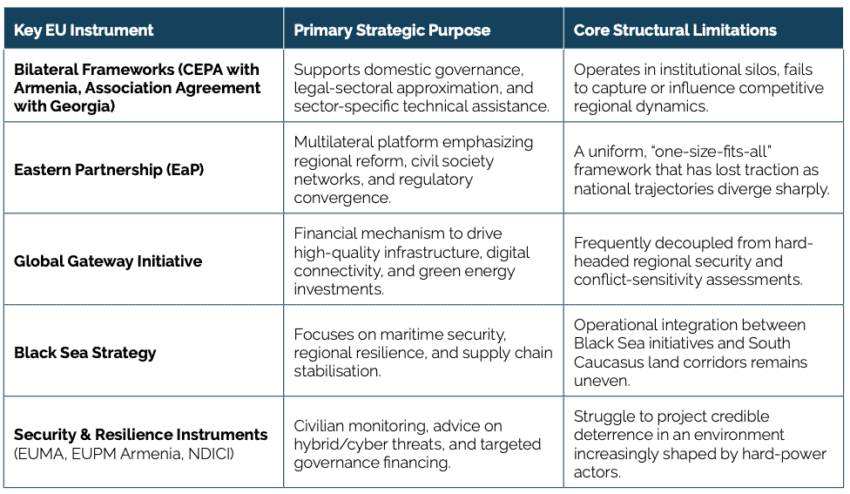 Source: Author’s compilation.
Three Countries, Three Realities
To construct a functional regional strategy, the European Union must solve a fundamental geopolitical puzzle: while the infrastructure of the South Caucasus, including transport arteries, power grids, and digital cables, is physically and economically interdependent, the political orientations of the three states are sharply diverging.
The region could not and, especially now, cannot be approached through a collective or uniform framework. Instead, Brussels faces three distinct and, more or less, independent actors operating on entirely different timelines and driven by unequal vulnerabilities. Their relationships with Europe have different motivations. Attempting to apply uniform democratic conditions or standardised trade programmes across this fragmented landscape will not lead to regional integration. It will simply cause the EU to lose leverage in all three capitals simultaneously.
The scale of this divergence is remarkably stark. Armenia has achieved a historic geopolitical realignment, formally moving to reduce its security ties to Russia and launching an EU accession pathway, supported by high-level bilateral summits and the deployment of a dedicated EU Partnership Mission to counter hybrid threats. Conversely, Georgia’s European integration path is at a de facto standstill due to severe domestic political polarisation and democratic backsliding by the ruling government, creating an acute disconnect between a passionately pro-European public and an increasingly illiberal state. Meanwhile, Azerbaijan operates from a position of intense post-war confidence, viewing its relations with the West through a strictly transactional lens. Baku leverages its role as a critical energy supplier and the primary geographic gatekeeper of the Trans-Caspian Middle Corridor to resist normative external pressure entirely.
For the EU, the strategic mandate is complex: it must craft a policy that is granular enough to meet each country exactly where it stands with deep understanding of internal developments and specifics, while ensuring that individual bilateral agreements do not inadvertently deepen regional fragmentation. Recent high-level EU visits and financial commitments represent positive steps towards a more active European role in the South Caucasus. However, these initiatives have not yet been brought together within a coherent regional strategy, and the EU’s growing engagement has not translated into corresponding strategic influence.[1]
Table 2: Divergence 2026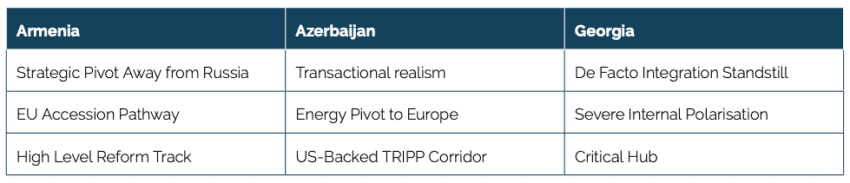 Source: Author’s compilation.
Armenia
In Armenia, security and economic policies are being radically transformed. Spurred by deep anxieties over the collapse of historical security arrangements with Russia, Armenia is seeking to diversify its security partnerships and strengthen cooperation with Western partners. The EU has responded to this opening by expanding confidence-building measures, offering rule-of-law assistance, and delivering concrete economic diversification support. This includes targeted initiatives where the European Commission is deploying expert groups to help Armenia diversify its energy imports away from total Russian dependence, backed by a €25 million investment in renewable energy infrastructure.
Furthermore, €18 million has been allocated to establish an Export Promotion Agency, completing a larger €52 million assistance package that brings total recent EU support to Armenia to €288 million. Crucially, the EU is opening its market to allow around eighty per cent of Armenian exports to enter duty-free, structurally redirecting products like fresh produce and alcoholic beverages away from the volatile Russian market. This economic track runs parallel to a high-level dialogue set for late 2026 to review multi-sector reform progress, as Armenia remains in an active visa liberalisation process, targeted for completion by 2029.[2]
Azerbaijan
Azerbaijan presents an entirely different strategic profile, defined by a confident post-war posture that emphasises absolute sovereignty and pragmatic multi-vector diplomacy with Turkey, Russia, China, and the West. Baku uses its energy exports as a primary mechanism of geopolitical influence, creating engagement opportunities for the EU that focus strictly on trade, Middle Corridor facilitation, and green energy cooperation under transparent commercial frameworks.
To solidify this policy, Baku has intensive interaction with the EU and its member states.
Recently, the European Commission has proposed launching an EU-Azerbaijan Connectivity Partnership, supported by Global Gateway grants of up to €200 million with the potential to mobilise up to €2 billion in total investment. This runs alongside a €20 million programme for demining, rural development, and healthcare.[3]
The EU is Azerbaijan’s largest trading partner, accounting for over forty per cent of its trade, while Azerbaijan represents nearly seventy per cent of the bloc’s trade with the South Caucasus. Half of Azerbaijan’s natural gas exports currently supply ten EU member states via the Southern Gas Corridor, and the country is rapidly expanding its commercial seaports, railway networks, and offshore Caspian wind capacity to establish a green energy corridor directly linking its grid to Europe. This economic leverage is augmented by a strong transatlantic dimension. Following historic meetings in Washington, cooperation has been formalised via the Trump Route for International Peace and Prosperity (TRIPP) initiative and a Strategic Partnership Charter signed by U.S. Vice President JD Vance and President Ilham Aliyev. This framework focuses on regional connectivity, security, and advanced technology, bringing over US$8 billion in American commercial agreements in artificial intelligence and advanced materials. These developments strengthen Azerbaijan’s position as an important regional transport and commercial hub. At the same time, Azerbaijani fuel supplies to Armenia represent a practical step towards economic cooperation and confidence-building between the two countries.[4]
Georgia
Georgia remains the most complex and unpredictable piece of the regional matrix. While public support for Euro-Atlantic integration remains exceptionally high, the country’s actual trajectory is heavily obscured by intense political polarisation, rule-of-law setbacks, and severe vulnerabilities to Russian and Chinese hybrid interference. The government’s unclear positions toward strategic Western partners, combined with an unbalanced foreign policy approach toward the eastern and southern neighbourhoods, make it highly difficult to predict future steps or the Western reaction to these shifting alignments.
This is further complicated by the utilisation of Georgian transport infrastructure to circumvent international sanctions against Russia, creating a deeply paradoxical situation where a vital transit state develops intense cooperation with the eastern endpoints of trade corridors while remaining in diplomatic conflict with the western end of those same routes. Despite this volatile environment, certain defensive adjustments have occurred. For instance, the Kulevi oil refinery, operated by Black Sea Petroleum, has committed to completely ending the importation and refining of sanctioned Russian crude oil by August-September 2026. Having refined over 650,000 tons of oil in the first half of 2026, the facility is transitioning exclusively to non-Russian feedstocks and expanding its automation infrastructure via Honeywell to secure uninhibited access to export markets.
Simultaneously, Georgia is attempting to build pragmatic links with rapidly developing Central Asian markets, highlighted by a comprehensive strategic cooperation agreement signed when the President of Uzbekistan visited Tbilisi. During President Serdar Berdimuhamedov’s visit to Tbilisi, Georgia and Turkmenistan agreed to deepen cooperation in transport and energy. They prioritised the development of the Trans-Caspian Middle Corridor and the Lapis Lazuli route and reaffirmed plans to connect Central Asian trade with European markets through Georgia’s Black Sea infrastructure. In the energy sector, both governments confirmed their readiness to develop joint trans-Caspian transit frameworks to route Turkmen energy resources toward Europe.[5]
This environment demonstrates that the EU’s policy must be flexible enough to treat each country on its own merits while ensuring that regional projects sequence mutual gains, lower logistics costs across borders, and mainstream strict conflict sensitivity to prevent bilateral frictions from shattering wider continental security.
This comparison illustrates that the European Union is no longer engaging with three countries moving along different stages of a common integration pathway. Instead, it faces three distinct strategic realities requiring different political, economic and security approaches. Armenia demands sustained support for reforms and diversification away from long-standing external dependencies. Azerbaijan requires a pragmatic partnership centred on connectivity, energy and regional stability, while acknowledging its preference for transactional cooperation. Georgia presents perhaps the greatest strategic dilemma, where continued public commitment to European integration contrasts sharply with growing political uncertainty and increasing external influence. Together, these realities confirm that future EU policy cannot be built on uniformity. Differentiated bilateral engagement is essential, but it must remain anchored within a coherent regional strategy that strengthens connectivity, reinforces stability, and advances Europe’s long-term strategic interests across the South Caucasus as a whole.
[1] Council of the European Union. (2026b, May 5). Joint declaration following the first Armenia–EU summit; European Commission. (n.d.-c). Georgia: EU enlargement policy; European External Action Service. (2026a, July 16). Armenia: EU launches partnership mission to support the country’s resilience against evolving hybrid threats.
[2] European Commission. (2026a, July 2). EU and Armenia strengthen their partnership, boosting resilience, trade and connectivity; Prime Minister of the Republic of Armenia. (2026, May 5). Statements summing up the inaugural Armenia–EU summit; Council of the European Union. (2026a). First report under the EU–Armenia visa liberalisation dialogue (ST 8858/2026 INIT).
[3] European Commission. (2026b, July 1). EU launches connectivity and communities support programmes for peace in the South Caucasus.
[4] European Commission. (n.d.-b). EU trade relations with Azerbaijan; European Commission. (n.d.-a). Diversification of gas supply sources and routes; Ministry of Foreign Affairs of the Republic of Armenia. (2026b, January 14). TRIPP Implementation Framework; President of the Republic of Azerbaijan. (2026, February 10). Charter on Strategic Partnership between Azerbaijan and the United States; Reuters. (2026a, June 2). US plans energy investments in Azerbaijan, says $8 billion in deals signed.
[5] European Commission. (n.d.-c). Georgia: EU enlargement policy; Black Sea Petroleum. (2026, July 31). Crude oil supply diversification statement; President of the Republic of Uzbekistan. (2026, July 3). Uzbekistan and Georgia elevate relations to strategic partnership; Government of Turkmenistan. (2026, July 18). Ashgabat and Tbilisi confirm readiness to expand strategic partnership in transport and energy.
A Region Shaped by External Actors: Multi-Polar Geopolitical Rivalry
The strategic vulnerability of the South Caucasus does not arise solely from its internal political differentiation, but from its role as an open geopolitical theatre where major regional and global powers directly project their security, commercial, and diplomatic influence. The era when the Russian Federation acted as the primary, unconstrained arbiter of Caucasian affairs has given way to a multi-polar, highly volatile balance of power. As the region becomes the central land bridge for Eurasian trade, anchoring both the Middle Corridor and Western-backed connectivity initiatives, external powers are no longer merely trying to influence local capitals. Instead, they are actively attempting to incorporate the South Caucasus into their own broad economic and security frameworks.
This competitive environment has reached an intense phase, turning physical infrastructure like rail lines, sea ports, and subsea cables into major points of strategic rivalry. The traditional regional order has been thoroughly destabilised by a series of major geopolitical shifts, including Russia’s long-term military diversion in Ukraine, the rollout of the US-mediated transit frameworks connecting Armenia and Azerbaijan directly to Western markets, and the severe strategic shockwaves stemming from the early 2026 military containment and joint US-Israeli strikes against Iran under Operation Epic Fury. The June 2026 Memorandum offered some hope of resolving the situation, but no concrete prospect of a settlement. As predicted, the agreement did not hold.
Following the collapse of the June 2026 Islamabad Memorandum of Understanding, which briefly established a 60-day truce to restore maritime shipping, the U.S. reinstated its naval blockade on July 8 over transit disputes and ship attacks, prompting Iran to formally suspend its participation ten days later. In the middle of July, the conflict degenerated into intense active warfare as U.S. forces launched consecutive nights of heavy airstrikes against southern Iranian air defences, naval positions, and vital transport and energy infrastructure to forcibly reopen the Strait of Hormuz. In response, Tehran declared a state of full-scale war, launching retaliatory drone and ballistic missile strikes against U.S. bases and regional host-nation energy infrastructure, which paralysed global maritime traffic and caused international energy prices to surge until regional mediators introduced an urgent ten-day ceasefire proposal to halt strikes and restart diplomatic negotiations.
These overlapping events have shattered the old status quo, forcing local elites into a complex game of diplomatic hedging. They must balance the immediate demands of adjacent hard-power states with the long-term economic incentives offered by global players like China and the European Union. For the EU, operating in this crowded landscape requires a shift in mindset. Brussels cannot treat external powers as secondary players or isolated variables; it must view them as active competitors who frequently offer rapid, transactional infrastructure financing free from any normative or democratic conditions.[1]
Table 3: The crowded geopolitical theatre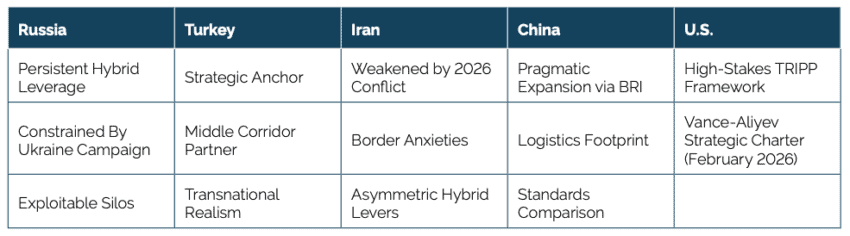 Source: Author’s compilation.
Within this crowded geopolitical theatre, the primary external actors operate with highly distinct strategic motivations, employing specific tools of influence that are constrained by unique baseline limitations, each carrying direct imperatives for European foreign policy.
The Russian Federation remains driven by the desire to retain historical hegemony over its self-defined near abroad, block the permanent consolidation of a Western security or normative footprint, and obstruct transport infrastructure that completely bypasses Russian territory. To achieve this, Moscow relies on its residual military footprints, including the 102nd Military Base in Armenia and occupation forces in Abkhazia and South Ossetia, alongside control over critical domestic infrastructure like gas distribution networks, and sophisticated hybrid warfare operations designed to exploit domestic polarisation, particularly within Georgia.[2]
However, Russia’s core capabilities are deeply constrained by the fifth year of its war in Ukraine, which has severely degraded its conventional military flexibility and forced it into a pragmatic, hands-off reliance on Azerbaijan to keep regional trade moving. This limitation creates a strategic imperative for the European Union to exploit Moscow’s current regional constraints, reinforcing local sovereign choices and economic autonomy while maintaining a clear-eyed, defensive posture to neutralise inevitable hybrid retaliation.
In contrast, the Republic of Türkiye seeks to establish itself as an indispensable Eurasian energy and logistics mega hub, project pan-Turkic influence into Central Asia via Azerbaijan, and balance its complex, multi-layered relationship with Russia. Ankara shapes its power through a comprehensive military-strategic alliance with Azerbaijan (formalised in the Shusha Declaration) direct participation in East-West transit infrastructure, and deep private-sector commercial footprints across the entire region. The core limitation of Turkish policy is its strict grounding in transactional realism and economic self-interest, meaning Ankara’s regional priorities are frequently detached from Western goals regarding human rights or democratic convergence. Consequently, the EU must treat Turkey as a critical, systemic partner for regional connectivity, actively coordinating along the Middle Corridor while pragmatically managing deep divergences on governance standards.
To the south, the Islamic Republic of Iran remains motivated by the need to prevent geopolitical encirclement, block Western-controlled transport infrastructure near its northern border, and maintain its vital territorial contiguity with Armenia. Historically, Tehran has utilised asymmetric hybrid leverage, cross-border trade networks, and localised security escalation capabilities to project influence. However, Iran is currently structurally weakened and deeply vulnerable following the devastating joint US-Israeli military strikes that began in February 2026 under Operation Epic Fury. Tehran is consumed by intense internal domestic fragility, severe economic isolation, and high anxieties regarding the security of its immediate border corridors. The strategic imperative for the EU is to ensure its regional diplomacy remains highly conflict-sensitive, developing infrastructure in a manner that avoids triggering defensive, zero-sum responses from a cornered Tehran, while keeping lines of communication open regarding border stability and non-provocative trade patterns.
Simultaneously, the People’s Republic of China is focused on securing, diversifying, and de-risking supply routes to European markets independent of Russian overland control, while expanding its geoeconomic footprint in strategic physical infrastructure. Beijing deploys targeted, state-backed commercial investments under the Belt and Road Initiative, rapidly acquiring ports, rail links, and digital networks through substantial credit lines offered without political conditionality. China’s main limitation is its highly cautious, hyper-pragmatic posture, as it rarely projects hard security or takes direct political risks, preferring to let other actors manage localised conflicts while it quietly secures commercial assets. This reality requires the EU to aggressively deploy its Global Gateway initiative to present a superior, high-quality alternative, insisting on absolute financial transparency, environmental sustainability, and international standard-setting to prevent regional infrastructure from being captured by Beijing’s state-backed enterprises.
Finally, the United States of America enters the matrix with the strategic motivation to completely dismantle Russian and Chinese monopolies over Eurasian transit, isolate Iran, secure direct access to critical minerals, and anchor the region firmly into Western-managed commercial and technological ecosystems. Washington leverages powerful diplomatic weight, substantial private-sector capital mobilisation, and direct bilateral security assistance. The core limitation of American policy stems from the current administration’s reliance on a highly transactional, hyper-focused model of commercial diplomacy that can occasionally bypass traditional multilateral institutions and European coordination tracks.
The strategic imperative for the EU is not simply to align with US initiatives, but to engage with them early and actively. This includes the TRIPP framework – the US-controlled entity managing the multimodal transit corridor across southern Armenia, as well as the U.S.-Azerbaijan Strategic Partnership Charter signed in Baku in February 2026 by U.S. Vice President JD Vance and President Ilham Aliyev. These initiatives create important opportunities for cooperation in connectivity, investment, advanced technology and regional security. At the same time, the EU should use its own political, regulatory and financial weight to help shape their direction where European interests, regional stability or long-term connectivity objectives require a different approach. By combining Global Gateway resources with US engagement while retaining a clear European strategic role, the EU can help ensure that transatlantic initiatives reinforce rather than bypass a broader European strategy for the South Caucasus.[3]
Taken together, these five actors illustrate that the South Caucasus has evolved into a highly competitive geopolitical environment in which multiple strategic agendas operate simultaneously rather than sequentially. For the European Union, this fundamentally changes the nature of engagement. Success can no longer be measured solely by the effectiveness of bilateral partnerships or the delivery of individual programmes. Instead, it depends on the EU’s ability to position its political, economic and security instruments within a broader strategic framework that anticipates the actions of competing powers, exploits areas of complementarity where possible, and protects European interests where competition is unavoidable. In this environment, the absence of a coherent regional strategy does not simply reduce the Union’s influence; it creates opportunities for external actors to shape regional developments in ways that may directly conflict with European strategic objectives.
[1] The American Presidency Project. (2026, June 17). Islamabad Memorandum of Understanding Between the United States of America and the Islamic Republic of Iran; Reuters. (2026b, August 25). US starts returning staff to Middle East missions after Iran war evacuations; Reuters. (2026c, August 29). War weighs on Iran’s economy as US intensifies sanctions.
[2] European External Action Service. (2026b, August 7). Georgia: Statement by the Spokesperson marking 18 years since the outbreak of the war between Russia and Georgia.
[3] Ministry of Foreign Affairs of the Republic of Armenia. (2026a, May 26). Framework Agreement on Strategic Cooperation Concerning TRIPP; President of the Republic of Azerbaijan. (2026, February 10). Charter on Strategic Partnership between Azerbaijan and the United States.
Towards a New EU Strategy: Objective, Principles, and Execution
The preceding assessment identifies three interrelated shortcomings in the EU’s current approach: the absence of an integrated regional strategy, the growing divergence of the three South Caucasus states, and the increasingly competitive geopolitical environment created by multiple external actors. Addressing these challenges requires more than incremental adjustments to existing policies. It calls for a coherent strategic framework that aligns the Union’s political objectives, financial instruments and institutional capacities around a common regional vision. The following principles are designed to provide such a framework.
To transition from a reactive, piecemeal stakeholder into a primary strategic architect, the European Union must anchor its foreign policy in a single, unshakeable core objective supported by guiding principles. The core objective dictates that the European Union will invest its political capital and financial leverage to transform the South Caucasus into a highly resilient, economically integrated, and politically stable geographic unit that actively secures European energy independence and supply chain security while protecting the sovereign choices of the regional states.
This objective must be operationalised through four core operating principles that eliminate the historical disconnect between financial outlays and geopolitical influence.
First, the principle of regional coherence with national specificity demands that the EU treat the South Caucasus as an interconnected strategic geographic unit when designing major economic and security frameworks, while concurrently avoiding a rigid approach by tailoring implementation tools to the specific domestic realities, institutional capacities, and foreign policy trajectories of Yerevan, Baku, and Tbilisi.
Second, the principle of conflict sensitivity and real-time de-escalation dictates that every economic project, financial injection, and institutional intervention must undergo continuous security assessments, ensuring that the EU’s footprint acts as an active catalyst for peace and deliberately minimises any risk of exacerbating historical or cross-border tensions.
Third, the principle of strategic connectivity and infrastructure independence requires that financial and technical resources strictly prioritise eliminating structural bottlenecks along trans-regional trade networks. By modernising ports, upgrading rail lines, and integrating digital grids, the EU will successfully diversify supply routes away from restrictive single-point dependencies and lock the region into Western commercial ecosystems.
Fourth, the principle of complementarity with strategic transatlantic partners ensures that the EU actively coordinates its diplomatic and financial initiatives with external partners, including the United States, NATO members, Turkey, and major multilateral financial institutions such as the European Investment Bank, the European Bank for Reconstruction and Development, and the World Bank, thereby maximising collective geopolitical leverage and avoiding duplicated efforts.
Europe’s Need for Institutional Innovation
The South Caucasus matters more to Europe today than at any point in modern history, serving no longer as a distant neighbourhood project but as an indispensable geoeconomic nexus. The EU possesses the correct tools, unmatched financial capacity, and deep normative appeal, but it currently lacks the structural synthesis required to deploy them cohesively. Without an immediate pivot to an integrated regional strategy, the Union risks being completely marginalised by faster, hyper-focused, and transaction-oriented global competitors. The EU’s actions must be rapid, reflect the Union’s interests as a whole, and provide effective mechanisms for implementing strategic goals. To turn strategic intent into structural impact, the European Commission must urgently implement three primary institutional innovations.
The first critical innovation could be an EU Regional Coordinator for the South Caucasus. This high-level envoy must be equipped with a direct, cross-institutional mandate to break down existing bureaucratic silos, effectively harmonising the daily operations of EU Delegations on the ground, Member State embassies, and Brussels directorates into a single, unified diplomatic front.
The second structural innovation is to launch a Pooled Eurasian Connectivity Facility. The EU should structurally blend Global Gateway grants, the Neighbourhood, Development and International Cooperation Instrument (NDICI) budgets, and European investment bank capital into a rapid-disbursing, flexible financial vehicle. This facility must be made capable of matching the tight delivery timelines of bilateral competitors, allowing Brussels to rapidly anchor multi-billion-dollar projects like the Middle Corridor and regional green energy networks without prolonged administrative delays.
The third institutional measure is a structured EU-U.S. mechanism for South Caucasus stabilisation and development. Brussels should institutionalise a direct, high-level coordination mechanism with Washington that allows the EU not only to align relevant regulatory, economic and infrastructure initiatives with U.S.-led frameworks, but also to help shape their direction where European interests, regional stability or long-term connectivity objectives require adjustment. This should include close coordination of European infrastructure investments with the TRIPP transit corridor and transatlantic defence-security assistance, while ensuring that these initiatives remain consistent with a broader European strategy for the South Caucasus.[1]
These institutional innovations should not be understood as independent initiatives, but as sequential components of a single implementation model. Effective regional policy begins with political coordination capable of establishing common strategic priorities and ensuring coherence across EU institutions and Member States. This political framework should then guide the allocation of financial resources through an integrated funding mechanism that aligns investment decisions with broader regional objectives. Finally, coordinated political leadership and targeted financing must translate into coherent implementation on the ground, ensuring that infrastructure, connectivity, governance, security and resilience initiatives reinforce one another and collectively advance the European Union’s long-term strategic interests in the South Caucasus.
By deploying this targeted, regionally coherent policy and executing these structural reforms, the European Union can permanently secure its long-term geoeconomic interests, safeguard the vital transit lines of the Middle Corridor,
[1] Ministry of Foreign Affairs of the Republic of Armenia. (2026a, May 26). Framework Agreement on Strategic Cooperation Concerning TRIPP.
References
Black Sea Petroleum. (2026, July 31). Crude oil supply diversification statement. https://bsp.com.ge/en/news/4/
Council of the European Union. (2026a). First report under the EU–Armenia visa liberalisation dialogue (ST 8858/2026 INIT). https://data.consilium.europa.eu/doc/document/ST-8858-2026-INIT/en/pdf
Council of the European Union. (2026b, May 5). Joint declaration following the first Armenia–EU summit. https://www.consilium.europa.eu/en/press/press-releases/2026/05/05/joint-declaration-following-the-first-armenia-eu-summit/
European Commission. (n.d.-a). Diversification of gas supply sources and routes. https://energy.ec.europa.eu/topics/energy-security/diversification-gas-supply-sources-and-routes_en
European Commission. (n.d.-b). EU trade relations with Azerbaijan. https://policy.trade.ec.europa.eu/eu-trade-relationships-country-and-region/countries-and-regions/azerbaijan_en
European Commission. (n.d.-c). Georgia: EU enlargement policy. https://enlargement.ec.europa.eu/countries/georgia_en
European Commission. (2025, May 28). New EU strategy for a secure, prosperous and resilient Black Sea region. https://enlargement.ec.europa.eu/news/new-eu-strategy-secure-prosperous-and-resilient-black-sea-region-2025-05-28_en
European Commission. (2026a, July 2). EU and Armenia strengthen their partnership, boosting resilience, trade and connectivity. https://enlargement.ec.europa.eu/news/eu-and-armenia-strengthen-their-partnership-boosting-resilience-trade-and-connectivity-2026-07-02_en
European Commission. (2026b, July 1). EU launches connectivity and communities support programmes for peace in the South Caucasus. https://enlargement.ec.europa.eu/news/eu-launches-connectivity-and-communities-support-programmes-peace-south-caucasus-2026-07-01_en
European External Action Service. (2026a, July 16). Armenia: EU launches partnership mission to support the country’s resilience against evolving hybrid threats. https://www.eeas.europa.eu/eupm-armenia/armenia-eu-launches-partnership-mission-support-countrys-resilience-against-evolving-hybrid-threats_en
European External Action Service. (2026b, August 7). Georgia: Statement by the Spokesperson marking 18 years since the outbreak of the war between Russia and Georgia. https://www.eeas.europa.eu/eeas/georgia-statement-spokesperson-marking-18-years-outbreak-war-between-russia-and-georgia_en
Government of Turkmenistan. (2026, July 18). Ashgabat and Tbilisi confirm readiness to expand strategic partnership in the transport and energy sectors. https://www.turkmenistan.gov.tm/index.php/en/post/108467/ashgabat-and-tbilisi-confirm-readiness-expand-strategic-partnership-transport-and-energy-sectors
Ministry of Foreign Affairs of the Republic of Armenia. (2026a, May 26). Framework Agreement between the Republic of Armenia and the United States of America on Strategic Cooperation Concerning the Trump Route for International Peace and Prosperity (TRIPP). https://www.mfa.am/en/press-releases/2026/05/26/TRIPP_Framework/13971
Ministry of Foreign Affairs of the Republic of Armenia. (2026b, January 14). Joint statement on the publication of the Armenia-U.S. Implementation Framework for the Trump Route for International Peace and Prosperity (TRIPP). https://www.mfa.am/en/press-releases/2026/01/14/TRIPP/13721
President of the Republic of Azerbaijan. (2026a, February 10). Baku hosted signing ceremony of ‘Charter on Strategic Partnership between the Government of the Republic of Azerbaijan and the Government of the United States of America’. https://president.az/en/articles/view/71562
President of the Republic of Azerbaijan. (2026b, February 10). Charter on Strategic Partnership between the Government of the Republic of Azerbaijan and the Government of the United States of America. https://president.az/en/articles/view/71553
President of the Republic of Uzbekistan. (2026, July 3). Uzbekistan and Georgia elevate relations to the level of strategic partnership. https://president.uz/oz/lists/view/9378
Prime Minister of the Republic of Armenia. (2026, May 5). Nikol Pashinyan, António Costa and Ursula von der Leyen make statements summing up the inaugural Armenia–EU summit. https://www.primeminister.am/en/interviews-and-press-conferences/item/2026/05/05/Nikol-Pashinyan-joint-statement/
Reuters. (2026a, June 2). US plans energy investments in Azerbaijan, says $8 billion in deals signed. https://www.reuters.com/business/energy/us-plans-energy-investments-azerbaijan-says-8-billion-deals-signed-2026-06-02/
Reuters. (2026b, August 25). US starts returning staff to Middle East missions after Iran war evacuations, sources say. https://www.reuters.com/world/middle-east/us-prepares-send-diplomats-back-middle-east-embassies-after-iran-war-evacuations-2026-08-25/
Reuters. (2026c, August 29). War weighs on Iran’s economy as US intensifies sanctions. https://www.reuters.com/world/asia-pacific/war-weighs-irans-economy-us-intensifies-sanctions-2026-08-29/
The American Presidency Project. (2026, June 17). Islamabad Memorandum of Understanding Between the United States of America and the Islamic Republic of Iran. https://www.presidency.ucsb.edu/documents/islamabad-memorandum-understanding-between-the-united-states-america-and-the-islamic