
Over the past decade, international technology companies have paid approximately EUR 2.2 billion to settle tax disputes in Italy, often without authoritative judicial clarification of the underlying tax obligations. What appears distinctive in Italy is the repeated combination of contested legal interpretations, criminal investigations, precautionary asset seizures and personal exposure for corporate executives.
These practices create incentives to settle rather than litigate, leaving fundamental questions of tax law unresolved and generating uncertainty for investors. For a country already lagging behind its European peers in attracting international technology investment, the economic consequences extend well beyond the companies directly affected. They also risk fragmenting the European Single Market and creating new tensions in transatlantic economic relations.
Italy Cannot Afford Another Investment Disadvantage
Italy has every right to collect tax and to go after evasion. Multinational companies are fully subject to Italian law. The issue is how Italian authorities enforce it and what this means for Italy’s attractiveness as an investment destination.
US companies account for approximately 11 per cent of Italy’s inward foreign direct investment stock, compared with 15 per cent in Spain, 17 per cent in France and around a quarter in Germany. If Italy simply matched Spain’s share, it would have around EUR 18 billion more in US investment, holding its total inward investment stock constant. Matching France’s share would imply approximately EUR 25 billion more.
Measured against the size of the economy, US investment amounts to 2.1 per cent of GDP in Italy, compared with 8.3 per cent in Spain. Between 2017 and 2024, US investment in Italy grew by 20 per cent. In Spain, it grew by 81 per cent.
These differences cannot be attributed directly to tax enforcement practices alone. Energy prices, permitting procedures and administrative burdens all play a role. The point is that Italy cannot afford to add another source of uncertainty.
The good news is that Italy is very much in the game for the next wave of cloud and AI investment. Microsoft announced EUR 4.3 billion in investment in 2024, its largest ever in Italy. Amazon Web Services announced more than EUR 1.2 billion in additional investment in its Milan cloud region.
But investment announcements are not money in the ground. Research by the Polytechnic University of Milan found that only around two-thirds of the data-centre investment forecast for Italy between 2023 and 2025 actually materialised. Almost three-quarters of the EUR 25 billion planned for the following three years depends on companies not yet operating in the Italian data-centre market.
Data centres are built in phases. Each phase can be delayed, scaled down or redirected to another country. The real risk is that Italy quietly loses the next expansion phase to Madrid, Paris or Frankfurt. And legal predictability matters precisely at this margin.
Billions in Settlements, but Little Legal Clarity
The scale of Italy’s digital-tax cases is remarkable. Apple paid EUR 318 million in 2015, Google EUR 306 million in 2017, Airbnb EUR 576 million in 2023 and Amazon EUR 527 million in a settlement agreed in December 2025. Together with other settlements, these payments amount to approximately EUR 2.2 billion. Another EUR 1 billion is being claimed from Meta, LinkedIn and X.
Yet almost none of these cases has produced an authoritative court judgment clarifying the underlying contested tax interpretations. Table 1 below provides a short overview of the cases.
Table 1: Reported amounts in Italian tax enforcement cases against major digital and platform companies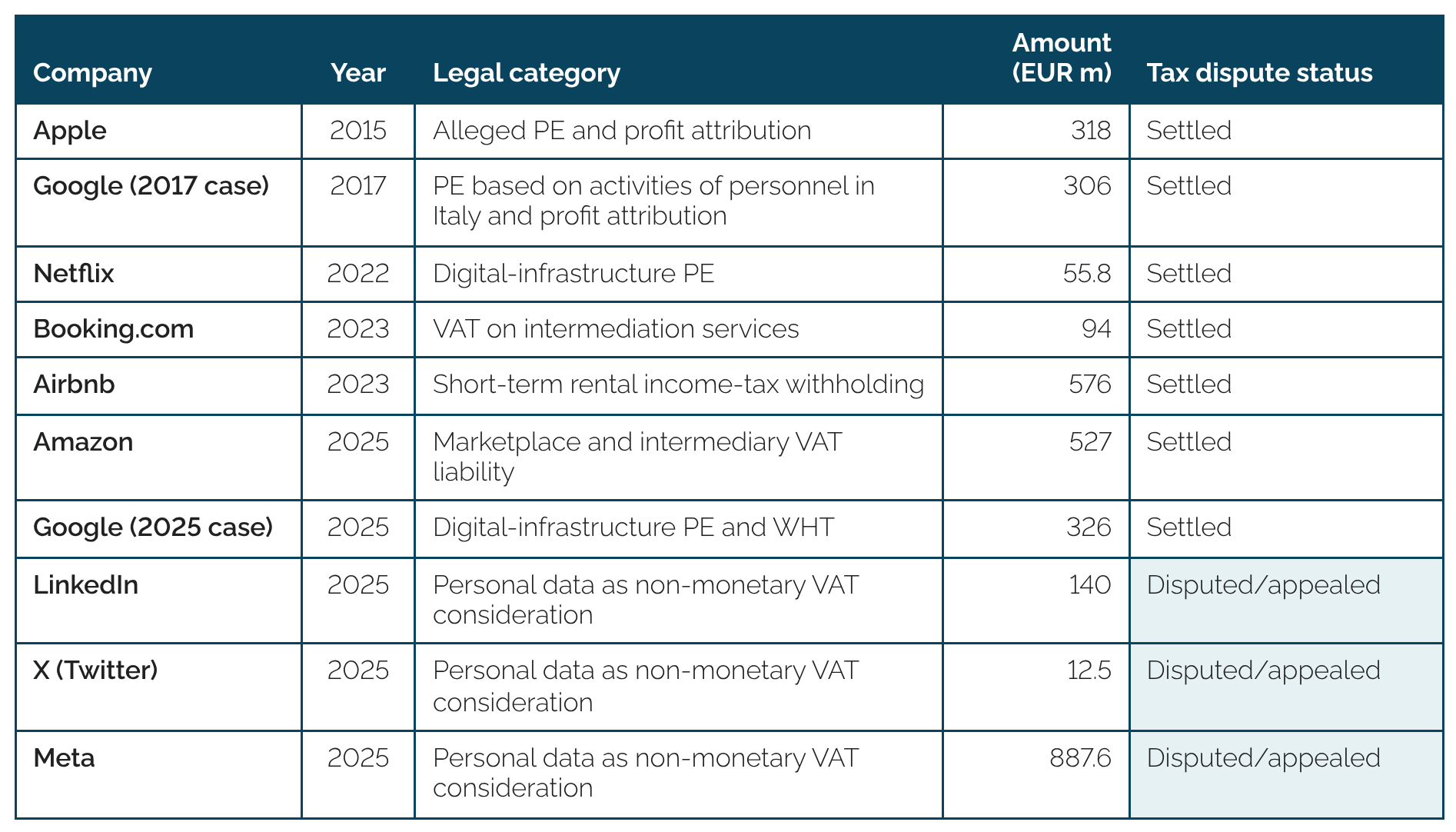 Source: ECIPE elaboration based on publicly reported cases. PE = permanent establishment; WHT = withholding tax. Settlements do not necessarily imply an admission of liability or the termination of related criminal proceedings. Disputed amounts remain subject to change.
Not all cases are alike. Some concern relatively well-established obligations, such as Italy’s requirement that Airbnb withhold a 21 per cent tax on short-term rental income, which was largely upheld by the European Court of Justice in 2022. Companies must comply with such obligations. Other cases, however, involve genuinely contested questions of tax law.
The first concerns whether personal data constitutes payment. The Italian authorities argue that users of services such as Facebook and Instagram provide personal data in exchange for digital services, creating a transaction subject to VAT. On this basis, Italy has claimed almost EUR 888 million from Meta, EUR 140 million from LinkedIn and EUR 12.5 million from X.
This interpretation is difficult to reconcile with the non-binding position expressed by the EU’s VAT Committee in 2018. Subsequent consideration at EU level has pointed towards more specific circumstances in which VAT could apply. There is also a practical economic problem: where a service has no monetary price, there is no straightforward mechanism for collecting VAT from users or valuing their individual data.
The second question concerns whether servers create a taxable presence. Milan investigators argued that around 350 Netflix servers located in third-party Italian data centres constituted a permanent establishment. Netflix settled for approximately EUR 56 million in 2022. Google faced a similar dispute involving digital infrastructure and paid EUR 326 million in 2025.
International tax rules recognise that computer equipment can, under certain conditions, constitute a permanent establishment. Whether those conditions were satisfied in these cases remains unresolved.
A settlement resolves one company’s tax bill. It does not tell other companies where the legal boundary lies. For Italy, which is actively seeking investment in digital infrastructure, this uncertainty is particularly problematic.
The Milan Model: Why Companies Pay Even When They Believe They Are Right
At the heart of these cases is Italy’s dual-track enforcement system. Administrative tax assessments and criminal investigations can proceed in parallel. The latter can involve searches, precautionary asset seizures and personal investigations of company executives.
In Milan, close cooperation between prosecutors, the Guardia di Finanza, the Revenue Agency and customs authorities has become known as the Modello Milano – the Milan model.
The two enforcement tracks do not necessarily end together. Three months after Amazon reached its December 2025 settlement with the Revenue Agency, Milan prosecutors requested that its European company stand trial.
In February 2026, as part of a separate investigation into Amazon’s alleged undeclared permanent establishment in Italy, the Guardia di Finanza searched Amazon’s Milan headquarters, the private homes of seven managers and the offices of its tax adviser KPMG. According to Amazon, the company had already sought formal clarification from the Italian Revenue Agency on the tax treatment of the activities under investigation.
Three economic considerations can make settlement rational, irrespective of the merits of the underlying tax claim: uncertainty about eventual tax liabilities, the immediate costs of legal proceedings and frozen assets, and the personal exposure of executives to criminal proceedings.
Airbnb illustrates these dynamics. In November 2023, a Milan judge ordered the seizure of almost EUR 780 million, and three managers were placed under investigation. Five weeks later, Airbnb agreed to pay EUR 576 million without admitting liability.
A settlement reached under such circumstances tells us relatively little about the legal merits of the underlying dispute. Authorities collect revenue, companies reduce their immediate exposure, but other investors receive little additional guidance about their own obligations.
The uncertainty survives the settlement.
Italy is of course not alone in criminalising serious tax offences. France, for example, has pursued cases involving Google and Netflix. However, Google’s French case ended in 2019 with a negotiated resolution covering both the criminal and administrative dimensions. Moreover, our research did not identify a comparable pattern of recent criminal-tax proceedings against major technology companies in Germany or Spain.
What appears distinctive in Italy is the repeated combination of contested tax interpretations, coercive enforcement measures and relatively limited opportunities for comprehensive resolution. While the cases are concentrated in Milan, investors assess country risk. The investment risk therefore extends throughout Italy.
Clarify the Law First, Then Enforce It Firmly
The implications go beyond Italy. Many of the companies concerned are American. Where enforcement practices are perceived as discriminatory or insufficiently grounded in established law, domestic tax disputes risk becoming transatlantic trade disputes.
There is also a Single Market problem. Divergent national interpretations of common European tax rules can create different liabilities for economically identical activities. The costs do not stop with large technology companies. European SMEs increasingly depend on advanced ICT and AI services, online marketplaces and digital advertising.
Italy should distinguish more clearly between deliberate tax evasion, abusive practices and legitimate disputes over tax interpretation. Criminal procedures and asset seizures must not become the instruments for testing disputed tax theories.
The EU should clarify the VAT treatment of data and make tax certainty an integral part of its competitiveness agenda. The United States should raise legitimate concerns through EU–US dialogue rather than resorting to economically damaging trade retaliation. And the OECD should prioritise simplification and dispute prevention over additional layers of corporate tax code complexity.
Italy is right to fight tax evasion. But using criminal investigations, asset seizures and settlement pressure to test interpretations of tax law that courts have yet to confirm sends a troubling signal to every investor deciding where to build the next data centre, establish a research facility or open a new manufacturing site.