
Summary
DOWNLOAD PDFThe European Union is discussing ways to raise revenues for its budget that come from so-called “own resources”. In a proposal for the next Multiannual Financial Framework, the European Commission has proposed several new own resources. However, many of the proposed new own resources have drawn criticism from EU member states who fear that the EU would eat into their own revenue streams.
In this paper, we propose a new own resource based on online gambling. Building on the pragmatic model applied in the EU’s existent own resource based on non-recycled plastic waste, member states would make national contributions to the EU budget based on a decided call rate on the Gross Gaming Revenue for online gambling recorded in their territories.
There are several advantages offered by this new own resource and in online gambling as the source activity for new EU revenues. First and foremost, it would raise significant revenues for the EU – up to EUR 5 billion annually in a scenario of a moderate call rate. Online gambling is a rapidly growing sector and, therefore, a rapidly growing revenue base. It faces a relatively low tax burden in most EU member states – compared to the tax burden on land-based gambling and other recreational or entertainment services. While the tax rate varies across the EU, it remains on average relatively low.
Experiences from recent examples of increasing tax rates for online gambling also suggests that total revenues will not be depressed by a tax increase – should EU governments decide to fund the new national contribution through a tax increase. Online gambling is a growing tax base that is yet to reach the peak of the “Laffer curve” of taxation. A national contribution to the EU could, therefore, be based on a higher tax rate that do not compete with the revenues that EU governments are raising today.
1. Introduction
The European Union has long sought to develop new “own resources” for its annual budget. Own resources are simply defined as the guaranteed revenue streams around which the EU configures its budget. While the category can be a bit confusing as it incorporates different sources of revenues for the EU, it is best divided into two sub-categories. The first being revenue sourced from the member states, like the Gross National Income (GNI) based contribution which forms the biggest portion of EU revenue, and the EU’s 3.5 per cent share of member states’ total Value Added Tax (VAT). The second sub-category is often termed “genuine” own resources, given that they are collected directly by the EU. This includes the original genuine own resource, custom duties, and a levy on the total unrecycled plastic waste by each member state. Currently this levy sits at EUR 0.8 per kilogram, but the European Commission aims to increase this rate to EUR 1 per kilogram in 2028 by indexing it to inflation to further discourage increased waste and allow for sustained revenue.[1]
Following a decline in revenues from the original own resource, customs duties, calls for new ones have grown stronger over time. The proposed 2028-2034 EU Multiannual Financial Framework (MFF) takes a new step to develop new genuine own resources. Genuine own resources provide greater fiscal independence to the EU and help fund growing expenditures. In the current MFF, approximately 30 per cent of the revenue each year between 2021 and 2026 comes from genuine own resources, while the remaining 70 per cent is formed by the GNI-based contribution.[2] However, it has long been considered important for the EU to avoid competing with member state governments over taxes and tax bases. New (genuine) own resources should preferably not lead to a reduction of tax revenues in member states.
The proposed MFF includes bold proposals from the European Commission. It seeks to expand the EU’s own resources to include five new own resource streams. These are: 1) 30 per cent of the funds from the existing Emissions Trading System (ETS); 2) 75 per cent of the funds from the Carbon Border Adjustment Mechanism (CBAM); 3) an all new unrecycled e-waste contribution identical in structure to the plastic waste own resource; 4) a 15 per cent share of member state tax revenue on tobacco products; and 5) the Corporate Resource for Europe (CORE) contribution, which presents a lump-sum bill to companies with annual turnover of over EUR 100 million, ranging from EUR 100,000 to EUR 750,000.[3] In all, these proposals are expected to amount to an average of EUR 44 billion for the EU budget each year. [4],[5]
Many of these proposals have already drawn the ire of member state governments. While there is an ongoing process involving the European Parliament and the Council negotiating these proposals, it seems unlikely that some of these own revenues will be included in the next MFF. The criticism against them takes aim at different aspects of the proposed own resources, but a common thread is that several of them will eat into the tax revenues of EU member states; that they represent a shifting/re-allocation of revenue rather than genuine new resources; that they apply to uncertain or shrinking tax bases; and will subsequently generate political controversy in many countries. In the case of CORE, for example, it has been argued that a tax on doing business in the EU will negatively impact competitiveness.[6]
In this paper we propose the development of a new EU own resource based on online gambling. We outline why such an own resource would be fiscally valuable, and how it could be managed and avoid the EU competing with member states over revenues. An own resource based on revenues from online gambling has been discussed for many years.[7] This begs the question as to why such a proposal was not included in the original MFF proposal from the European Commission. EU institutions have made some back-of-the-envelope estimations of how much revenue it could generate for the EU – and the estimates are pointing to notable revenues. Importantly, it could be designed to avoid common problems related to own resources that imitate direct taxation.
Chapter 2 outlines the idea of an own resource based on online gambling. Chapter 3 provides a first estimate of the revenues it could generate by 2030, depending on different design choices. Chapter 4 concludes the paper.
[1] Dobreva, A. (2026). Proposal for a Council decision on the system of own resources of the European Union and repealing Decision (EU, Euratom) 2020/2053 – COM(2025) 574, 16.7.2025 (EPRS Briefing No. PE 782.679). European Parliamentary Research Service. https://www.europarl.europa.eu/RegData/etudes/BRIE/2026/782679/EPRS_BRI(2026)782679_EN.pdf
[2] This excludes miscellaneous income (i.e. surpluses and carry-overs, lending income, etc.). See, European Commission. (2026). Annual EU budget: All annual budgets. https://commission.europa.eu/strategy-and-policy/eu-budget/annual-eu-budget/all-annual-budgets_en
[3] In effect a 0.1 per cent tax on turnover (in ascending brackets) for companies with revenue between EUR 100,000,000 and 750,000,000.
[4] European Commission. (2025). A dynamic EU budget for the priorities of the future: The Multiannual Financial Framework 2028–2034 (COM(2025) 570 final). https://eur-lex.europa.eu/legal-content/EN/TXT/PDF/?uri=CELEX:52025DC0570
[5] Baert, P. (2025). Revision of the Tobacco Taxation Directive (EPRS Briefing No. PE 775.907). European Parliamentary Research Service. https://www.europarl.europa.eu/RegData/etudes/BRIE/2025/775907/EPRS_BRI(2025)775907_EN.pdf
[6] van der Vlugt, S. (2025). The ‘CORE’ contribution as a new EU own resource and its legal consequences. EUR Research Information Portal. https://pure.eur.nl/ws/portalfiles/portal/206365631/THE_CORE_.pdf
[7] An EU resolution from 2013 discusses the requirement for tax coordination, albeit stopping short of calling for a central tax. See European Parliament, Committee on the Internal Market and Consumer Protection. (2013). Report on online gambling in the internal market (2012/2322(INI)) (A7-0218/2013). https://www.europarl.europa.eu/doceo/document/A-7-2013-0218_EN.html
2. Online Gambling as a Basis for an Own Resource
Online gambling is a good target for an EU own resource for several reasons. The first is that significant revenues can be raised without having to establish a complex and costly structure for revenue collection. The purpose of an own resource is to raise sufficient revenue for the EU and, as will be shown later, an own resource based on online gambling does the job. Moreover, an own resource should ideally not just be a reallocation of tax revenues between an EU member state and the EU. An online gambling resource may also be originated as a new revenue stream.
When online gambling has previously been discussed as an own resource, it has been proposed as a direct tax applied at the EU level on a chosen metric of revenues from online gambling services. We in turn think the principal model used for the plastic waste levy is an instructive and pragmatic example for an own resource based on online gambling. Under the plastic waste levy, each member state makes a national contribution to the EU budget based on the total mass of unrecycled plastic packaging waste calculated within their borders. As in the plastic-contribution’s case for instance, some EU member states have introduced a tax on plastic packaging, while others have just drawn from existent revenue streams. How each EU member state will raise the revenue for the national contribution is left to their discretion.
While the plastic waste levy did have teething problems, the diversity of options for revenue collection has been a strength. In principle, revenues can be collected but the EU does not need to mandate how. The plastic contributions have accumulated to become a significant sum: the EU receives around 4 per cent of its revenues from this own resource, which in nominal terms means between EUR 7 and 8 billion per fiscal year.[1]
Replicating this proven model avoids complicated legal issues around direct EU taxation or revenues based on harmonisation of tax rates or tax bases. For practical purposes, we envision a similar logic as for the plastic waste contribution: the national contribution will be decided based on a selected metric of economic activity or revenue in online gambling. In our estimates of what revenues such national contributions could generate, we have used the Gross Gaming Revenue (GGR) for online gambling in EU member states. Other metrics have been used in other estimates.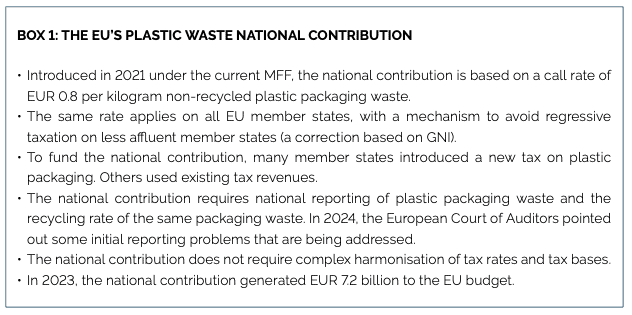 Besides generating revenue, the plastic levy also allows for EU-wide progress on its environmental objectives to reduce plastic waste and encourage recycling. Therefore, it maintains the triple benefit of sustained revenue, political feasibility, and alignment with core policy agenda.[2] In this sense as well, our proposition of an online gambling premium is similar. Pursued with care and precision, an own resource based on online gambling would raise revenue for the EU while being politically feasible. It also helps place greater attention on the social harms of gambling – especially those associated with online gambling. [3]
The reasons for focus on online gambling, as opposed to an all-gambling own resource are plentiful. Land-based gambling is already subject to substantial added costs and taxes that do not apply to online gambling. Land-based gambling is both capital and labour intensive, sustaining a microeconomy which includes tourism and employment.[4] An own resource based on online gambling also connects directly with the essence of the EU single market because, unlike land-based gambling, it is an inherently cross-border activity and the sector relies on cross-border distribution. Online gambling is therefore much harder to regulate and, with a growing illegal market, poses greater public health concerns. It has higher proportions of high-risk and problem gambling in comparison to land-based gambling, and resulting in higher levels of indebtedness on average.[5],[6] While being more accessible to vulnerable people than land-based gambling, online gambling also offers little of the social and economic welfare attributable to the latter.[7] At the same time, revenues from online gambling have continued to soar, not least because of increased spending on marketing and gamer acquisitions.[8]
While a national contribution-based model is firmly anchored in the basic laws of the EU and the regulations of the single market, it is understood that EU member states are already taxing online gambling, and at very different rates. Most (but not all) states have settled on a GGR-based tax to avoid complex differences between types of online gambling with different house margins. Many EU governments have also been raising the tax rate. However, with some exceptions, taxes on online gambling remain comparatively low – especially considering online gambling not being subject to VAT in many countries.
This points to two other advantages of an own resource based on online gambling. First, for those EU countries that wish to do so, there is an opportunity to raise tax rates to fund the national contribution without approaching levels of tax rates that lead to a reduction in tax revenues. In other words, they have not reached the peak of the “Laffer curve” of taxing online gambling. Second, and relatedly, this own resource does not necessarily have to compete with EU member states about the use of an existing stream of tax revenues. This makes such an own resource distinct from some other proposed new own resources, for which the chief concern among many governments in the EU is that they would lose income. Therefore, in the estimates presented in this paper we assume that member states will increase their current rate of tax and, consequently, that the GGR will be affected by the higher tax rate.
While member states do not need to tax online gambling in addition to current taxation, raising the tax rate would also even out the effective tax differential between different forms of gambling and other recreational services in most EU countries. It is unlikely that demand would be dampened by small-to-moderate tax increases. There is remarkably strong growth in the market for online gambling. While there is variety between countries, an industry body forecasts online gambling in Europe to grow by 6.9 per cent per year through this decade.[9] This trend is structural rather than cyclical and a moderate increase in tax rate is not going to change the gambling sector’s structural shift to online business. There are also high margins in the sector, which means there is absorptive capacity in the industry to accommodate higher rates of tax on online gambling while continuing its growth and maintaining odds and payouts.
Recent studies also present observations which refute a general problem for the industry to accommodate higher tax rates. The UK’s National Centre for Social Research observed in a 2022 study that the top 1 per cent of online slots players accounted for 40 per cent of the revenue. For online casino games, the top 1 per cent represented nearly 60 per cent of the revenue, while the top 5 per cent of players accounted for more than 80 per cent of the revenue. Unfortunately, as highlighted, there are social and distributional consequences of online gambling – addiction, for instance.[10] Overall, the profile of revenue distribution in the sector suggests that a higher rate of tax can be accommodated because of relatively inelastic demand.
Some recent examples of tax increases in online gambling give weight to this thesis: demand has been sustained, even grown, despite increases in taxes. In 2021, for example, Denmark increased its GGR-based tax from 20 to 28 per cent. Some industry-predictions suggested revenues to go down for the licensed market, but that scenario did not materialise. Online gambling revenues continued to increase despite the tax hike, with land-based gambling recovering up to and quickly exceeding pre-COVID figures following the easing of restrictions.[11] Italy, Europe’s largest gambling market in absolute terms, is another case. A multi-year study covering the period 2006-2017, showed that contrary to intuition gambling revenue was increasing (particularly that of online gambling in latter years) even as successive governments were increasing taxation with the aim of reducing gambling figures.[12] In 2024, Sweden raised its tax rate for gambling from 18 to 22 per cent. Market growth moderated in 2025, but online gambling revenues still grew by more than 3 per cent in that year.[13]
The case of the Netherlands is sometimes suggested to prove the opposite: that new taxes on online gambling suppress demand and revenue. It is correct that the country experienced a contraction in its gambling tax revenues following the increased tax rate for 2025 onwards. However, the Dutch government cautions against such a reading. In fact, it says that the recent market development is impacted by significant regulatory interventions. The tax hike was preceded by advertising and sponsoring restrictions, with new restrictive policy implementations each year between 2023 and 2025, and mandated betting limits varying with age. In response, pass through was widely increased, resulting in lower payouts to gamblers and thus a contracted market.[14]
Illegal online gambling is clearly a big concern, but that is an argument for taking stronger measures against illegal activities – not to leave licensed online gambling untaxed or unregulated. Like in other areas, illegal activities require more enforcement – and there is certainly a lot more that can be done to enforce regulation. Illegal operators, for instance, rely on a legal supply chain of advertisement and payment. While it has been argued that tax increases could also lead to a shift from licensed gambling to illegal gambling, this is largely not the case, outside of problem and high-risk gamblers chasing higher payouts. There is little concrete evidence to suggest that a moderate tax increase would deter legal gambling and push gamblers to the illegal activities. For instance, a recent cross-border study showed a weak link between lower taxes and increased channelisation (or the diversion of illegal gambling traffic towards safer, regulated alternatives), and vice versa.[15]
The market itself is the strongest proof of point. Licensed online gambling in Europe is growing, despite new and higher taxes. The mean tax rate on online gambling has increased across the EU, but channelisation has increased, too.[16] This has also been proven in the Denmark case, whilst in the Netherlands the tax increase and anti-gambling regulation of recent years have not decreased the channelisation rate in terms of the number of gamblers, as 91 per cent of gamblers gambled in legal markets after the tax hike compared with 92 per cent pre-hike. It is only in monetary terms that it decreased, with the GGR of the illegal market growing relative to the legal market, hinting at a shift in the addict/problem gambler group.[17]
An own resource based on national contributions calculated on the GGR for online gambling will require new reporting instruments for the EU. While this will involve some legislative developments, the challenges should not be overstated. As already pointed out, many EU states already use GGR as bases for national taxation. The industry also uses GGR as metric and collects data for it. All own resources – current and proposed – are associated with the need to develop the reporting of data and establishing standards that are transparent and correct. This can be achieved in the EU without complex legislation or costly mechanisms for reporting.
[1] European Court of Auditors. (2024). EU revenue based on non-recycled plastic packaging waste: A challenging start hindered by data that is not sufficiently comparable or reliable (Special Report 2024/16). https://www.eca.europa.eu/ECAPublications/SR-2024-16/SR-2024-16_EN.pdf
[2] Schratzenstaller, M. (2026, March). New own resources for the EU budget (Policy Brief). Foundation for European Progressive Studies. https://feps-europe.eu/wp-content/uploads/2026/03/New-own-resources-for-the-EU-budget.pdf
[3] See Wardle, H. et al. (2024). The Lancet Public Health Commission on gambling, The Lancet Public Health, 9(11), e950–e994, available at: https://doi.org/10.1016/S2468-2667(24)00167-1; and CPME. (2026). Policy on gambling and gaming (CPME AD 21032026 069(2025) FINAL). CPME AISBL. https://www.cpme.eu/api/documents/adopted/2026/03/cpme_ad_21032026_069(2025).final.policy.gambling.gaming.pdf
[4] Boto-García, D., & Pérez, L. (2023). Tourism seasonality and gambling: The role of a new casino’s opening. Annals of Tourism Research, 99, Article 103529. https://doi.org/10.1016/j.annals.2023.103529
[5] See for reference Hing, N. et al., Gambling prevalence and gambling problems amongst land-based-only, online-only and mixed-mode gamblers in Australia: A national study, Computers in Human Behavior, 132, 2022, Article 107269, available at: https://doi.org/10.1016/j.chb.2022.107269; and Estévez, A. et al., How do online sports gambling disorder patients compare with land-based patients?, Journal of Behavioral Addictions, 6(4), 2017, pp. 639–647, available at: https://doi.org/10.1556/2006.6.2017.067.
[6] See P. Gómez et al., Minors and online gambling: Prevalence and related variables, Journal of Gambling Studies, 36, 2020, pp. 735–745, available at: https://doi.org/10.1007/s10899-019-09923-3, and Nerilee Hing et al., Do advertising and promotions for online gambling increase gambling consumption? An exploratory study, International Gambling Studies, 14(3), 2014, pp. 394–409, available at: https://doi.org/10.1080/14459795.2014.903989
[7] James Noyes, The duty to differentiate: How gambling tax reform can raise revenue for the Government, reduce harm to the public and save British horse racing, Social Market Foundation, July 2025, available at: https://www.smf.co.uk/wp-content/uploads/2025/07/The-Duty-to-Differentiate-July-2025.pdf
[8] For reference the revenue of the six largest online gambling companies operating in Europe (Betsson, Bet365, Entain, Evoke, Flutter, and Super Group) was a reported EUR 28.5 billion, while marketing spend we have estimated to over EUR 6.6 billion.
[9] European Gaming and Betting Association. (2025b). European Gambling Market Reaches €123.4 Billion in 2024, With Online Gambling Approaching 40% Market Share. https://www.egba.eu/news-post/european-gambling-market-reaches-e123-4-billion-in-2024-with-online-gambling-approaching-40-market-share/
[10] See Forrest, D. et al. (2022). Patterns of play: Extended executive summary report. NatCen Social Research. https://natcen.ac.uk/sites/default/files/2023-03/Patterns%20of%20Play-%20Summary%20Report.pdf; and Fiedler, I. et al. (2019). Gambling spending and its concentration on problem gamblers. Journal of Business Research, 98, 82–91. https://doi.org/10.1016/j.jbusres.2019.01.040.
[11] Spillemyndigheden. (2025). The gambling market in numbers 2024. https://spillemyndigheden.dk/media/edbpfkpd/gambling-market-in-numbers-2024.pdf
[12] The authors in particular mention the increased payout of online gambling (page 4, footnote 6). Here we can observe the logic deduced above, the lower cost and overall tax burden of online gambling relative to land based gambling, allows for higher payout or a lower pass-through of taxes to consumers when compared with the latter. Whilst the overarching point that increased taxes (up to a point) do not necessarily coincide with reduced gambling revenue, given the revenue stream of problem and addicted gamblers is stressed. See Valdes, C., & Frattola, E. (2019). Ma le tasse sul gioco d’azzardo funzionano davvero? Osservatorio Conti Pubblici Italiani, Università Cattolica del Sacro Cuore. https://osservatoriocpi.unicatt.it/cpi-gioco_azzardo_OCPI.pdf
[13] Spelinspektionen. (2026). Nyckeltal: Spel hos aktörer med svensk licens eller tillstånd 2025. https://www.spelinspektionen.se/om-oss/statistik/
[14] Kansspelautoriteit. (2025). Effecten op de kansspelmarkt: Verhoging kansspelbelasting. https://kansspelautoriteit.nl/sites/default/files/effecten_verhoging_kansspelbelasting.pdf
[15] Of course, it is to boil it down the authors’ core point, that taxation and channelling do not have a linear nor a one-to-one relationship, and that the cluster of regulation around gambling, and the size of the legal market relative to the illegal, dictate channelling rates. Which aligns with the Dutch experience. See Marionneau, V. et al. (2025). Channelling and taxation in European online gambling markets: Evolution and policy implications. Harm Reduction Journal, 22, Article 1. https://doi.org/10.1186/s12954-024-01145-0
[16] Ibid.
[17] Kansspelautoriteit. (2025). Effecten op de kansspelmarkt: Verhoging kansspelbelasting, pp. 22–24. https://kansspelautoriteit.nl/sites/default/files/effecten_verhoging_kansspelbelasting.pdf
3. Revenues: Online Gambling as an Own Resource
A national contribution based on online gambling could generate significant revenues for the EU. Online gambling is a rapidly growing sub-industry, on track to overtake land-based gambling in revenue terms. It is thus not an economic activity that is declining for economic or political reasons, even if many governments rightly use taxes of online gambling to address negative social consequences of gambling.
The European Gaming and Betting Association (EGBA) expects online gambling to form 45 per cent of European Gross Gaming Revenue (GGR) by 2029, or EUR 66.8 billion, whilst confirmed figures for 2023 amount to EUR 42.9 billion.[1] Across the EU, gambling tax regimes widely vary, with some states applying a broad tax on all forms while others differentiate by the type – land-based or online, casino-type game or online betting, for instance. A point of convergence in the majority of EU countries is the application of a tax on online gambling GGR.[2] In practice here, the difference between total stake or amount gambled, minus the winnings paid out, is taxed before any other costs or taxes are applied. Across tax-regime types, rates vary from a high of 45 per cent on GGR set to be applied in Austria, to a low of 5 per cent currently applied in Malta on all forms of gambling (albeit with changes due).[3]
What would an own-resource national contribution based on online gambling generate for the EU? Using the logic behind the plastic packaging waste contribution, revenues can be estimated and calculated using forecasted figures for GGR posted by the member states.[4] These forecasts for GGR reported by member states could be used to calculate the contribution as a fixed percentage. Revenues will depend on the applied call rate, and below we test two ballpark scenarios: a low of 3.5 per cent and a moderate of 10 per cent. Based on our estimations, an online gambling contribution could provide the EU budget with a low of EUR 1.7 billion and a high of EUR 4.7 billion by 2029. This is a significant revenue stream which fares well in comparison with other proposed own resources in the new MFF. For instance, the proposed CBAM revenue is expected to total EUR 1.6 billion. CORE is expected to generate EUR 6.8 billion. Obviously, if the call rate exceeds 10 per cent, the national contributions to the EU would be higher.
Table 1 shows the potential revenue accruable to the EU budget. These were calculated using the reported European Gaming and Betting Association online GGR forecasts for 2023-2029. A hypothetical scenario with the proposed contribution applied from 2023 onwards is used to estimate potential revenue.
Table 1: Estimated EU revenues from a 10 and 3.5 per cent online gambling contribution, 2023-2029 (EUR Bln)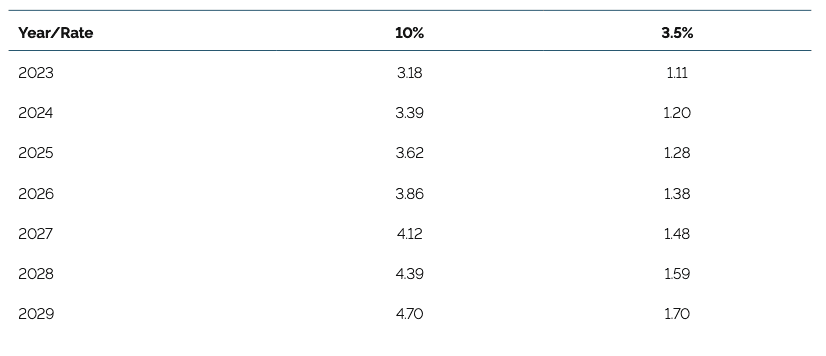 Source: ECIPE calculations.
A further merit of model for this own resource is that it allocates contribution based on the size of their online gambling market, mirroring the plastic packaging contribution and the e-waste levy proposal. For reference, Romania and the Czech Republic whose GNI contribution placed them twelfth and thirteenth on the EU list for 2023, would be eighth and ninth largest contributors in our hypothetical case. In effect, every member state would contribute based on a metric that is not a direct reflection of prosperity. Based on the estimates, Italy would have contributed EUR 460 million, Sweden, EUR 166 million, and Malta, EUR 14 million, under a 10 per cent scenario for the year 2023. Table 2 below details a hypothetical distribution of our proposition had it been in force in 2023.
Table 2: Revenue by member state from a contribution based on online gambling (2023, EUR Mln)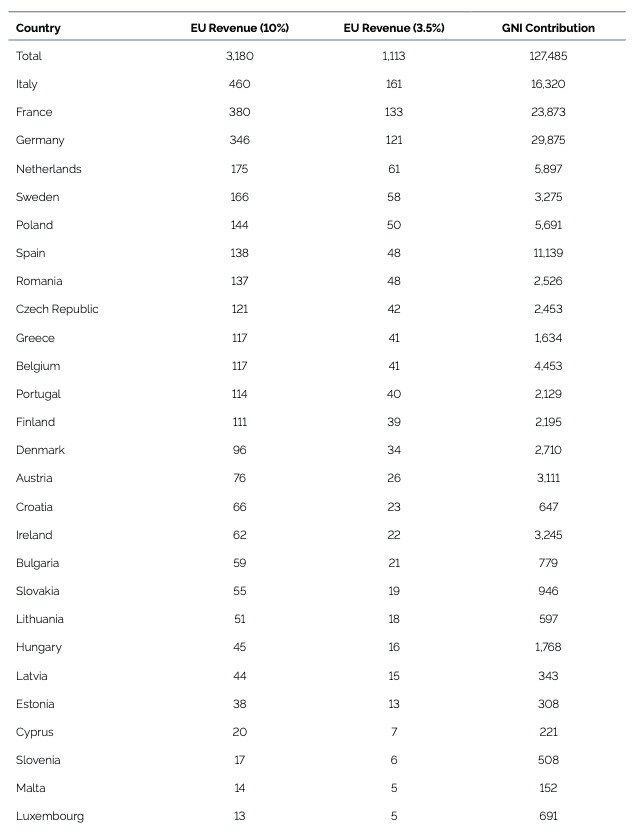 Source: ECIPE calculations.
3.1 Revenue Calculations
In our estimation of an online gambling contribution, we first evaluated how gambling and specifically online gambling is taxed across the EU. Given that in the majority of member states, it is taxed on the amount of Gross Gaming Revenue (GGR), or the difference between the stake of a given game and the winnings paid out, we used that as our basis.[5] Tax rates, as stated previously, vary significantly in magnitude, and the mean value across the 27 amounted to 23 per cent.
Using EGBA (European Gaming and Betting Association) GGR forecasts for the period 2023-2029, we were then able to calculate various scenarios in which an EU own resource is applied on top of member state taxes across the period. Assuming an EU tax applied in all countries, we wanted to account for a “depressive” effect on the total GGR. In accordance with the national case studies covered above, the effect of a tax was found to be mostly negligible given the low elasticity of gambling demand. The simple model below illustrates how this depressive rate was calculated and applied.
Δg = g₀ · (1 − |ε|) · ρ · Δt/(1−t₀)
Δg is the change in the growth rate of GGR
g₀ is the original or baseline (mean) annual growth rate of GGR
ε is the price elasticity of gambling, or how its demand varies with the price[6]
ρ is the pass through, or how much of the tax is passed on to consumers (here, gamblers)
Δt is the change in the effective tax rate
t₀ is the effective tax rate under the current regime, that is the mean figure of 23 per cent
What this model was designed to do, in essence, was to give a new decreased average annual rate which could then be applied to forecasted figures such that a more accurate estimate of revenue could be calculated. We used our two scenarios of increased taxation in member states to fund the national contribution: a high of 10 per cent and a low of 3.5 per cent. With a higher value for elasticity of 1.2 extracted from a UK government study on the tax elasticity of online gambling, we find that the tax base would remain stable.[7],[8] This thesis is also held when we increase the pass-through value from 1.0 to 1.5 – meaning a price increase more than the tax bill incurred post-increase, as seen in alcoholic beverages – as a stress test.[9] Based on this formulation, the fall in GGR would at most approximate to EUR 1 billion by 2029 in the high scenario of a 10 per cent EU contribution, and approximately EUR 0.3 billion in the low scenario of a 3.5 per cent EU contribution. EU “own resource” revenues from a gambling tax would thus be maintained between an approximate EUR 1.7 billion in the 3.5 per cent scenario and EUR 4.7 billion in the 10 per cent scenario by 2029.[10]
Figure 1: Depressive effect of an EU-wide tax – the 10 per cent scenario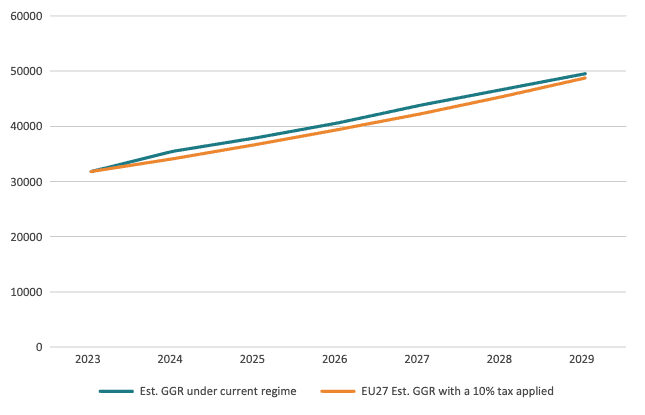 Source: ECIPE calculations.
Figure 2: Depressive effect of an EU-wide tax – the 3.5 per cent scenario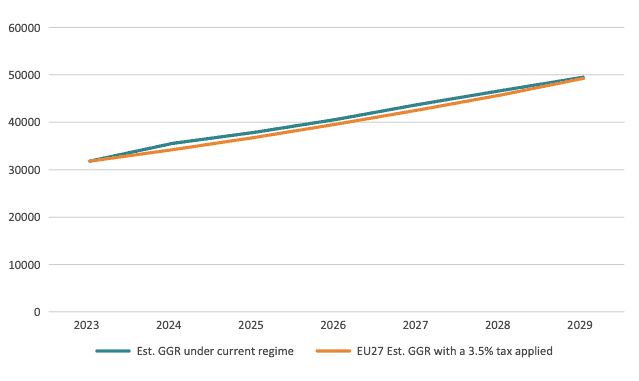 Source: ECIPE calculations
[1] This figure includes the UK’s market. For revenue calculations below the EU27 figures were isolated. See, European Gaming and Betting Association. (2025a, March 25). European gambling market: Key figures 2025 edition. EGBA. https://www.egba.eu/uploads/2025/04/250325-EGBA-European-Gambling-Market-Key-Figures-2025-Edition.pdf
[2] Either 24 or 26 out of 27 depending on how narrowly it is defined.
[3] For Austria: Gracanin, M. (2026, June 29). Austria’s plan to open online gambling market faces early test as black market fears grow. iGamingToday. https://www.igamingtoday.com/austrias-plan-to-open-online-gambling-market-faces-early-test-as-black-market-fears-grow/. For Malta: PwC Malta. (2026, April 7). Changes in gaming tax applicable from October 2026. https://www.pwc.com/mt/en/publications/gaming/changes-in-gaming-tax-applicable-from-october-2026.html
[4] WTS Global, Plastic taxation in Europe 2025, 12 June 2025, available at: https://wts-global.com/wts.com/publications/climate-protection-green-tax-energy/2025/20250612-plastic-taxation-in-europe-2025.pdf
[5] 24 or 25 out of the 27 depending on how it is evaluated.
[6] The assumption was taken here that increased taxes will be passed on to the consumers/gamblers rather than wholly absorbed.
[7] HM Revenue & Customs and Frontier Economics, The UK betting and gaming market: Estimating price elasticities of demand, HMRC Research Report No. 313, 2014, available at: https://assets.publishing.service.gov.uk/media/5a7e40a9e5274a2e87db0870/report313.pdf
[8] Studies on the US gambling market, have placed the price elasticity of gambling in the 0.7-1.0 range. See, Landers, J. (2007). Estimates of the price elasticity of demand for gaming, and the impact of wagering and admission taxes on the demand for gaming. Proceedings. Annual Conference on Taxation and Minutes of the Annual Meeting of the National Tax Association, 100, 236–244; and Landers, J. (2008). What’s the potential impact of casino tax increases on wagering handle: Estimates of the price elasticity of demand for casino gaming. Economics Bulletin, 8(6), 1–15.
[9] Wilson, L. B. et al. (2021). The effect of alcohol tax changes on retail prices: How do on-trade alcohol retailers pass through tax changes to consumers? The European Journal of Health Economics, 22, 381–392. https://doi.org/10.1007/s10198-020-01261-1
[10] All calculations are based on the forecasted values posted by the EGBA. For reference see European Gaming and Betting Association. (2025a, March 25). European gambling market: Key figures 2025 edition. EGBA. https://www.egba.eu/uploads/2025/04/250325-EGBA-European-Gambling-Market-Key-Figures-2025-Edition.pdf
4. Conclusion
In this paper we argue for an online gambling contribution as part of the EU’s new “own resources” package for the Multiannual Financial Framework of 2028-2034. Online gambling is rapidly growing within the wider gambling industry, and is on track to overtake land-based gambling in revenue terms by the next decade. In many EU countries, online gambling is subject to comparatively low taxation.
In our proposal, it is a matter for EU member states to decide how the national contribution should be funded. In our estimates, we assume that member states will introduce an additional tax on Gross Gaming Revenue, being applied alongside existent taxes. We estimate that a national contribution at either 3.5 or 10 per cent of Gross Gaming Revenue can generate revenues of between approximately EUR 2 billion and 5 billion by 2029. This would be a significant contribution to the EU budget and be comparable to other proposed EU own resources in the new MFF.
References
Baert, P. (2025, September). Revision of the Tobacco Taxation Directive (EPRS Briefing No. PE 775.907). European Parliamentary Research Service, European Parliament. https://www.europarl.europa.eu/RegData/etudes/BRIE/2025/775907/EPRS_BRI(2025)775907_EN.pdf
Boto-García, D., & Pérez, L. (2023). Tourism seasonality and gambling: The role of a new casino’s opening. Annals of Tourism Research, 99, Article 103529. https://doi.org/10.1016/j.annals.2023.103529
CPME. (2026). Policy on gambling and gaming (CPME AD 21032026 069(2025) FINAL). CPME AISBL. https://www.cpme.eu/api/documents/adopted/2026/03/cpme_ad_21032026_069(2025).final.policy.gambling.gaming.pdf
Dobreva, A. (2026, March). Proposal for a Council decision on the system of own resources of the European Union and repealing Decision (EU, Euratom) 2020/2053 – COM(2025) 574, 16.7.2025 (EPRS Briefing No. PE 782.679). European Parliamentary Research Service. https://www.europarl.europa.eu/RegData/etudes/BRIE/2026/782679/EPRS_BRI(2026)782679_EN.pdf
Estévez, A., Rodríguez, R., Díaz, N., Granero, R., Mestre-Bach, G., Steward, T., Fernández-Aranda, F., Aymamí, N., Gómez-Peña, M., del Pino-Gutiérrez, A., Baño, M., Moragas, L., Mallorquí-Bagué, N., López-González, H., Jauregui, P., Onaindia, J., Martín-Romera, V., Menchón, J. M., & Jiménez-Murcia, S. (2017). How do online sports gambling disorder patients compare with land-based patients? Journal of Behavioral Addictions, 6(4), 639–647. https://doi.org/10.1556/2006.6.2017.067
European Commission. (2025, July 16). A dynamic EU budget for the priorities of the future: The Multiannual Financial Framework 2028–2034 (COM(2025) 570 final). https://eur-lex.europa.eu/legal-content/EN/TXT/PDF/?uri=CELEX:52025DC0570
European Commission. (2026). Annual EU budget: All annual budgets. Retrieved June 30, 2026, from https://commission.europa.eu/strategy-and-policy/eu-budget/annual-eu-budget/all-annual-budgets_en
European Court of Auditors. (2024). EU revenue based on non-recycled plastic packaging waste: A challenging start hindered by data that is not sufficiently comparable or reliable (Special Report 2024/16). https://www.eca.europa.eu/ECAPublications/SR-2024-16/SR-2024-16_EN.pdf
European Gaming and Betting Association. (2025a, March 25). European gambling market: Key figures 2025 edition. EGBA. https://www.egba.eu/uploads/2025/04/250325-EGBA-European-Gambling-Market-Key-Figures-2025-Edition.pdf
European Gaming and Betting Association. (2025b). European gambling market reaches €123.4 billion in 2024, with online gambling approaching 40% market share. EGBA. https://www.egba.eu/news-post/european-gambling-market-reaches-e123-4-billion-in-2024-with-online-gambling-approaching-40-market-share/
European Parliament, Committee on the Internal Market and Consumer Protection. (2013). Report on online gambling in the internal market (2012/2322(INI)) (A7-0218/2013). https://www.europarl.europa.eu/doceo/document/A-7-2013-0218_EN.html
Fiedler, I., Kairouz, S., Costes, J.-M., & Weißmüller, K. S. (2019). Gambling spending and its concentration on problem gamblers. Journal of Business Research, 98, 82–91. https://doi.org/10.1016/j.jbusres.2019.01.040
Forrest, D., McHale, I. G., Dinos, S., Ashford, R., Wilson, H., Toomse-Smith, M., & Martin, A. (2022). Patterns of play: Extended executive summary report. NatCen Social Research. https://natcen.ac.uk/sites/default/files/2023-03/Patterns%20of%20Play-%20Summary%20Report.pdf
Gómez, P., Feijóo, S., Braña, T., Varela, J., & Rial, A. (2020). Minors and online gambling: Prevalence and related variables. Journal of Gambling Studies, 36, 735–745. https://doi.org/10.1007/s10899-019-09923-3
Gracanin, M. (2026, June 29). Austria’s plan to open online gambling market faces early test as black market fears grow. iGamingToday. https://www.igamingtoday.com/austrias-plan-to-open-online-gambling-market-faces-early-test-as-black-market-fears-grow/
Hing, N., Cherney, L., Blaszczynski, A., Gainsbury, S. M., & Lubman, D. I. (2014). Do advertising and promotions for online gambling increase gambling consumption? An exploratory study. International Gambling Studies, 14(3), 394–409. https://doi.org/10.1080/14459795.2014.903989
Hing, N., Russell, A. M. T., Black, A., Rockloff, M., Browne, M., Rawat, V., Greer, N., Stevens, M., Dowling, N. A., Merkouris, S., King, D. L., Salonen, A. H., Breen, H., & Woo, L. (2022). Gambling prevalence and gambling problems amongst land-based-only, online-only and mixed-mode gamblers in Australia: A national study. Computers in Human Behavior, 132, Article 107269. https://doi.org/10.1016/j.chb.2022.107269
HM Revenue & Customs and Frontier Economics. (2014). The UK betting and gaming market: Estimating price elasticities of demand (HMRC Research Report No. 313). https://assets.publishing.service.gov.uk/media/5a7e40a9e5274a2e87db0870/report313.pdf
Kansspelautoriteit. (2025). Effecten op de kansspelmarkt: Verhoging kansspelbelasting. https://kansspelautoriteit.nl/sites/default/files/effecten_verhoging_kansspelbelasting.pdf
Marionneau, V., Matteucci, N., Vieira Lima, S., Nikkinen, J., & Selin, J. (2025). Channelling and taxation in European online gambling markets: Evolution and policy implications. Harm Reduction Journal, 22, Article 1. https://doi.org/10.1186/s12954-024-01145-0
Noyes, J. (2025, July). The duty to differentiate: How gambling tax reform can raise revenue for the government, reduce harm to the public and save British horse racing. Social Market Foundation. https://www.smf.co.uk/wp-content/uploads/2025/07/The-Duty-to-Differentiate-July-2025.pdf
PwC Malta. (2026, April 7). Changes in gaming tax applicable from October 2026. https://www.pwc.com/mt/en/publications/gaming/changes-in-gaming-tax-applicable-from-october-2026.html
Schratzenstaller, M. (2026, March). New own resources for the EU budget (Policy Brief). Foundation for European Progressive Studies. https://feps-europe.eu/wp-content/uploads/2026/03/New-own-resources-for-the-EU-budget.pdf
Spelinspektionen. (2026). Nyckeltal: Spel hos aktörer med svensk licens eller tillstånd 2025. https://www.spelinspektionen.se/om-oss/statistik/
Spillemyndigheden. (2025). The gambling market in numbers 2024. https://spillemyndigheden.dk/media/edbpfkpd/gambling-market-in-numbers-2024.pdf
Valdes, C., & Frattola, E. (2019). Ma le tasse sul gioco d’azzardo funzionano davvero? Osservatorio Conti Pubblici Italiani, Università Cattolica del Sacro Cuore. https://osservatoriocpi.unicatt.it/cpi-gioco_azzardo_OCPI.pdf
van der Vlugt, S. (2025). The ‘CORE’ contribution as a new EU own resource and its legal consequences. EUR Research Information Portal. https://pure.eur.nl/ws/portalfiles/portal/206365631/THE_CORE_.pdf
Wardle, H., Degenhardt, L., Marionneau, V., Reith, G., Livingstone, C., Sparrow, M., Tran, L. T., Biggar, B., Bunn, C., Farrell, M., Kesaite, V., Poznyak, V., Quan, J., Rehm, J., Rintoul, A., Sharma, M., Shiffman, J., Siste, K., Ukhova, D., Volberg, R., Salifu Yendork, J., & Saxena, S. (2024). The Lancet Public Health Commission on gambling. The Lancet Public Health, 9(11), e950–e994. https://doi.org/10.1016/S2468-2667(24)00167-1
Wilson, L. B., Pryce, R., Angus, C., Hiscock, R., Brennan, A., & Gillespie, D. (2021). The effect of alcohol tax changes on retail prices: How do on-trade alcohol retailers pass through tax changes to consumers? The European Journal of Health Economics, 22, 381–392. https://doi.org/10.1007/s10198-020-01261-1
WTS Global. (2025, June 12). Plastic taxation in Europe 2025. WTS Global. https://wts-global.com/wts.com/publications/climate-protection-green-tax-energy/2025/20250612-plastic-taxation-in-europe-2025.pdf